You are now in Education Features category.

Third grader Jeeanna Mendoza fro, Camarena Elementary School, won first place in the Otay Water District student poster contest in the K-3 category. Photo: Otay Water District

Otay Student Poster Contest Winners Illustrate Importance of Water-Use Efficiency

Six talented elementary school students were recognized on August 7 by the Otay Water District Board of Directors as the winners of the District’s “Water is Life” Student Poster Contest.

As one of the Otay Water District’s educational programs, the contest offers an opportunity for students to showcase their creativity while reflecting on the importance of using water efficiently in their daily lives. Students were encouraged to illustrate the value of water used both inside and outside the home as an informational poster intended to educate others.

“We’re proud to offer students this opportunity to have fun and be creative, while at the same time thinking and learning about water conservation,” said Otay Water District General Manager Mark Watton.

More than 245 students from 10 different schools in the District’s service area submitted entries. The District judged the entries based on categories in two grade categories: kindergarten through third grade, and fourth through sixth grade. First, second and third prize winners were chosen from each category.

Winners received an award certificate, gift card, art kit, and a goodie bag filled with District promotional items. The lucky first place winners in each category also received a pizza party for their entire class.

The six posters winners were submitted by students in the Chula Vista Elementary School District.

jeeanna Mendoza, Grade 3, Camarena Elementary School (first place; K-3)

Jeeanna Mendoza, Grade 3, Camarena Elementary School (first place; K-3). Photo: Otay Water District

  • Jeeanna Mendoza, Grade 3, Camarena Elementary School (First Place; K-3)

Amerie Constantino, Grade 1, Wolf Canyon Elementary School (second place; K-3). Photo: Otay Water District

Amerie Constantino, Grade 1, Wolf Canyon Elementary School (second place; K-3). Photo: Otay Water District

  • Amerie Constantino, Grade 1, Wolf Canyon Elementary School (Second Place; K-3)

Miguel-Angel Gonzalez, Grade 2, Wolf Canyon Elementary School (third place; K -3). Photo: Otay Water District

  • Miguel-Angel Gonzalez, Grade 2, Wolf Canyon Elementary School (Third Place; K-3)

Maya Santana, Grade 5, Wolf Canyon Elementary School (first place; 4-6). Photo: Otay Water District

Maya Santana, Grade 5, Wolf Canyon Elementary School (first place; 4-6). Photo: Otay Water District

  • Maya Santana, Grade 5, Wolf Canyon Elementary School (First Place; 4-6)

Malayiah Williams, Grade 5, Wolf Canyon Elementary School (Second Place; 4-6). Photo: Otay Water District

Malayiah Williams, Grade 5, Wolf Canyon Elementary School (Second Place; 4-6). Photo: Otay Water District

  • Malayiah Williams, Grade 5, Wolf Canyon Elementary School (Second Place; 4-6)

Rin Smith, Grade 5, Wolf Canyon Elementary School (Third Place; 4-6). Photo: Otay Water District

Rin Smith, Grade 5, Wolf Canyon Elementary School (Third Place; 4-6). Photo: Otay Water District

  • Rin Smith, Grade 5, Wolf Canyon Elementary School (Third Place; 4-6)

Otay Water District winners advance to regional contest

In addition, according to the Metropolitan Water District of Southern California’s 2020 Student Art Calendar Contest rules, the District submitted five of the six winning posters to MWD’s contest. MWD will select 36 posters from its overall regional entries to be displayed in its 2020 “Water is Life” calendar. The winners will be honored at a student art exhibit and recognition event in December.

To learn more about the Otay Water District’s “Water is Life” Student Poster Contest, go to otaywater.gov/education.

READ MORE: San Diego County Students Inspire Water Conservation Through Art

Sometimes improving your water efficiency is as simple as changing a few old habits. Photo: Karolina Grabowska/Pixabay

Indoor Water Efficiency at No Cost

There are many ways to use water more efficiently indoors, and a lot of these are completely free! You don’t have to go through the expense of replacing appliances or installing new ones to improve indoor water efficiency. Sometimes it’s as simple as changing a few old water usage habits.

Here are some easy ways to reduce water usage inside your home:

  • Use a bowl of water to help thaw frozen food. Did you know that running the tap to thaw frozen meats and vegetables could use up to 2.5 gallons per minute? Using a bowl of room temperature water instead can greatly improve your water efficiency.
  • Scrape dirty dishes first before rinsing them. Not only will this save you time at the sink, but it will also conserve up to 2.5 gallons of water per minute.
  • Wash fruits and vegetables in a bowl of water instead of running water.
  • Run the dishwasher only when it’s full. Too often people are tempted to run the dishwasher as soon as the sink is empty, but standard dishwashers can use 2-4.5 gallons of water per load.
  • Turn off the water when brushing your teeth. This is possibly the easiest habit to change when it comes to water efficiency, and most people are already doing it.
  • Shorten showers to five minutes or less. Setting a timer on your watch or phone can help with this.
  • Use a bucket to collect water in the shower while you’re waiting for it to warm up. Then use this water to water your plants. Sometimes it can take a while for the shower to get to the right temperature before you step in. This is a perfect time to collect some clean water that can be reused around the house.
  • Wash only full loads of clothing – standard clothes washing machines can use a whopping 15-50 gallons per load. By running the washing machine only when it’s full, you can greatly improve your water efficiency.

Learn more about how to use water more efficiently indoors and outdoors this summer.

Check out WaterSmartSD.org for more resources

WaterSmartSD.org also has information about incentives for indoor and outdoor water conservation, as well as opportunities to sign up for FREE WaterSmart checkups. If you’re looking to revamp your landscaping this year, take a look at the WaterSmart landscape makeover classes for some easy ways to get started.

Sweetwater Authority Utility Worker II Julio Salazar's innovative new tool won recognition from the Association of California Water Agencies. Photo: Sweetwater Authority Sweetwater Authority employee

Award-Winning, Time-Saving Tool Created by Sweetwater Authority Employee

For his initiative in designing and creating a new tool designed to improve safety and efficiency on the job, Sweetwater Authority employee Julio Salazar won the Association of California Water Agencies Joint Powers Insurance Authority  H.R. LaBounty Safety Award.

The award recognized Salazar for creating a ‘Large AMS Stabilizing Tool.’ Salazar’s design resulted in making the process of replacing 1.5 inch and two inch angle meter stops, or AMS, easier, more ergonomic, and safer.

“Our water professionals are industry leaders, finding new ways to work smarter and safer,” said Tish Berge, general manager. “Sweetwater Authority could not be more proud of Julio’s tool and much deserved recognition.”

The H.R. LaBounty Safety Award recognizes water industry employees who implement significant safety improvements to prevent occupational injuries/illness. Winners are recognized twice a year.

See a demonstration of the new award-winning tool.

Salazar, a Utility Worker II with Sweetwater, came up with the idea after talking with co-workers about ways to improve the process. In the past, replacing an AMS often required employees to break out the meter box in order to make enough space to fit large wrenches and tools.

The process was often awkward and difficult, adding strain on the employee who had to remove the AMS at an odd angle. The concrete panel would also need to be replaced, adding to the time, cost, and safety risk associated with the replacement.

The new tool is designed to secure the AMS using meter bolts, and can be placed in-line with the service lateral. Once secured, an employee can simply use an adjustable wrench to loosen or tighten the bottom nut on the AMS. It eliminates the need to break the meter box, and gives the employee a more comfortable, ergonomic grip while working. It also makes the process safer.

Salazar says the design is similar to existing stabilizing tools, but there was nothing quite the right size for the 1.5 inch and 2 inch AMS – until now.

Water industry professionals recognized for safety improvements

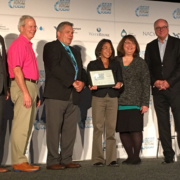
Sweetwater Authority Utility Worker II Julio Salazar displays his H.R. LaBounty Safety Award Sweetwater Authority employeerecognition certificate from the Association of California Water Agencies. Photo: Sweetwater Authority

Sweetwater Authority Utility Worker II Julio Salazar displays his H.R. LaBounty Safety Award recognition certificate from the Association of California Water Agencies. Photo: Sweetwater Authority

The Association of California Water Agencies Joint Powers Insurance Authority – ACWA JPIA for short – is a partnership of water agencies dedicated to avoiding the high cost of commercial insurance. JPIA is a risk-sharing pool for property, liability, workers’ compensation and employee benefits, which allows for more rate stability for customers, broader coverage and expanded benefits and services than private insurance.

READ MORE: Proactive Partnerships Keep Pipelines In Top Shape


WaterSmart Landscape Contest-The Nieves family of Bonita won the Sweetwater Authority's 2019 Landscape Makeover Contest for theier creative WaterSmart landscaping design. Photo: Sweetwater Authority 2021 Landscape Makeover

Creative WaterSmart Landscaping Wins Sweetwater Authority’s 2019 Landscape Contest

Bonita residents Efren and Ily Niervas won the Sweetwater Authority 2019 Landscape Contest after transforming their front yard from a traditional thirsty expanse of lawn to a WaterSmart landscaping approach.

When the Niervas moved to their home in 2017, they realized the cost of watering their yard, with a large lawn and assorted shrubbery, was too high. They decided to change their landscape and attended home improvement events and expos as part of their research. They also did online research. The research paid off, as the Niervas thoughtfully designed their own xeriscape plan for their creative watersmart landscaping.

Creative hardscapes and colorful plant palette transform landscaping

Before: The Nieves' landscaping prior to undertaking their award-winning, watersmart redesign project. Photo: Sweetwater Authority

Before: The Niervas’ landscaping prior to undertaking their award-winning, watersmart redesign project. Photo: Sweetwater Authority

With the design in hand, the Niervas began work on making the landscape transformation themselves. They purchased plants on sale, and collected small cuttings and succulents from friends and neighbors.

Knowing the soil in the yard was dry and hard, they patiently waited for wetter and softer conditions in the fall months to begin working on their yard. The landscape transformation was finally complete in March 2019. The Niervas are thrilled with the beautiful, water-saving results.

After: The stunning results of the landscaping transformation. Photo: Sweetwater Authority

After: The stunning results of the landscape transformation. Photo: Sweetwater Authority

Creative watersmart landscaping

The yard design features swales in the form of rock-lined dry creek beds, which capture rainwater from roofs, driveways, and other hard surfaces to slow it down, spread it out, and allow the water to sink into the soil. Lighted flagstone pathways wind through the yard.

The design features a diverse palette of succulents, cacti, and California native plants. The Niervas completed their yard décor with beautiful ceramic containers, gazing balls, and whimsical artwork including starfish and a peacock.

The homeowners completed their yard décor with beautiful ceramic containers, gazing balls, and whimsical artwork including starfish and a peacock. Photo: Sweetwater Authority

San Diego County homeowners can take advantage of free landscaping makeover classes offered by the San Diego County Water Authority to help plan to create a colorful and watersmart landscape. Go tot the WaterSmart Landscape Makeover Program

A diverse palette of colorful succulents, cacti, and California native plants add to the winning design. Photo: Sweetwater Authority

A diverse palette of colorful succulents, cacti, and California native plants add to the winning design. Photo: Sweetwater Authority

READ MORE: Winning Vista Irrigation District WaterSmart Landscape Reduces Water Use

Establishing unique partnerships with leading technology providers, such as Pure Technologies, has ensured the best available tools are used in the most cost-effective way. Photo: Water Authority

Proactive Partnerships Keep Pipelines in Top Shape

This summer, the Water Authority is partnering with three technology companies to test the condition of the agency’s oldest pipelines forming the First Aqueduct in Valley Center. Technology providers test their new and improved tools on Water Authority and member agency pipes. The tools are then used to assess the condition of those same pipes.

This efficient strategy ensures maximum condition assessment accuracy. The strategy also allows for technology to keep up with what water agencies need and minimizes costs. Targeted repairs and maintenance activities maximize the life expectancy of some of the region’s most critical infrastructure.

Industry leaders in pipeline condition assessment

The Water Authority turned to experienced contractors from the oil and gas industry to effectively and efficiently identify corrosion issues on the 70-year-old pipe:

  • Pure Technologies’ regional headquarters in San Diego brought its near-field electromagnetic inspection expertise to assess low-pressure portions of the reinforced concrete pipelines using the PipeWalker® tool.
  • Pipeline Inspection and Condition Analysis Corp. (PICA) from Edmonton, Alberta, assessed medium-to-high pressure zones on a similar type of pipe construction that includes an additional steel cylinder. Their Electromagnetic Inspection Tool (EMIT®) was deployed to find areas of distress and corrosion.
  • Diakont, based in Carlsbad, deployed two of their unique RODIS® robotic tools to use laser profilometry and Electromagnetic Acoustic Transducer (EMAT) technologies to assess thick steel pipe in the highest-pressure zones.

About a quarter of the planned work has been completed. The remainder is scheduled over the next 18 months.

Outstanding record of innovation

For more than 20 years, the Water Authority has been developing innovative ways to maintain major water infrastructure worth billions of dollars.

Establishing unique partnerships with leading technology providers has ensured the best available tools are used in the most cost-effective ways. And, the strategic partnerships allow operations and maintenance teams to extend the lifespan of pipes as well as prevent failures.

In addition to extending pipeline lifespan, high-tech inspection tools are part of a proactive maintenance and repair process by reliably detecting pipeline anomalies and alerting staff to where potential problems may arise. As the tools travel through pipes, data is collected, downloaded and analyzed by staff. Then specific areas where repairs may be needed are identified. Without accurate data, staff would not be able to identify potential issues within the pipes, which could lead to disrupted service and inflated costs.

Vallecitos Water District contest winners are honored at the July board L to R: Sierra Whiteside, Zofia Dowd. Photo: Vallecitos Water District

San Diego County Students Inspire Water Conservation Through Art

Three talented fourth grade students in north San Diego County will have their winning drawings featured in the 2020 “Be Water Smart” calendar produced by the Vallecitos Water District. The students were honored by the District’s Board of Directors at its July meeting.

To develop and promote water conservation awareness from an early age, the District holds a calendar contest available to all fourth graders in its service area. The top three drawings go on to represent the District in the regional North County Water Agency calendar for the following year.

Water conservation art features nature themes

Sierra Whiteside is the first place winner and "Viewer's Choice winner in the Vallecitos Water District calendar art contest. Photo: Courtesy Vallecitos Water District

Sierra Whiteside is the first place winner and “Viewer’s Choice” winner in the Vallecitos Water District calendar art contest. Photo: Courtesy Vallecitos Water District

Sierra Whiteside from Carrillo Elementary School won first place and also the “Viewer’s Choice” award through a public vote on the District’s social media channels. She wins a froYo party compliments of Menchie’s Frozen Yogurt. Sierra says she will save water by “making an invention that gives you only the water you need.”

Sofia Dowd won second place in the Vallecitos Water District calendar art contest. Photo: Courtesy Vallecitos Water District

Zofia Dowd won second place in the Vallecitos Water District calendar art contest. Photo: Courtesy Vallecitos Water District

Zofia Dowd from Double Peak School received second place for her artwork featuring a whale. Zofia says she will save water by “taking short showers, not running water, taking buckets to fill up water in the rain, and will only use water when needed.”

Lia Van Der Jagt won third place in the Vallecitos Water District calendar art contest. Photo: Courtesy Vallecitos Water District

Lia VanferJagt won third place in the Vallecitos Water District calendar art contest. Photo: Courtesy Vallecitos Water District

Lia VanderJagt, also a student at Double Peak School won third place for her artwork depicting the earth. Lia says she will save water by “doing my best to use less of it and value it more.” She will take shorter showers and only fill her cup to what she can drink.

Skylar Groke from Carrillo Elementary School is the honorable mention winner. Photo: Vallecitos Water District

Honorable mention went to Skylar Groke from Carrillo Elementary School for his rainbow artwork.

All winners received Amazon gift cards.

The Vallecitos Water District extends its sincere appreciation to Menchie’s and all of the students who participated in this year’s contest. The contest is held annually with a submission deadline of April 10. Click here for contest rules and entry form. For questions or to receive a free calendar, contact the District’s Public Information Department through email or at (760) 744-0460.

READ MORE: Poster Contest Winners Illustrate ‘Water Is Life’


The winning water sample was taken directly from the Richard A. Reynolds Desalination Facility, the same water provided to its customers. Photo: Sweetwater Authority Bset Tasting Water Award

Sweetwater Authority Wins ‘Best Tasting Membrane Water’ Award

The Sweetwater Authority Governing Board was presented with the Southwest Membrane Operators Association (SWMOA) ‘Best Tasting Membrane Water in the Southwest Region Award’ at its July 24 board meeting.

The award recognizes the Authority’s Richard A. Reynolds Desalination Facility as the winner of the Best Tasting Membrane Water Competition held during the SWMOA Annual Symposium in June.

The winning water sample was taken directly from the Richard A. Reynolds Desalination Facility, the same water provided to its customers. Judges based their assessment on the following criteria: taste, odor, color, clarity, mouthfeel, and aftertaste.

Among the participants in the competition representing water agencies from the Southwest United States, the Authority received the highest cumulative score.

Facility provides Authority customers with one-third of their annual water supply

The Richard A. Reynolds Desalination Facility is a state-of-the-art groundwater desalination facility Photo: Sweetwater Authority Best Tasting Membrane Water Award

The Richard A. Reynolds Desalination Facility is a state-of-the-art groundwater desalination facility Photo: Sweetwater Authority

The Richard A. Reynolds Desalination Facility in Chula Vista is a state-of-the-art groundwater desalination facility designed to use reverse-osmosis membrane treatment to remove dissolved salts and microscopic particles, such as bacteria and other contaminants which can be found in groundwater. The facility can produce up to 10 million gallons of drinking water per day, enough for approximately 18,000 families, and provides Authority customers with about one-third of their annual water supply.

The facility began operating in 1999 drawing brackish groundwater from five wells. That same year, the facility was honored with a San Diego Orchid award in the competition’s environmental solutions category. Its phase two expansion was completed in 2017.

The facility’s sustainable design also includes 2,950 ground-mounted solar PV panels as an alternative energy source. The solar array offsets the cost of treating water and reduces the facility’s overall carbon footprint.

The facility was previously honored with the American Society of Civil Engineers’ Project of the Year award, as well as the South County Economic Development Council’s Corky McMillin/Best of South County Award.

Among the participants in the competition representing water agencies from the Southwest region of the country, the Authority received the highest cumulative score. Photo: Sweetwater Authority Best Tasting Membrane Water Award

Among the participants in the competition representing water agencies from the Southwest region of the country,  Sweetwater Authority received the highest cumulative score. Photo: Sweetwater Authority

The Southwest Membrane Operator Association is an affiliate of the American Membrane Technology Association and dedicated to the Southwest United States region including, but not limited to Arizona, California, Colorado, Hawaii, New Mexico, Nevada, and Utah.

READ MORE: San Diego’s Farmer of the Year Taps Every Drop

Colorful, waterwise plants replaced a thirsty, labor intensive front lawn in Deborah Brant's winning landscape makeover. Photo: Vista Irrigation District

Winning Vista Irrigation District WaterSmart Landscape Reduces Water Use

Vista resident Deborah Brandt showed how attractive water-wise landscaping can be when low-water use plants are combined with other landscape components in winning the Vista Irrigation District’s 2019 WaterSmart Landscape Contest. District officials selected Brandt’s entry this month among many quality entries received.

The Vista Irrigation District is among 13 San Diego member agencies with landscape contests in 2019 with the goal of showcasing beautiful residential water-wise landscapes throughout the region.

Outdoor watering accounts for more than half of the residential water use in San Diego County. Homeowners can significantly reduce outdoor watering by replacing a thirsty lawn with water‑wise landscaping. While Internet research or visiting a local nursery for ideas are both helpful, seeing examples of residential garden makeovers can provide inspiration and motivation.

Contrasting watersmart elements and textures transform yard

Deborah Brandt's winning landscape includes contrasting elements, such a cactus, river rock and wood chips, against a backdrop of dramatic magenta, purple and striking orange. Photo: Vista Irrigation District

Deborah Brandt’s winning landscape includes contrasting elements, such a cactus, river rock and wood chips, against a backdrop of dramatic magenta, purple and striking orange. Photo: Vista Irrigation District

Brandt replaced her water and maintenance-intensive lawn with WaterSmart landscaping to save money and water, and reduce the amount of time she spent on yard work. By including contrasting elements such as cactus, river rock and wood chips, against a backdrop of dramatic magenta, purple and striking orange, Brandt transformed a basic lawn into a dazzling array of textures and colors.

Brandt chose low maintenance plant varieties, including agaves, yuccas, Sea Lavender, Calandrinia Grandiflora, and ‘Sticks on Fire’ (also called ‘Firesticks’), that grow easily and require little care or trimming, providing her landscape “year round colorful contrast of form, shape and color.”

By showcasing her water-wise landscape, Brandt is providing other homeowners with great ideas about how to make their yards attractive and use less water. Photo: Vista Irrigation District Winning Vista Irrigtion District

By showcasing her water-wise landscape, Brandt is providing other homeowners with great ideas about how to make their yards attractive and use less water. Photo: Vista Irrigation District

Brandt admits she has enjoyed receiving so many compliments on her yard transformation from friends and neighbors. By showcasing her water-wise landscape, Brandt is providing other homeowners with great ideas about how to make their yards attractive and use less water.

Deborah Brandt's front yard before its makeover. Photo: Vista Irrigation District Winning Vista Irrigtion District

Deborah Brandt’s front yard before its makeover. Photo: Vista Irrigation District

For more information about the 2020 contest open to customers of the Vista Irrigation District and 12 other member agencies in San Diego County, along with examples of award-winning WaterSmart landscaping, go to https://landscapecontest.com/

Homeowners can take advantage of free landscaping makeover classes offered by the Water Authority to help plan and execute your own transformation. Visit the WaterSmart Landscape Makeover Program website for the schedule and to register.

READ MORE: Colorful Carlsbad Water-Efficient Garden Wins Olivenhain MWD 2019 Landscape Contest


Most native Southern California plants do well in hotter temperatures, so summer plant care is easy with a little planning. Photo: Annie Spratt/Pixabay

Summer Plant Care

Summer is heating up! While you’re heading to the beach or pool to cool off, your landscape might need a little help keeping cool too. Summer plant care is easy with a little planning.

Native plants

Most native Southern California plants do well in hotter temperatures if they are established before the summer begins. Avoid planting new plants, repotting, or fertilizing during the hot summer months. Fertilizing in the summer can trigger more green growth, which means an increase in water needs. During hot days, it is difficult to keep up with these needs as the soil tends to dry out more quickly.

Pruning is a great summer plant care strategy to help keep growth in check and provide pest control. Save most of the pruning for the cooler months to promote growth, but light pruning in the summer can benefit plant and tree maintenance.

Water deeply and less frequently

It might seem counterintuitive to water less frequently in the summer, but this is important for summer plant care. Watering too frequently on warmer days can cause too much water loss due to evaporation. Less frequent watering will also encourage your plants and trees to grow a network of deep roots. This will benefit them in the long term.

Protect soil with mulch

A good layer of high-quality mulch helps keep soil cool and prevents evaporation. Insulating the soil with mulch can also protect thinner roots that plants use to feed from surrounding soils. Over time, these roots will grow deeper along with less frequent watering.

Mulch is great for summer plant care, but it’s also a good investment any time of the year as it helps maintain a consistent soil moisture so you can water less.

Wait until fall to plant

Timing is important when planting new plants or trees. New plants require more water more frequently to develop their new root systems. Wait until the cooler fall months to begin planting to ensure higher rates of success.

With a little planning, summer plant care is a breeze!

The Water Authority and its partners also offer other great resources for landscaping upgrades, including tips for sustainable landscaping best practices at SustainableLandscapesSD.org and free WaterSmart classes at WaterSmartSD.org.

La Mesa residents Bob and Shan Cissell transformed 2,500 square feet of turf into their own Conservation Garden in La Mesa, winning the 2019 Oty Water District Landscaping Contest. Photo: Otay Water District

La Mesa Conservation Garden Wins 2019 Otay Water District WaterSmart Landscape Contest

La Mesa residents Bob and Shan Cissell’s conversion of 2,500 square feet of thirsty irrigated lawn into a creative conservation garden was selected by the Otay Water District as the winner of its 2019 WaterSmart Landscape Contest.

The annual competition recognizes landscape redesign projects among 13 participating San Diego County water agencies which best represent water-efficient landscaping principles.

Project inspired by free WaterSmart landscaping classes

The Cissells designed their new yard after attending the Water Authority's free WaterSmart Landscape Makeover courses. Photo: Otay Water District

The Cissells designed their new yard after attending the Water Authority’s free WaterSmart Landscape Makeover courses. Photo: Otay Water District

Inspired after their participation in the Water Authority sponsored WaterSmart Landscape Makeover Program courses, and by the Water Conservation Garden in El Cajon, the Cissells began their La Mesa Conservation Garden project in April 2018 by removing the sod. They incorporated creative elements including a hand-built waterfall made from an old truck ladder rack, and other solid materials otherwise destined to become trash in a landfill.

Water from a swale feeds the waterfall, then travels through microtubes up a faux bonsai tree — made of concrete and unused materials – to irrigate flower baskets resting at the end of each tree branch. Large tree roots that once ran through their yard now decorate other areas of their yard.

Water from the waterfall grotto travels up the faux bonsai tree in the Cissells' La Mesa Conservation Garden. Photo: Otay Water District

Water from the waterfall grotto travels up the faux bonsai tree in the Cissells’ La Mesa Conservation Garden. Photo: Otay Water District

New efficient irrigation includes drip tubing along the top of the ground, and corrugated drain piping below. The piping allows excess water to irrigate the slopes surrounding the home. To assure their drip system would continue to work properly, the Cissells came up with a system using a birdbath made from an old sink. When their drip system turns on, it feeds the birdbath. The water flows up into the sink and into the overflow hole and back down to the trees. No water is wasted, and mosquito reproduction is avoided. If the birdbath is dry, it means that the drip system is not working properly.

‘Not a single drop of water wasted’

The Cissells’ “Stonehenge” is constructed from large tree roots topped with stones (left), serving as a reminder of what was once the nature beneath them. Photo: Otay Water District

“The coolest thing is that it was a 100 percent makeover from irrigated lawn that took a pathetic amount of water to keep it green, and it wasn’t even green,” said Shan Cissell. “It’s the design, the technical, the labor, the creativity, and the focus on not a single drop of water being wasted that we took seriously.”

The Cissells maximized their viewing area by strategically placing curved walking paths of decomposed granite throughout their yard. Paths are surrounded by vegetation and water-wise plants such as succulents, honeysuckle, pincushion flowers, and manzanita. The Cissells say they their efforts have reduced their water bill as much as 25 to 30 percent.

The Cissells maximized their viewing area by strategically placing curved walking paths of decomposed granite throughout their yard. Photo: Otay Water District

“The Cissells’ unique project proves that creating a beautiful WaterSmart landscape can be both cost-efficient and environmentally beneficial,” says Mitch Thompson, Otay Water District board president and Water Conservation Garden Joint Powers Authority member. “The benefits can be attributed to their efforts in incorporating recycled material along with water-saving features.”

Winners are selected based on overall attractiveness, design, plant selection, and efficient irrigation and maintenance. The Cissells were recognized with a certificate of recognition, gift certificate to a local nursery of their choice, and other promotional items. View more photos of the Cissells’ winning landscape here.

READ MORE: City of Oceanside Selects Drought Tolerant Gardens as 2019 Contest Winners