You are now in Achievements Features category.

The San Diego County Water Authority’s Board of Directors celebrated the agency’s 75th anniversary.

Water Authority Celebrates 75 Years of Service to San Diego County

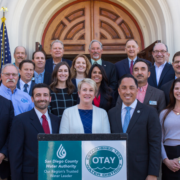
The San Diego County Water Authority’s Board of Directors celebrated the agency’s 75th anniversary during today’s Board meeting, which included 20 proclamations honoring the agency for its service to the region dating back to 1944.

Cities across the region joined the state Assembly and Senate, the San Diego County Board of Supervisors and other state and local leaders to formally mark the occasion. The San Diego City Council and the San Diego County Board of Supervisors even proclaimed today “San Diego County Water Authority Day” in honor of the agency’s legacy of water supply reliability.

75 years of service

“Starting with the historic first water deliveries in the 1940s, the Water Authority has partnered with our member agencies to build, operate and maintain the vital infrastructure that supports our region’s $231 billion economy and unparalleled quality of life,” said Board Chair Jim Madaffer. “Our collective investments have created extraordinary advances in water supply reliability that are sustained by the daily vigilance necessary to operate and maintain such a complex system.

“While today we celebrate the past, the Water Authority and its 24 member agencies continue to focus on the future by fostering innovative solutions to ever-changing water resource challenges,” Madaffer said. “Together, we will supply the San Diego region with safe and reliable water supplies for generations to come.”

San Diego County Water Authority service sArea and 24 member agencies

Since 1991, the Water Authority and its 24 member agencies have deployed one of the most aggressive water supply diversification strategies in the nation to improve regional water supply reliability. In the years ahead, member agency projects will play an increasingly important role in continuing to ensure reliability for the San Diego region.

Forward thinking on water

The Water Authority’s current forward-thinking efforts include developing water storage capacity in Lake Mead to provide additional drought resilience for San Diego and the Southwest.

The agency also is working closely with the City of San Diego to assess a potential pumped storage project at San Vicente Reservoir that could help meet clean energy goals and benefit water ratepayers. In addition, the Water Authority is analyzing the costs and benefits of a regional water conveyance system that could help San Diego County and the entire Southwest to more effectively manage water resources.

Profound impact

During today’s ceremonies, water agency, civic and business leaders noted the Water Authority’s profound impact on the San Diego region and wider water issues over the past 75 years.

  • “A reliable water supply is critical for San Diego’s regional economy and for maintaining a competitive business climate. The business community applauds the Water Authority and its 24 member agencies for their leadership, and for increasing the county’s water supply reliability with investments that keep our economy growing.” — Mark Cafferty, president and CEO, San Diego Regional Economic Development Corp.
  • “It is a pleasure to celebrate the San Diego County Water Authority’s 75th anniversary. We share a common history and a common vision for water supply reliability that has been essential to the economic vitality and prosperity to all San Diegans. We look forward to strengthening our relationship to meet the future needs of San Diegans.” — Gloria D. Gray, chair, Metropolitan Water District Board of Directors
  • “Farming is a foundational piece of our regional economy and quality of life – but it doesn’t happen without a reliable water supply. Our farmers are constantly innovating to use water more efficiently by adopting new technology and planting more-efficient crops.” — Eric Larson, executive director, San Diego County Farm Bureau
  • “On behalf of the Imperial Irrigation District Board of Directors, I salute the San Diego County Water Authority on its 75th anniversary. Our two agencies are partners in the nation’s largest agriculture to urban transfer and in the process, we have forged a durable alliance at the Salton Sea. It is a relationship that the IID highly values.” — Erik Ortega, president, Imperial County Irrigation District Board of Directors
  • “By combining a diversified set of water supply sources with greatly enhanced storage capacity, we are developing a more robust safety net for San Diego County.” — Jerry Sanders, president and CEO, San Diego Regional Chamber of Commerce

On June 9, 1944, San Diego voters approved the Water Authority’s formation under the County Water Authority Act. Imported water arrived three years later to slake the thirst of a growing population just weeks before local supplies would have run out.

The modern era of the Water Authority started during deep, drought-induced water supply cuts in the early 1990s. Since then, Water Authority and its 24 member agencies have deployed one of the most aggressive water supply diversification strategies in the nation to improve regional water supply reliability.

At the same time, the agencies have aggressively helped to reduce per capita water use so that the total regional water use today is well below 1990 levels despite significant growth in the population and economy.

San Vicente Aqueduct

Officials commemorate installation of the first portion of pipe along the new Second Pipeline of the San Vicente Aqueduct in 1951. Photo: Water Authority

75th anniversary milestones

The Water Authority reached several major milestones over the past two decades. They include:

  • In 2003, Olivenhain Dam was the first major new dam built in San Diego in more than 50 years. At 318 feet, it was the tallest roller-compacted concrete dam at the time.
  • In 2008, the Twin Oaks Valley Water Treatment Plant north of San Marcos began operations. It was the largest submerged membrane water treatment plant in the world when it was commissioned.
  • In 2011, the San Vicente Tunnel and Pipeline Project – an 11-mile long, 12-foot diameter tunnel with an 8-1/2-foot diameter pipeline – created a link from the City of San Diego’s San Vicente Reservoir to the Water Authority’s Second Aqueduct, greatly improving the Water Authority’s ability to distribute water and store water in the reservoir.

San Vicente Dam raise

  • In 2012, the Lake Hodges Hydropower Facility started serving the dual purposes of connecting the lake to the Water Authority’s aqueduct system and generating 40 megawatts of clean, on-demand electricity.
  • In 2014, the San Vicente Dam Raise Project, the tallest dam-raise project in U.S. history, expanded the reservoir’s capacity by more than 157,000 acre-feet.
  • In 2015, the $1 billion Claude “Bud” Lewis Carlsbad Desalination Plant, distribution pipeline and related facilities started commercial operations as the largest seawater desalination project in North America.
  • The Water Authority’s Asset Management Program, which includes a multi-year project to reline 82 miles of large-diameter prestressed concrete cylinder pipelines with new steel liners, helps to prevent pipeline failure and extend their lifespans by 75 years or more at significantly less cost than traditional pipeline replacement programs.
San Diego regional water quality regulators issued a new permit for the development of permanent, stand-alone seawater intake and discharge facilities at the Carlsbad Desalination Plant. Photo: Water Authority

San Diego regional water quality regulators issued a new permit in May 2019 for the development of permanent, stand-alone seawater intake and discharge facilities at the Carlsbad Desalination Plant. Photo: Water Authority

Worldwide recognition

The Water Authority’s innovative efforts have been recognized nationally and internationally.

In 2017, for instance, the president of the American Society of Civil Engineers recognized the Water Authority’s Emergency & Carryover Storage Project for winning ASCE’s top international engineering award.

The same year, Water Authority was honored by the Association of California Water Agencies – the nation’s largest statewide coalition of water agencies – for innovation and excellence in water resources management with its addition of supplies from the Carlsbad Desalination Project. And in 2016, the Water Authority received a top national award from the Association of Metropolitan Water Agencies for its commitment to improving the region’s water supply reliability in a manner that balances economic, social and environmental needs.

Limited rainfall means avocado grower John Burr must use innovative farming methods. Photo: Water Authority

San Diego’s Farmer of the Year Taps Every Drop

Growing water-intensive crops like avocados in San Diego County is no small feat. Producing avocados requires the use of innovative farming methods to supply the trees with enough water.

It’s the use of innovative farming methods that earned John Burr the title of San Diego County’s Farmer of the Year – an honor he recently celebrated on KUSI-TV with Water Authority Board Chair Jim Madaffer as part of the agency’s Brought to You by Water outreach and education program.

Innovative farming methods

Over the past few months, the Water Authority partnered with local agriculture industry leaders like the San Diego County Farm Bureau to highlight the importance of safe and reliable water supplies for more than 5,500 local farms that are part of the county’s $4.8 billion agriculture industry.

Local farmers like Burr are invaluable in growing the agricultural bounty that sustains 3.3 million residents and the region’s quality of life.

Found in everything from tacos to smoothies to toast, avocados have become a staple in California cuisine and, with only about 10 inches of annual rainfall in the San Diego region, it takes innovation and technology to grow the popular fruit.

Technology saves water

For decades, Burr has been perfecting the operations on his Escondido farm, using state-of-the-art technology like the California Irrigation Management Information System. Two different satellite systems allow him to regulate irrigation by zones to determine precise water amounts to prevent using too much or too little water on his trees.

Satellites collect data, which Burr then analyzes with spreadsheets to determine how many gallons of water each tree requires. Every bit of data collected, from water usage to atmospheric conditions to soil type, allows Burr and his team to streamline their operations to be even more water-efficient.

“In San Diego County, we have to get the most out of our crops with the least amount of water,” said Burr, who irrigates his farm with water from the City of Escondido. “When the weather varies with changing seasons or fluctuating weather patterns, providing the right amount of water at the right time is paramount to using water efficiently. These technologies provide the information and tools that allow us to do that consistently, and ensure our crops grow successfully.”

Efficient land use conserves water

Those who see Burr’s farm may also notice another difference from the typical avocado farm, which is that his groves are designed for high-density planting.

“A typical avocado grove can have about 100 trees, but ours have about 400 in the same area of land. This cuts our water usage in half,” he said.

Each tree is also limited in height to prevent water loss through transpiration. This is especially important in a region like San Diego County, where temperatures can rise quickly on summer days.

Matthew G Phy tweeted this photo and two other photos in the San Diego Grown Photo Contest.

San Diego Grown Photo Contest Highlights Agriculture

More than 260 photos were submitted during May as part of the “San Diego Grown Photo Contest” highlighting how safe and reliable water supplies fuel the region’s thriving agriculture industry. The San Diego County Water Authority hosted the social media contest during Water Awareness Month.

The contest highlights the significance of agriculture to the regional economy. As one of the nation’s top producers of avocados, ornamental trees and shrubs, flowers, succulents, lemons, and other agricultural products, San Diego County farms cover approximately 250,000 acres and generate $4.8 billion in total annual economic activity.

Photos were posted to Twitter and Instagram using the hashtag #B2UbyH2O and came from home gardens, local farms, community gardens and farmers’ markets throughout the region.

A giant Swiss chard was one of the most liked in the San Diego Grown Photo Contest in May 2019.

Kristina Cornejo submitted this photo on Twitter of a giant Swiss Chard in the San Diego Grown Photo Contest.

One participant on Instagram thanked the Water Authority, posting this comment: “Things like these are what bring Communities together and brings awareness to the importance of water in our lives!”

Contest ‘Brought To You By Water’

The San Diego Grown Photo Contest was part of the Water Authority’s ongoing Brought to You by Water outreach and education program, designed to convey the importance of water supply reliability for sustaining the region’s 3.3 million people and its $231 billion economy. The Water Authority and its 24 member agencies work together to meet current and future water demands, while promoting water-use efficiency.

Qualifying submissions received prizes generously donated by local businesses and organizations including Specialty Produce, the San Diego County Farm Bureau, and Jimbo’s … Naturally.

Over the past year, the Water Authority has highlighted an array of the region’s core industries – including tourism, manufacturing and brewing – that would not exist without substantial investments in water supply reliability by the Water Authority and its 24 member agencies.

Those industries provide tens of thousands of jobs that help make San Diego County universally regarded as one of the best places to live. The regional economy is made possible, in part, by continued investments in the pumps, pipes, projects and people who deliver more than 450,000 acre-feet of water per year for everything from washing hotel towels and growing avocados to brewing craft beer and building ships.

Follow #B2UbyH2O on Instagram and Twitter to see all the photos.


The Water Authority created a sustainable landscaping demonstration garden for the public at its Kearny Mesa headquarters. Photo: San Diego County Water Authority

National Report Highlights Success of San Diego Sustainable Landscapes Program

San Diego’s Sustainable Landscapes Program ranked among the most effective landscape transformation programs in the nation in a study released today by the Chicago-based Alliance for Water Efficiency. The “Landscape Transformation Study: 2018 Analytics Report” compiled data from 14 similar landscape conservation programs in the U.S. and Canada.

The Alliance for Water Efficiency concluded that San Diego program participants reduced water use by an average of 114.8 gallons per day, or 34.8 percent. “The Water Authority has established a high benchmark for landscape transformation programs that include rigorous program requirements that result in the achievement of multiple benefits,” according to the report.

By saving about 42,000 gallons of water per project each year, Sustainable Landscapes Program participants who transformed their landscapes save enough water to supply the average four-person household in San Diego County for more than three months.

“This study highlights our success improving water-use efficiency across the San Diego region,” said Jim Madaffer, chair of the Water Authority’s Board of Directors. “We empower program participants to take a hands-on approach to WaterSmart living, and it’s gratifying to see their pride of ownership in these projects that are changing the way San Diegans think about landscapes. An enhanced environment and happy homeowners are part of the promise of sustainable landscaping.”

The national report was accompanied by a survey of more than 3,000 homeowners across North America, which emphasized that residents are ready to embrace new landscape ideals.

“Beautiful landscapes are a source of pride for homeowners, but the emotional connection we have with our outside spaces is not in conflict with a more sustainable approach. People also want to be smart water users,” said Mary Ann Dickinson, president and CEO of the Alliance for Water Efficiency, in a press release today. “Whether it’s installing a more efficient irrigation system, opting for drought-tolerant turf or re-landscaping with climate-appropriate plants, we need to communicate that a sustainable landscape can be beautiful and water-conscious.”

Empowering WaterSmart lifestyles

Efforts to develop the San Diego landscape program began in 2010 with a successful Proposition 84 grant application. Known as the SLP, the program was developed to help homeowners upgrade their yards with climate-appropriate plants, high-efficiency irrigation equipment, rainwater capture and detention features, and soil amendments. The sum of these measures results in multiple environmental benefits, including water use efficiency.

The SLP was a partnership by the San Diego County Water Authority, the City of San Diego, the County of San Diego, the Surfrider Foundation, the California American Water Co. and the Association of Compost Producers. Although the grant-funded SLP pilot has been completed, the Water Authority continues to offer and promote SLP-related programs and resources, such as classes and personalized advice from landscape design professionals, a comprehensive guidebook, financial incentives, a demonstration garden and SustainableLandscapesSD.org.

Water Authority Water Conservation Program Manager Carlos Michelon said the SLP sets high standards for efficient water use and other sustainable practices above and beyond standard turf removal programs. Participants achieve multiple benefits, including water efficiency, drought tolerance, stormwater management, water quality enhancement and aesthetically appealing designs.

“Using smart irrigation technology and climate-appropriate plants to increase water-use efficiency makes sense,” Michelon said. “Doing so while also tapping rain water as a resource, improving soil health, and creating other environmental benefits makes even more sense. That’s sustainable landscaping in a nutshell.”

Recognizing the variety of landscapes and microclimates in San Diego County, SLP resources helped to inform and empower participants each step of the way.

“When it comes to sustainable landscaping, planning and collaboration are as critical as soil amendments or detention basins, Michelon said. “The synergy resulting from our collaborative partnerships with other agencies and non-profit organizations has created even more value for participants and the region.”

Financial incentives help fund landscape projects

During a pilot period, the Water Authority and its partners provided more than 325 Sustainable Landscape Incentives to San Diego County homeowners to help transform their landscapes into beautiful, climate-appropriate mini-watersheds.

While this locally-administered program is no longer accepting applications, the Landscape Transformation Program administered by the Metropolitan Water District of Southern California is open to qualifying water customers in the Water Authority’s service area. Effective April 1, 2019, residential rebates will start at $2 per square foot, for up to $5,000 square feet. Added funding by local water agencies (where available) means total incentives may be as high as $3.25 per square foot. An online incentive calculator at SoCalWaterSmart.com identifies incentives for specific proposed projects.

The SLP was made possible by an Integrated Regional Water Management program grant funded by the Safe Drinking Water, Water Quality and Supply, Flood Control, River and Coastal Protection Bond Act of 2006, administered by the California Department of Water Resources.

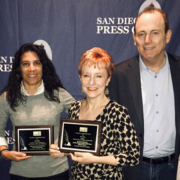
The San Diego County Water Authority won two first place awards and a second place award for its communication efforts from the San Diego Press Club.

Water Authority’s Outreach Efforts Honored

The San Diego County Water Authority received two first place awards and a second place award for its public outreach and education at the 2018 San Diego Press Club’s 45th annual Excellence in Journalism Awards. The event took place at the Jacobs Center for Neighborhood Innovation’s Joe and Vi Jacobs Community Center on October 30.

San Diego’s finest reporters, photographers, writers, artists, and communicators were honored with the region’s top awards.

(L to R) Dennis Cushman, Assistant General Manager; Denise Vedder, Public Outreach and Conservation Director; and Mike Lee, Public Outreach and Conservation, accept their San Diego Press Club Journalism Awards. Photo: Water Authority

Left to right: Water Authority Assistant General Manager Dennis Cushman, Public Outreach and Conservation Director Denise Vedder, and Public Affairs Supervisor Mike Lee accepted the agency’s San Diego Press Club awards on Oct. 30. Photo: Water Authority

The Water Authority received the following Press Club awards:

Websites, Public Service or Consumer Advocacy Site: First Place, Water News Network

Websites, Blog by Corporation or Group: Second Place, Water News Network

Public Relations and Trade Publications, Annual Report: First Place for the 2017 Annual Report titled Pioneering. Visionary. Agile. Driven.

“The San Diego Press Club Excellence in Journalism awards shows that solid research, writing, reporting and photography matter more than ever,” said Kristen Castillo, 2018 Press Club president. “I’m proud our organization honors student and professional journalists and public relations professionals in San Diego.”

The San Diego Press Club’s journalism awards program is among the largest regional competitions of its kind in the nation. A total of 478 awards were presented in 188 categories, with a record number of entries. Press Club officials say entries continue to be robust from a diverse array of media and public relations professionals.

Judges included members of press clubs in San Francisco, Los Angeles, New Orleans, Rochester, Florida, Cleveland, Orange County, Milwaukee, Tulsa and Alaska.

Water News Network receives Award of Merit

Earlier this month, the Water Authority’s Water News Network received an Award of Merit for External Websites at the 26th annual Edward L. Bernays Mark of Excellence Awards ceremony on October 25, hosted by the San Diego/Imperial Counties Chapter of the Public Relations Society of America.

“As communication pros, we spend most of our time highlighting our clients and executives. The Bernays Awards are a unique opportunity for our fellow professionals to be recognized for all of their contributions and tremendous efforts,” said Jenny Corsey, chapter president.

Named after Edward L. Bernays, the “father of public relations,” the awards were open to all agencies and organizations in San Diego and Imperial Counties. They recognize excellence in public relations campaigns and tactics in a range of categories including media relations, community relations and public affairs. Members of the West Michigan PRSA Chapter judged all award entries.


Kelsey Ceccarelli (center), the Citizens Water Academy's 500th graduate, with Water Authority Assistant General Manager Dennis A. Cushman (left) and Board Chair Jim Madaffer (right). Photo: Water Authority

500th Community Leader Graduates from Citizens Water Academy

The San Diego County Water Authority’s pioneering Citizens Water Academy celebrated the graduation of its 500th community leader Friday at the conclusion of the fall class series.

During the popular and award-winning academy program, civic leaders learn about visionary local efforts to ensure a safe and reliable water supply for the San Diego region. Participants get an in-depth look at how the Water Authority helps protect the region’s economy and quality of life through strategic planning, innovative programs, and cost-effective investments.

After the third and final class of each academy, graduates are given diplomas to the sounds of “Pomp and Circumstance” and congratulations from Water Authority executives – a tradition that took on special significance in light of today’s milestone.

“The Citizens Water Academy has profoundly improved the understanding of water issues across our region and demystified the critical work we do to sustain San Diego County’s $220 billion economy and quality of life for 3.3 million people,” said Jim Madaffer, chair of the Water Authority’s Board of Directors. “Reaching 500 graduates is an impressive accomplishment – but we are not done.

“Anyone who aspires to civic or business leadership should invest the time to learn about this fundamental resource,” Madaffer said. “I guarantee that the Citizens Water Academy will change the way they think about this amazing place we call home.”

Citizens Water Academy graduates remain engaged in regional water issues

Kelsey Ceccarelli, the Citizens Water Academy's 500th graduate, displays her Certificate of Completion. Photo: Water Authority

Kelsey Ceccarelli, the Citizens Water Academy’s 500th graduate, displays her Certificate of Completion. Photo: Water Authority

The Citizens Water Academy launched in fall 2014 and produced a diverse inaugural class of 49 graduates. Over the years, 99 percent of participants said they would recommend the Water Academy to a colleague, and nearly 50 percent of graduates stay engaged through the Water Authority’s alumni program.

Participants said the class series helped them understand the physical movement of water into and around the region; the importance of the region’s water supply diversification strategy; how large-scale water projects are built and maintained; and how water managers are preparing for future water supply needs.

The Water Authority typically hosts three academies of about 50 participants each year. Classes have been held in Kearny Mesa, the South Bay and North County to promote regional participation. Class series include presentations by agency executives, role-play activities, and tours of world-class water facilities such as the Claude “Bud” Lewis Carlsbad Desalination Plant.

In addition, the Water Authority maintains an active network of Water Academy graduates who participate in specialized tours, lectures and other events. They also stay connected through an alumni newsletter – part of the Water Authority’s commitment to supporting engaged and knowledgeable regional leaders.

The Water Authority received the Silver Bernays Mark of Excellence Award for the Citizens Water Academy from the San Diego/Imperial Counties Chapter of the Public Relations Society of America in 2015. The program also won the Communications Initiative Award from the San Diego Section of the American Planning Association in 2016.

The next Citizens Water Academy is scheduled for Spring 2019, though dates have not been set. The selection process is competitive, and acceptance is not guaranteed. For more information, go to www.sdcwa.org/citizens-water-academy. The site includes a link to sign up for notifications when future class dates are announced.


Lisa Marie Harris was selected to deliver the keynote address at the 2018 Municipal Bond Women’s Forum on October 18 in San Francisco. Photo: Water Authority

Harris Headlines Fall Conference for Women in Finance

For Lisa Marie Harris, serving as the director of finance for the San Diego County Water Authority is far more than a job. It’s part of a calling that started in college.

As an undergrad, Harris secured a fellowship to study public policy at the University of Michigan, which confirmed her desire to pursue a career in government finance. Today, she is responsible for overseeing the Water Authority’s $2.3 billion debt portfolio, developing the agency’s bi-annual $1.5 billion operating budget, and setting the agency’s annual rates and charges.

“I consider it a noble profession,” said Harris, who led the Water Authority’s successful efforts to earn a AAA rating from Standard & Poor’s in 2016. “It’s been rewarding to know I assisted my community and protected the assets of my community.”

That approach to her job is part of the reason that Harris was selected to deliver the keynote address at the 2018 Municipal Bond Women’s Forum on October 18 in San Francisco. The organization comprises women leaders in the municipal bond industry, including public finance bankers, analysts, traders, brokers, issuers and portfolio managers. Harris is the only speaker on the agenda from the public sector.

Diverse Leadership Experience Benefits Water Authority

After earning her master’s degree in public policy at Michigan, Harris served in several leadership positions, starting as a senior economist at the U.S. Environmental Protection Agency. Then, she served as chief finance officer for the Emergency Communications Department at the City of San Francisco; assistant deputy director of the San Francisco International Airport; and executive director of the California Debt and Investment Advisory Commission for the California State Treasurer’s Office.

Harris arrived in San Diego as chief deputy treasurer for San Diego County Treasurer/Tax Collector Dan McAllister to manage the county’s $5 billion investment portfolio. It was the perfect venue to showcase what Harris sees as her strengths: her readiness to accept challenging assignments, her ability to make adjustments, and her willingness to ask for help.

After seven years, Harris left for a stint in investment banking. But she continued to feel the need to serve the larger community – and when the Water Authority offered her a position as director of finance and treasurer in 2014, she eagerly accepted.

Today, she touts the same philosophy that she has for most of her career: “Strive for excellence. Don’t be mediocre. Go for the best and try to be the best.”

Civic Engagement Vital to Career Advancement

Harris attributes her success in part to civic engagement and professional contributions outside the workplace. She strongly recommends that women in financial careers pursue opportunities to develop their skills and contribute value outside of the workplace as a career-building strategy.

In addition to her participation in the Municipal Bond Women’s Forum, Harris also is a longtime member of the Government Finance Officers Association, having served on various committees, the executive board, and the nominating committee that selects the organization’s president. In addition, Harris recently completed a three-year term on the national board of Women in Public Finance, and she helped charter the San Diego chapter of this nationwide organization.

Harris explains the benefit of seeking leadership opportunities in volunteer roles: “You get to demonstrate to the world what you bring outside of work,” she said. “You can’t always receive accolades and demonstrate your skill sets at your job.”

She also advises colleagues across the financial services industry to seek help achieving a work-life balance – a topic she plans to address during her keynote address in October.

“If you want to have children, you have to set up the infrastructure in your family,” said Harris, who has been married 28 years and has two children in college. “I think I got it done,” she said, “but I couldn’t have done it without my husband.”


The San Diego County Water Authority presented its inaugural Water Innovation & Efficiency Award to Kyocera. Photo: Water Authority

Kyocera First Recipient of New Water Authority Award

In an effort to remind regional stakeholders in the business community about the importance of water to San Diego’s regional economy, the San Diego County Water Authority presented its inaugural ‘Water Innovation & Efficiency Award’ to Kyocera International during the Industrial Environmental Association’s 34th annual conference at the San Diego Convention Center on September 28.

Kyocera was honored for its strong commitment to reusing water multiple in its production processes, thereby decreasing its water use by nearly 20 percent since 2014. This conserves more than 6 million gallons per year.

“Water is our most precious natural resource, and it’s so rewarding to see major employers like Kyocera redouble their efforts to use – and re-use – water efficiently,” said Jim Madaffer, whose term as chair of the Water Authority’s Board of Directors starts Oct. 1. “Corporate leadership like this, coupled with investments in water supply reliability, will help sustain our thriving economy and unparalleled quality of life.”

Madaffer presented the award to Kyocera in front of about 250 people at the conference. “There are a lot of folks in the industrial community here in San Diego,” he said. “By Kyocera’s example, we’re hoping that other companies follow their lead, being able to do what they can to save water for all of our region as well.”

Kyocera’s Meridith Marquis, Roger Blankenship and Mark Brodie accepted the award on behalf of the company.“Kyocera’s corporate motto is ‘Respect the Divine and Love People,’ which compels us to manufacture in resource-saving, eco-friendly ways,” said Marquis, divisional vice president for general affairs. “It takes a lot of water to manufacture the technology that surrounds us, and we must act in good conscience to recycle as much of that water as possible. The fact that we can save money while doing this makes it a win-win all around.”

View the award presentation video here.

Kyocera’s innovative efforts pay off

Headquartered in San Diego, Kyocera’s North American operations were established in 1971. Today, the company employs about 625 people locally and manufactures high-tech products such as ceramic semiconductor packages and microelectronic devices at its San Diego plant.

Kyocera has been investing in water-use efficiency at its local plant since 2000, with a marked increase in savings since 2014. Recent water savings result from:

  • Converting to a closed-loop cooling system that uses water multiple times instead of once
  • Re-using water from plating operations to cool its onsite co-generation plant
  • Installing water meters for production groups and making them accountable for water use
  • Adding flow regulators to fine-tune the amount of water delivered for manufacturing processes
  • Replenishing plating tanks only when necessary instead of continuously

Kyocera achieved significant water savings by installing a basic, off-the-shelf $30 valve allowing the company to repurpose reverse osmosis water that didn’t meet purity standards, and instead use it as cooling water. This single creative adjustment alone saved about 373,000 gallons per month. In all, Kyocera is saving about $62,500 a year in water costs compared to 2014, while upholding its corporate mission to embrace sustainability.

The Water Innovation & Efficiency Award is part of the Water Authority’s Brought to You by Water outreach and education program, designed to enhance the regional appreciation for the value of the safe and reliable water supplies. That effort includes enhanced partnerships to highlight the importance of water reliability to the region’s economy for tourism, agriculture, brewing, manufacturing and other key sectors.

This fall, the Water Authority is focusing on manufacturing companies with “products that put San Diego on the map.” For more information, go to the Brought To You By Water website.


Jeff Moore stands in his front yard featuring his award-winning waterwise landscaping work. Photo: Charlie Neuman, Water Authority Vallecitos

Waterwise Landscaping Blooms in San Marcos

San Marcos, Calif. – A beautiful native garden low on water use but not on style won first place in the Vallecitos Water District’s 2018 “WaterSmart Landscape Contest.

To encourage customers to reduce outdoor water use, Vallecitos recognizes customers whose yards best exhibit the beauty of California-friendly, low-water gardening. The Vallecitos Board of Directors honored the 2018 winners of the annual WaterSmart Landscape Contest at its August board meeting.

Jeff Moore stands in his front yard featuring his award-winning WaterSmart landscaping work. Photo: Water Authority

The winners are:

First place – Rhonda Holmes and Jeff Jenco

Second place – Dennis and Shannon Root

Third place – Patti Joyce and Jeffrey Moore

View a video tour and interviews with the winners here.

First place winner Rhonda Holmes said the landscape transformation at her Lake San Marcos-area home took place after purchasing the house and undertaking a complete remodel, which included replacing the front and back yard turf areas with water-efficient plants.

Holmes describes seeing neighborhood lawns with running sprinkler heads misting the streets. She wanted to design a garden that was smart on water, while being beautiful at the same time. As for the earth-friendly garden remodel, Holmes says, “It’s really easy to do. I’d love to see more people try to do their part.”

Bioswale feature prevents stormwater pollution

Jeff Moore rakes the zen garden in his back yard featuring his landscape work. Photo:  Water Authority

Holmes also installed a beautiful and environmentally conscious bioswale to reduce pollution to nearby Lake San Marcos. It prevents water from being emptied into the storm drain system.

“I think what people don’t realize is all the pesticides and fertilizers and chemicals we use on our plants, if we don’t do something like a biofiltration system with those chemicals, then end up leaching out into the streets, into the gutters and into the golf course here, and for example in Lake San Marcos,” said Holmes.

Holmes says in addition to water conservation, she is able to avoid pest control with chemicals, because native plants are more disease resistant.

All three winners experienced an unexpected benefit: an influx of wildlife into their yards including birds, bees and butterflies, and small reptiles. There is even a neighborhood peacock that visits the Root household.

Free fall series of landscape makeover classes now open for registration

Decorative elements highlight Jeff Moore’s landscaping. Photo: Water Authority

Shannon Root says she attended a landscaping seminar held at the Vallecitos Water District. Third place winner Jeffrey Moore attended the San Diego County Water Authority’s Landscaping Makeover series of classes. Both called them informative and extremely helpful. The next series of Landscaping Makeover classes are scheduled in October. Interested residents can register on the program’s website.


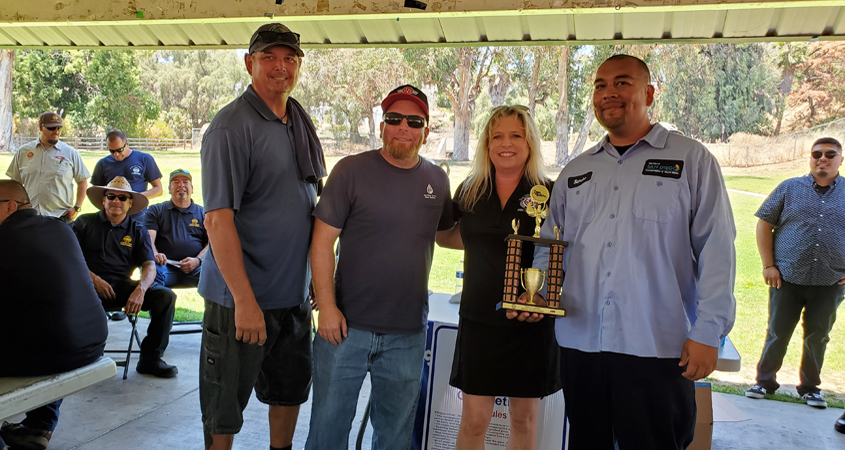
Water Authority maintenance employees John Brown and Bobby Bond Jr. ready to compete at the National Skills Roadeo in Kansas City, Missouri. Photo: Courtesy Bobby Bond Jr.

Maintenance Men Bring Home the Hardware from National Contest

Two maintenance pros representing San Diego brought home awards from the 2018 American Public Works Association’s National Roadeo Skills Competition in Kansas City, Missouri , in late August.

The San Diego County Water Authority’s Bobby Bond Jr. placed second in the backhoe/mini-excavator event, while John Brown, also of the Water Authority, placed third in the skid steer competition. They are the only winners from west of the Rockies, and the only two winners from a single agency nationwide.

A record number of 86 participants competed in three categories of competition: the backhoe/mini-excavator, skid steer, and mechanics. Each competition fielded 50 to 55 participants. Organizers ran through the rules and provided an orientation to the three categories of competition, as well as a tour of each course. Finally, all of the competitors drew numbers to determine their starting order.

Competition tests skills used to maintain vital infrastructure

Winners received engraved belt buckles as prizes. Photo: Courtesy Bobby Bond Jr. National Skills Roadeo

Winners received engraved belt buckles as prizes. Photo: Courtesy Bobby Bond Jr.

Bond competed in the skid steer category early, which served as a warm-up for the backhoe and the mini-excavator tests. Despite incurring a 25-second penalty for dropping a section of PVC pipe, Bond’s time through the course was 3 minutes, 3.2 seconds with minimal faults, earning him the second place finish.

It was Bond’s second year in the event, and his previous experience paid off. “This year, it was really competitive,” said Bond. “The course was really tight. They did a really good job making it fair for everyone. It was fun.”

John Brown placed third despite an unusual hiccup. While he was competing, his mini-excavator ran out of fuel on the second obstacle. He was allowed to restart on a replacement machine, earning Bond’s admiration for remaining cool under pressure. Brown’s final time was 1 minutes, 55.8 seconds, with no penalties assigned.

Both the national and regional competitions mimic skills that Bonds, Brown and thousands of other employees use each day on the job while maintaining water and wastewater systems, streets, and other vital infrastructure.

Jim Fisher, Director of Operations and Maintenance for the Water Authority, is proud of the results, but not surprised. “Bond and Brown are part of a team whose skills we count on every day to maintain our region’s water system. They exceed our expectations and both earned this well deserved recognition for their accomplishments.”

Bond says he intends to return for local and national competitions in coming years – and he aims to compete for the Water Authority when the National Roadeo Skills Competition returns to San Diego in 2022.

See the complete list of winners here.