Tag Archive for: Water Conservation

Water Payments Projected To Exceed Cash Reserves By $3.4M

The ag community at a Friday afternoon IID water conservation meeting wanted to know what the IID plans to change with water conservation payments projected to exceed the budget by $11.7 million. IID’s conservation needs under water transfer agreements with the San Diego County Water Authority and others are 303,000 acre feet. Of that, 103,000 acre feet comes from system conservation. The rest comes from on-farm water conservation.

Water Resources Engineer Sami Sweis holds the Nautilus in his right hand and a foam ball in his left hand that the high-tech device is placed in before it is inserted into a water pipeline to scan for potential leaks. Photo: Water Authority

High-Tech Tools Help Detect Possible Pipeline Problems

It’s a whole new ballgame for the San Diego County Water Authority when it comes to finding leaks in major pipelines with cutting-edge technology.

One new tech tool deployed for the first time in February actually looks like a tennis ball that floats through water-filled pipelines scanning for potential trouble.

Of course, the new device is much more complex inside than a tennis ball – in fact, the Nautilus is among the most advanced tools of its kind in the world.  It not only detects defects that are invisible to the human eye, it does so without requiring pipes to be drained, which saves a significant amount of water and disruption to customers.

Innovation Leader

The Nautilus is just the latest component of the Water Authority’s cutting-edge Asset Management Program that has been adopting and developing innovative tools for more than two decades. In fact, the Water Authority has been recognized by the American Water Works Association as a leader in the water industry for its focus on asset condition assessment, risk management, proactive pipeline replacement, and use of cutting-edge technology that saves ratepayers money.

“These high-tech tools are cost-effective and fit perfectly with our proactive approach to managing our infrastructure, including 310 miles of large diameter pipelines and 1,400 pipeline structures,” said Nathan Faber, an operations and maintenance manager with the Water Authority. “Our mission is to find potential failures in the system in advance, rather than react after a failure.”

‘Listening’ for leaks

The Nautilus uses acoustic feedback to detect leaks or abnormalities in active pipelines without causing any disruption to water service or supply, Faber said. About the size of a tennis ball, the Nautilus is placed inside a larger, sterilized foam ball, to float through operating pipelines.

For the First Aqueduct scan, 26 sensors, called synchronizers, were installed on various structures on the outside of the pipeline. Those sensors relayed information to the Nautilus as it floated between checkpoints. No leaks were discovered in the tested portions of the pipeline.

Digital Resolution

A scan from the LIDAR device shows precise and highly-accurate digital measurements that pinpoint pipeline problems. Photo: Water Authority

A scan from the LIDAR device shows precise and highly-accurate digital measurements that pinpoint pipeline problems. Photo: Water Authority

Leveraging new technology to gather data and pinpoint pipeline problems saves water and money.

“Responding or reacting after failures can cost up to six times the cost of proactive repairs,” Faber said.

He pointed to a recent pipeline repair project in La Mesa, where a Light Detection and Ranging device, or LIDAR, was used inside a pipe to provide highly-accurate digital measurements.

“The LIDAR took 1,600 measurements in five seconds,” Faber said. “The high-resolution images showed stressed pipe and verified cracking issues that allowed crews to make an efficient, proactive repair.”


Local water agencies are planning to offer rebates or professional help to customers during Fix a Leak Week March 18-24. Photo: Traphitho - Cesar Augusto Ramirez Vallejo/Pixabay CC

Save Water During Fix a Leak Week

Local water agencies are planning to offer rebates or professional help to customers who find and repair water leaks as part of national Fix a Leak Week activities March 18-24.

Fix a Leak Week is a reminder every March to check indoor and outdoor plumbing systems for leaks.

The Water Authority offers tips on how to identify and fix leaks around your home. Check WaterSmartSD.org for tips and for more information about Fix a Leak Week.

The U.S. Environmental Protection Agency reports that household leaks can waste nearly 1 trillion gallons of water annually nationwide. Average household leaks can account for nearly 10,000 gallons of water wasted every year – the amount of water needed to wash 270 loads of laundry, according to the EPA. Repairing a leaky toilet can save up to 500 gallons of water a day. That’s enough to fill a backyard swimming pool.

Common types of leaks found in the home are worn toilet flappers, dripping faucets, and other leaking valves. By fixing easily corrected household leaks, homeowners can save up to 10 percent on their water bills.

Sweetwater Authority offers rebates

During March, the Sweetwater Authority offers its customers rebates of up to $75 for leak repairs. Residential and business customers in the district may also schedule a free water audit to evaluate the water efficiency of their property.

Fix a leak during Earth Month in Oceanside

The City of Oceanside offers a Fix a Leak Workshop in conjunction with its Earth Month celebration in April.

A free three-hour workshop “Common Leaks and How to Fix Them” is scheduled for 9 a.m. to noon on Friday, April 26, in the Oceanside Civic Center Community Rooms.

A plumbing professional will describe how to identify and fix leaks.

Residents are encouraged to bring their questions. Attendees will receive a home water audit and leak detection kit. Attendance is free, but seating is limited. Email  to reserve a spot.


Conserving Water Is Still A Priority For California. How About Other States?

The Metropolitan Water District last week re-upped its turf-removal program, providing greater incentives for homeowners to replace thirsty lawns with drought-tolerant plants. In Utah, the state’s Division of Water Resources is encouraging residents to use more water so it can justify spending $3 billion on a pipeline that will take more water from Lake Powell, which is fed by the Colorado River, a source of water for Southern California residents. This tale of two states brings up an interesting question: Is water conservation de rigueur or passé?

Creative Kids Educate Region About Water Conservation

Eighteen talented San Diego, Coronado and Imperial Beach elementary school students used their artistic skills to communicate the importance of water conservation in the City of San Diego’s Public Utilities Department 18th annual Kids Poster Contest. Winning entries in the contest are featured in the 2019 Water Conservation Calendar, which debuts this month. They are available free for pickup at San Diego city libraries, recreation centers, and at San Diego City Hall, 202 C Street downtown.

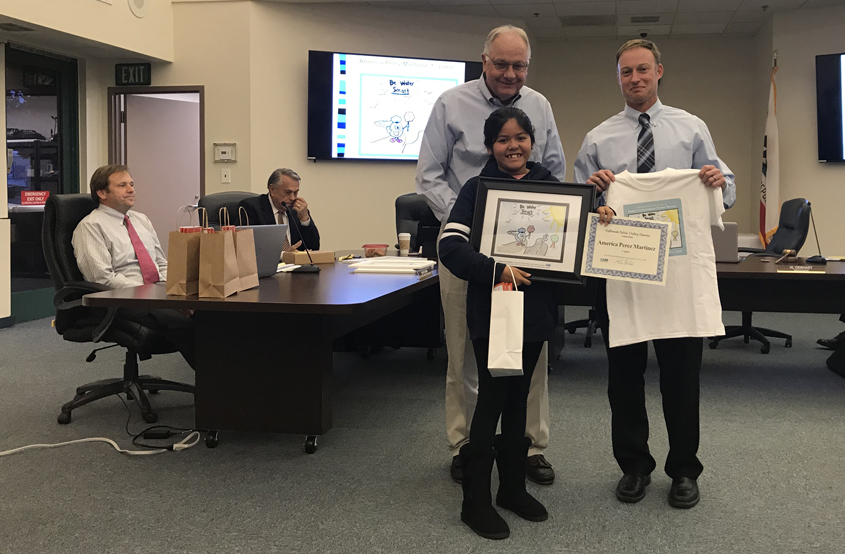
Contest winners honored at December board meeting: Top row: public affairs officer Noelle Denke, general manager Jack Bebee, board president Al Gebhart. Middle row: Mariana Jimenez, Stephania Miranda, Lexie Graves, Magdaleny Caralampio, America Perez Martinez, Maria Ordonez Rodriguez, Jordyn Jones. Last row: Hudson Quinn, Connor Siegler, Gabriel Velasco, Antonio Jesus. Photo: Fallbrook PUD

Young Artists Featured in Fallbrook PUD Conservation Calendar

Fourth-graders from five Fallbrook-area elementary schools put pens, crayons and watercolors to work with the goal of creating the best and brightest water-conservation posters in competition to become part of the 2019 Fallbrook Public Utility District’s “Be Water Smart” calendar.

Two hundred posters demonstrated the students’ enthusiasm and creativity. Out of these entries, 14 were honored in the 2019 calendar.

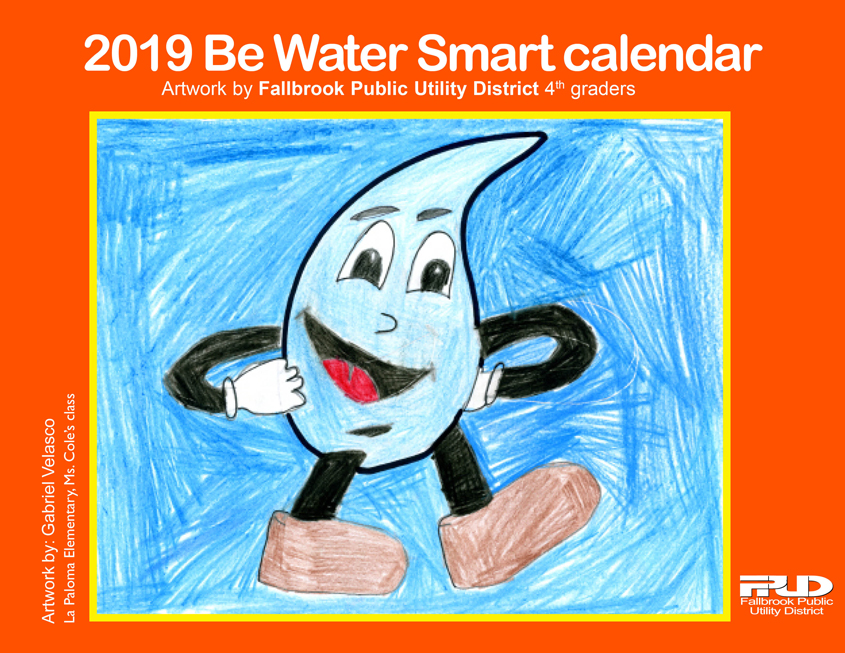
Gabriel Velasco's entry was chosen by the judges to appear on the 2019 calendar cover. Photo: Fallbrook PUD

Gabriel Velasco’s entry was chosen by the judges to appear on the 2019 calendar cover. Photo: Fallbrook PUD

The free calendars are available at the Fallbrook Public Utility District office, 990 E. Mission Road in Fallbrook, during business hours while supplies last.

The pupils’ colorful images vividly depict the contest’s theme, “Be Water Smart.” The district’s panel of judges viewed all the entries to find the most eye-catching artwork that successfully communicated the need for saving water.

Winners recognized at Fallbrook PUD board meeting

The winning fourth-grade artists were recognized at the Fallbrook PUD board of directors meeting on Dec. 10. In addition to being featured in the calendar, each winning artist was presented with their original artwork matted and framed for them to keep. They also received a signed certificate of commendation from the district, along with prizes such as school supplies and gift cards.

First place winner America Perez Martinez receives congratulations from Fallbrook PUD board president Al Gebhart and general manager Jack Bebee. Photo: Fallbrook PUD

First place winner America Perez Martinez receives congratulations from Fallbrook PUD Board President Al Gebhart and General Manager Jack Bebee. Photo: Fallbrook PUD

As a special award, the first-, second- and third-place student artists, plus the cover artist, received a personalized T-shirt with their winning artwork printed on it. Those artists are:

First place: America Perez Martinez, Fallbrook STEM Academy

Second place: Stephania Miranda, Maie Ellis Elementary

Third place: Hudson Quinn, Maie Ellis Elementary

Cover artist: Gabriel Velasco, La Paloma Elementary

Additional monthly winners include Magaly Maldonado, Magdaleny Caralampio, Antonio Jesus, Maria Ordonez-Rodriguez, Mariana Jimenez and America Giles of Maie Ellis Elementary; Jordyn Jones of William H. Frazier Elementary; Connor Siegler, Lexie Graves and Wendy Sanchez Hernandez of La Paloma Elementary.

The annual contest is open only to fourth-graders in the FPUD service area after they complete classroom instruction about water conservation and the water cycle. Students attending Fallbrook STEM Academy, William H. Frazier, La Paloma, Maie Ellis and Live Oak elementary schools submitted entries.

All 14 pieces of artwork will be displayed on the FPUD website. They will also be displayed in the FPUD boardroom through 2019.


Water Conservation Garden Welcomes New Executive Director

The Water Conservation Garden in Rancho San Diego has a new leader to keep it growing. Jennifer Pillsbury was hired in November to be the executive director/CEO of the xeriscape demonstration garden adjacent to Cuyamaca College. Overseen by an 11-member governing board, the 6-acre, not-for-profit garden displays drought-tolerant landscaping and offers water-saving ideas. It was founded in 1999. Its $1.3 million operating budget is offset in part by a joint powers agreement (JPA) with several local water agencies. The agencies are Helix Water District, Otay Water District, Sweetwater Authority, the city of San Diego and the San Diego County Water Authority. Cuyamaca College is also part of the agreement.

Wide Fluctuation In October Water Conservation Numbers

Water conservation numbers for October were announced last week by the Water Resources Control Board, and the savings were all over the place. Statewide, urban water use was down 13.4 percent compared to October 2013, the pre-drought benchmark year. That was down from 14.6 percent in September, but the conservation rate has been pretty static since July. However the Sacramento River watershed, usually one of the more thrifty regions, had savings of just 12.1 percent in October. The conservation rates were higher on the South Coast, 13.1 percent, and in the Bay Area, 14.0 percent.

Check irrigation systems when changing the clocks on Sunday November 4. Photo: Kelly M. Grow/ California Department of Water Resources daylight savinig time

Fall Back and Save Water As Clocks Change

Whether you are excited about an extra hour of sleep or dour about losing an hour of sunlight at the end of the day, daylight saving time ends Sunday, Nov. 4. The annual adjustment is a great reminder to perform several important household tasks, such as replacing smoke alarm batteries and restocking emergency preparedness kits.

The San Diego County Water Authority asks residents to add one more important task when changing the clocks: Adjust irrigation systems to save water in the months ahead.

“Adjusting irrigation is an easy way to conserve water, since landscapes need less irrigation as the days get shorter and cooler,” said Dana Friehauf, a water resources manager for the Water Authority. “Residents also should make sure their irrigation systems are working correctly, and are free of broken sprinkler heads or other leaks that waste water.”

Approximately half of a typical California household’s water use is outdoors. Seasonal adjustments to irrigation controllers in preparation for winter weather not only reduce water waste, they benefit the health of landscape plants.

Cool-season water-saving practices can reduce use

Additional water-saving practices during the fall and winter months include:

  • Turning off irrigation systems when rainstorms are predicted.
  • Leaving irrigation systems off for at least a week after significant rainfall.
  • Installing rain barrels or cisterns to help capture stormwater from roofs and store it for future irrigation use.

Fall is also the ideal time for residents to upgrade thirsty turf yards to WaterSmart sustainable landscapes. Homeowners can take advantage of winter rains to help establish a new landscape. The Water Authority’s award-winning WaterSmart Landscape Makeover Program offers a variety of free classes and how-to online videos to guide homeowners through the conversion process. More information is at WaterSmartSD.

In addition, there are a limited number of residential rebates available for homeowners who want to upgrade to sustainable landscaping at SoCal Water$mart.

The Water Authority offers additional water-saving resources for residents and businesses through its Live WaterSmart campaign. These include:

  • Free water-use surveys and irrigation checkups
  • Rebates for highly efficient irrigation equipment, washing machines and other devices
  • Water-efficiency training for professional landscapers
  • An online home water-use calculator and other tools

For a comprehensive list of tips, or to learn more about the Water Authority’s suite of water-saving resources, go to WaterSmartSD.org.


Almond Farms Keep Growing, And Keep Moving On Water Conservation

Much was written during California’s recent five-year drought about the amount of water used by almonds. The nuts have become California’s most lucrative agricultural commodity, and a major export product. Long before concerns about water use by almond growers emerged, the industry initiated measures to conserve water by embracing microirrigation systems. It has also become a leader in efforts such as recharging groundwater by flooding almond orchards during winter storms.