Tag Archive for: Water Conservation

EPA WaterSense-QWEL-Primary-Water Conservation

Water Authority Wins National 2021 EPA WaterSense Excellence Award

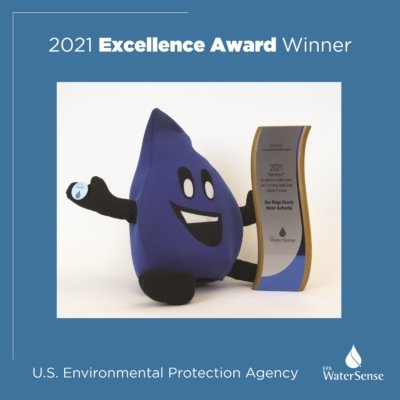
The U.S. Environmental Protection Agency has recognized the San Diego County Water Authority with a 2021 WaterSense Excellence Award for advancing water efficiency through its Qualified Water Efficient Landscaper, or QWEL, program. The Water Authority received one of 34 WaterSense awards last week at the national WaterSmart Innovations Conference in Las Vegas.

Due to the coronavirus pandemic, the Water Authority pivoted its QWEL courses to a virtual format. The Water Authority partnered with San Diego Gas & Electric to install nearly 4,000 WaterSense-labeled showerheads for county residents and helped reduce outdoor water waste by using its WaterSmart Contractor Incentive Program to install more than 1,000 WaterSense-labeled irrigation controller stations, saving more than 6 million gallons of water.

“Working collaboratively with the EPA to increase water efficiency by training hundreds of landscape professionals each year makes a significant contribution to saving water, especially during dry times,” said Gary Croucher, Board chair of the San Diego County Water Authority. “The QWEL program is an effective education program for landscape professionals that provides the knowledge and skills needed to help our communities save water and keep landscapes healthy and beautiful.”
EPA WaterSense-QWEL-Excellence Award

The U.S. Environmental Protection Agency has recognized the San Diego County Water Authority with a 2021 WaterSense Excellence Award for advancing water efficiency through its Qualified Water Efficient Landscaper, or QWEL, program.

As one of the first QWEL providers in Southern California, the Water Authority has helped to expand the program’s branded outreach and educational outcomes. Since the January 2016 launch of QWEL, more than 1,400 San Diego landscape professionals have participated, making the region’s program one of the largest in the nation. More than 800 landscape professionals have earned QWEL certificates in the San Diego region over the past six years by passing a rigorous national test.

Landscape water efficiency

The Water Authority promotes English and Spanish QWEL training in collaboration with trade associations, faith-based organizations, English-as-a-Second-Language programs, community colleges and Master Gardeners associations. Nearly all (99%) program participants surveyed said the class would help them better manage landscape water efficiency, and 98% rated the class good or excellent.

This is the third time the Water Authority has achieved the Excellence Award for the QWEL program, which is certified by EPA to significantly increase water management skills and knowledge among landscape professionals.

WaterSense works

WaterSense, a voluntary partnership program sponsored by EPA, is both a label for water-efficient products and homes and a resource for helping consumers learn ways to save water. Since the program started in 2006, WaterSense labeled products have helped consumers and businesses save 5.3 trillion gallons of water – enough water to supply all households in the United States with water for 200 days! In addition to water savings, WaterSense has helped reduce the amount of energy needed to heat, pump, and treat water by 603 billion kilowatt hours and save $108 billion in water and energy bills.

“In 2020, our WaterSense partners continued to make saving water possible by educating consumers and businesses about WaterSense and water-efficient behaviors,” said Veronica Blette, the WaterSense program manager. “Our award winners’ creative and committed approaches to water conservation helped consumers save water, energy, and money on their utility bills at a time when they needed it most.”

The San Diego regional QWEL program is made possible in part by grant funds from voter-approved Proposition 1 administered by the California Department of Water Resources.

For more information about WaterSense go to: :www.epa.gov/watersense.

For more about the Water Authority’s QWEL program, go to: https://qwel.watersmartsd.org/.
Water Authority Wins National 2021 EPA WaterSense Excellence Award

October 11, 2021 – The U.S. Environmental Protection Agency has recognized the San Diego County Water Authority with a 2021 WaterSense Excellence Award for advancing water efficiency through its Qualified Water Efficient Landscaper, or QWEL, program. The Water Authority received one of 34 WaterSense awards last week at the national WaterSmart Innovations Conference in Las Vegas.

Opinion: Up to 1 Million Gallons of Water … a Night? That’s Par for Some Desert Golf Courses

Doug Thompson couldn’t believe what he’d just been told. His wife, a botanist, was advising a Coachella Valley country club on drought-resistant landscaping, and Thompson, who got to talking with the groundskeeper, asked how much water it takes to irrigate a golf course.

Opinion: Conserving Water Can Cut Our Bills and Help Future Generations

Extended droughts broken up by rainy years are part of a natural cycle here in California. Our state is once again in another dry period, with areas of Northern California already experiencing a significant impact. It is not a question of if, but when the Coachella Valley faces a similar fate.

Thanks to decades of targeted projects and careful planning, Mission Springs Water District will have enough water to serve our 40,000 customers in and around Desert Hot Springs.

California Drought: Which Cities in Santa Clara County are Saving the Most and the Least Water

The Santa Clara Valley Water District, which is the main wholesale water provider in Santa Clara County, on June 9 declared a drought emergency and called on all residents to reduce water use 15% from 2019 levels to preserve supplies.

In August, the most recent month for which data is available, countywide water use dropped by 9%. That was an improvement from a 6% drop in July, but still is significantly under the goal.

Here is the percentage change in water use between August 2019 and August 2021 at the 13 cities and private water companies the Santa Clara Valley Water District serves.

Drought Emergency: San Jose Mayor Liccardo Proposes Outdoor Watering Limits To 2x/Week, Renews Calls To Conserve

San Jose Mayor Sam Liccardo renewed calls for residents to conserve water and proposed outdoor watering restrictions Wednesday as California’s ongoing drought deepens.

Choosing Your Best Irrigation Method: Spray or Drip

Your choices in irrigation methods come down to spray or drip systems. Spray irrigation emits water in an overlapping pattern. Drip irrigation delivers water directly to the roots of plants. This question is more important than ever during a drought cycle. How do you decide which meets the needs of your landscaping?

Irrigation-Conservation Corner-drought-Water Conservation

Choosing Your Best Irrigation Method: Spray or Drip

Your choices in irrigation methods come down to spray or drip systems. Spray irrigation emits water in an overlapping pattern. Drip irrigation delivers water directly to the roots of plants. This question is more important than ever during a drought cycle. How do you decide which meets the needs of your landscaping?

The case for spray irrigation

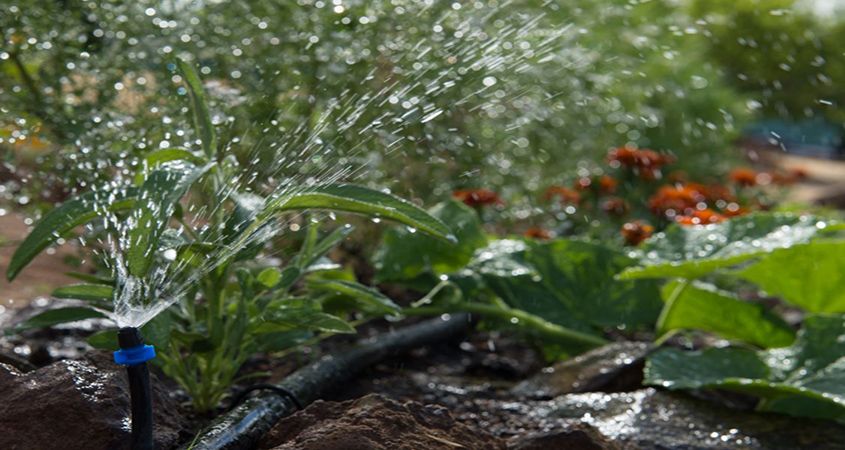
Ensuring that spray heads are properly tuned and far enough away from buildings or impermeable surfaces helps maximize your water efficiency. Photo: California Department of Water Resources

Ensuring that spray heads are properly tuned and far enough away from buildings or impermeable surfaces helps maximize your water efficiency. Photo: California Department of Water Resources

Spray irrigation can be an efficient way to irrigate large landscapes with groundcover or uniform plant materials like lawns or meadows.

Spray systems apply water in gallons per minute, so if you know the application rate of each spray head, the distance between the heads, and the pressure of your system, it is relatively easy to figure out how much water is applied every time you run your irrigation.

Low volume spray heads apply water at about one-third the rate of conventional spray heads. Newer spray irrigation heads have improved spray with heavier droplets more resistant to wind. Landscaping with grade changes using spray heads should have check valves installed to prevent water flowing out of the lower point heads.

Challenges of spray irrigation include narrow areas surrounded by hardscape or irregular patterns. Irregular patterns are particularly challenging because spray irrigation requires head-to-head coverage to be efficient. Odd-shaped areas may be under or overwatered. High-volume spray heads that emit water at a much higher rate than the soil can absorb should be replaced.

The case for drip irrigation

Drip systems apply water in gallons per hour, so they often need to run for longer periods of time than spray systems. But the actual run time must always account for precipitation rate and runoff.

Installation of subsurface systems (under at least two inches of mulch) is the most efficient way to irrigate nearly every type of garden area. Since the tubing is flexible, it can accommodate a variety of irregularly shaped areas or rectangular areas when laid in a grid pattern, and in rings you can easily expand as trees or shrubs grow.

Challenges of drip irrigation include the application of water too quickly for your soil to absorb. This needs to be considered when dripline grids are installed. Drip irrigation operates the most efficiently at low pressure (between 15 and 30 PSI). To achieve optimal performance, pressure regulation either at the valve or at the point of connection of the dripline to the buried lateral lines must be used. It is also essential to install some type of filtering system to keep the emitters from getting clogged.

This article is part of a year-long series inspired by the 71-page Sustainable Landscapes Program guidebook. The Water Authority and its partners also offer other great resources for landscaping upgrades, including free WaterSmart classes at WaterSmartSD.org.

Ramona Farmers, Winery Owners Weather Dry Years with Water Conservation Strategies

Farmers and winery owners in Ramona and other parts of San Diego County are weathering the drought better than their counterparts in Northern California and the Central Valley through a mix of smart water use strategies, adequate water supplies and resources such as free irrigation system evaluations, according to water experts.

One reason local agricultural water users have avoided shortfalls in water supplies is because residents and businesses have been reducing the amount of water they use per person over the last 30 years, said Jeff Stephenson, water resources manager for the San Diego County Water Authority.

Another Bay Area City Is Poised to Declare a Drought Emergency and Mandate Water Conservation

Amid California’s worsening drought, Pleasanton city officials on Tuesday are expected to declare a local drought and water shortage emergency, and require residents to reduce their water usage by 15%. The Pleasanton City Council will vote at Tuesday’s meeting. In a report accompanying the council’s agenda, staff urged council members to make such declarations after board members with the Zone 7 Water Agency voted to do the same in September. The water agency, which serves the cities of Livermore, Pleasanton, Dublin, San Ramon and parts of Dougherty, said Tri-Valley customers are falling short on water reduction compared with 2020.