Tag Archive for: Water Conservation

Why Southern California is Generally Better Prepared for Drought Than Northern California

Northern California receives more annual rain and snow than Southern California, with 75% of the state’s precipitation falling in the watersheds north of Sacramento. Yet amid a drought, it seems people in the north are conserving water by letting their lawns turn brown and taking shorter showers as districts and municipalities impose mandatory water-use restrictions, while urban areas of the arid south are lush and green with well-watered gardens and lawns.

Olivenhain Municipal Water District Logo landscape design workshops

OMWD to Host Free Native Plant Virtual Workshop on October 14

Encinitas, Calif. — Olivenhain Municipal Water District invites the public to attend a free virtual workshop on landscaping with native plants on October 14, from 5:00 p.m. to 6:30 p.m. The workshop is designed for individuals who are interested in incorporating native plants in their gardens to increase water efficiency and support local ecology.

Give Your Irrigation System a Fall Checkup

Staying on top of your irrigation system – especially in the midst of a drought – can mean the difference between maximizing your water efficiency and unknowingly wasting water running down sidewalks unused into the storm drain. Follow these tips for a thorough checkup.

Inspect your sprinkler heads regularly to make sure they are not obstructed or watering onto pavement or other hardscapes. Photo: Irrigation Association

Give Your Irrigation System a Fall Checkup

Staying on top of your irrigation system – especially in the midst of a drought – can mean the difference between maximizing your water efficiency and unknowingly wasting water running down sidewalks unused into the storm drain. Follow these tips for a thorough checkup.

Turn on each valve of your irrigation system and observe how quickly water begins to run off your landscaping. Note the time when each runoff occurs. For some systems, this could be immediate. For others, it may take as long as five minutes.

Make sure spray irrigation is never running for longer than eight minutes at any one time.

Take notes on your irrigation plan, and turn off your irrigation until you can fix the following issues:

  • Do you have broken sprinkler heads?
  • Are there heads that are blocked by plants or objects such as planters or lights?
  • When the system turns off, does water come out of the lowest heads in the landscape?
  • Are any heads in need of adjustment, so they don’t directly spay onto the hardscape, such as sidewalks or patios?

Adjust your sprinklers to eliminate runoff
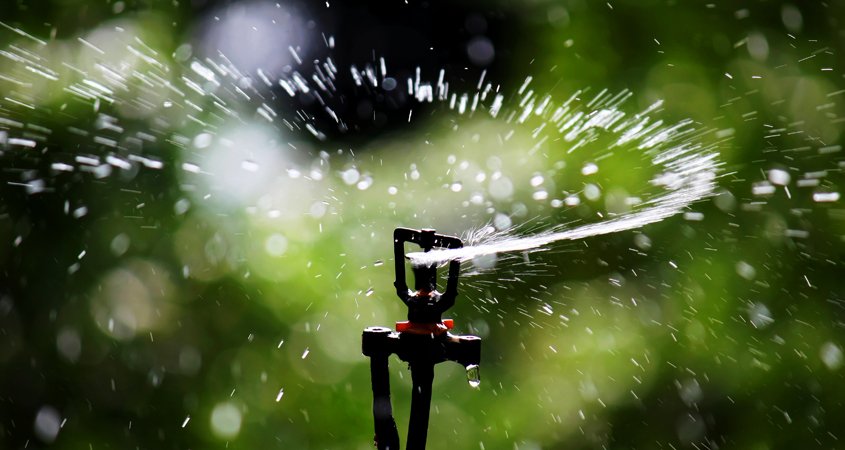
Don't allow your spriinklers to overspray your landscaping and waste water. Photo: Wikimedia irrigation tips

Don’t allow your sprinklers to overspray your landscaping and waste water. Photo: Wikimedia

Several things can be done to minimize runoff due to irrigation. This is among the most important factors in using irrigation efficiently.

  • Tune up spray irrigation systems, so there is no overspray on hard surfaces
  • Do not install spray irrigation in areas that are too narrow (generally eight feet wide or narrower)
  • Move spray heads 24 inches away from buildings or impermeable surfaces
  • Convent spray systems to micro or drip irrigation with pressure regulation and a filter
  • In lawn areas, be sure to follow the organic maintenance practices to keep your soil ‘spongy’ (link to soil post)
  • Replace standard overhead sprayers with high-efficiency rotator nozzles, or other types of low precipitation rate nozzles

This article is part of a year-long series inspired by the 71-page Sustainable Landscapes Program guidebook. The Water Authority and its partners also offer other great resources for landscaping upgrades, including free WaterSmart classes at WaterSmartSD.org.

Borrow Tree Watering Tips from Mother Nature

As drought continues to affect California, homeowners must balance two needs: preserving landscaping with irrigation while doing so as efficiently as possible to conserve water.

Even when not in a drought, trees planted in a Mediterranean climate often need additional water. For the most effective irrigation, mimic the way Mother Nature provides water.

Opinion: San Diego Should Be a Role Model on Water Conservation. Instead it’s Using More.

In July, Gov. Gavin Newsom called on Californians to voluntarily reduce their water use by 15 percent “through simple actions such as reducing landscape irrigation, running dishwashers and washing machines only when full, finding and fixing leaks, installing water-efficient showerheads and taking shorter showers.”

Turns out those suggestions weren’t enough, especially in San Diego.

State Allocates $50M to Fund Water Conservation Projects in Agricultural Centered Areas

Today local lawmakers toured the Kern Water Bank to see drought impact firsthand.

$50 million from the state budget is going to fund Assembly Bill 252, which calls for land repurposing all to focus on the drought and getting water flow back to where it matters.

Smart Landscape Irrigation Tips Save Water

During drought, it’s imore important than ever to conserve water used for irrigation. When you follow just a few smart landscaping irrigation tips, you can get the most from every drop of water applied to your landscaping.

Opinion: Yes, Southern California, We Have a Water Shortage Emergency Too

So Southern Californians didn’t decrease their water usage in July, despite Gov. Gavin Newsom’s request for a voluntary 15% cutback?

Well, of course not. The dusty lake beds, the dry spigots, the serious water-use cutback orders and the most frightening wildfires (so far, anyway) have been in Northern California, and that’s where Newsom focused his most dire warnings. He declared a drought emergency in Mendocino and Sonoma counties in April, expanded it to 41 counties in May, and then to 50 counties in July — but not Los Angeles, Orange, Ventura, San Diego, Riverside or San Bernardino counties. The Metropolitan Water District of Southern California warned of unprecedented shortages in Lake Mead and has launched an advertising campaign calling for increased conservation. But the MWD is the victim of its own success, in that it has done a superb job over the decades supplying enough water so that residents generally don’t think about shortages.

A Tiny Piece of Plastic Is Helping Farmers Use Far Less Water

On the bone-dry western flank of Arizona, where the Colorado River Basin meets the Mojave Desert, sit 11,000 acres of alfalfa, sorghum, wheat, and Sudan grass belonging to the Colorado River Indian Tribes (CRIT), all destined to be harvested and sold for animal feed. For anything to grow here, irrigation is a must. Less than a quarter inch of rain has fallen so far this year, according to Josh Moore, who manages the farm on behalf of his tribe.