Biden Administration Details Plans to Conserve 30% of US Land and Water by 2030
The Biden administration on Thursday outlined in a new report how it aims to achieve its goal of conserving 30% of America’s lands and waters by 2030.
At the monthly Mendocino City Community Services District meeting the board declared a Stage 4 drought. It also discussed the potential ramifications to the community as the surrounding areas and the state suffer through the second year of drought. It is common during dry years for residents within the district to refill their water tanks with water that is hauled in and purchased from the surrounding communities.
Gov. Gavin Newsom declared a drought emergency last month in Sonoma and Mendocino counties because of severe drop-offs in the winter rains that once had been counted on to fill reservoirs in the Russian River watershed, north of the San Francisco Bay Area. Like most other California reservoirs, those human-made lakes were built in the 20th century, an unusually wet period when compared with more than a thousand years of climate records reconstructed from studies of ancient tree rings and geological evidence.
San Diego County features many native canyons, and many homes are located in proximity to a native canyon. Native canyon hillsides near your home should not be disturbed. The more you can adapt your home’s landscaping to Nature’s landscaping, the healthier and more low maintenance it will be.
Your home may have been built on canyon slopes leveled or filled. When planting in previously disturbed or built slopes and hillsides, choose low-water use plants and trees, especially deep-rooted native plant species. Climate-appropriate plants with strong root structures are the best choices. Their powerful root systems can help hold your soil together.
Coarse compost and mulch can be applied directly to hillside and slope surfaces, providing protection from the force of rainfall and shading exposed soils, if your slope is gentle with a 33% grade or less. With occasional and gentle irrigation, mulch will “knit” together.
Compost blankets are another type of erosion control mat applied to the soil surface to protect and preserve it. They can be used alone, with coir mats or other organic-engineered material with biodegradable grids for stabilization. Mats allow water to penetrate through to the underlying soils while retaining loose soil and debris, preventing erosion. You can plant right through them, or use pre-seeded products.

Be sure your irrigation plan takes into account hills and slopes to prevent wasting water and erosion. Photo: Pixabay
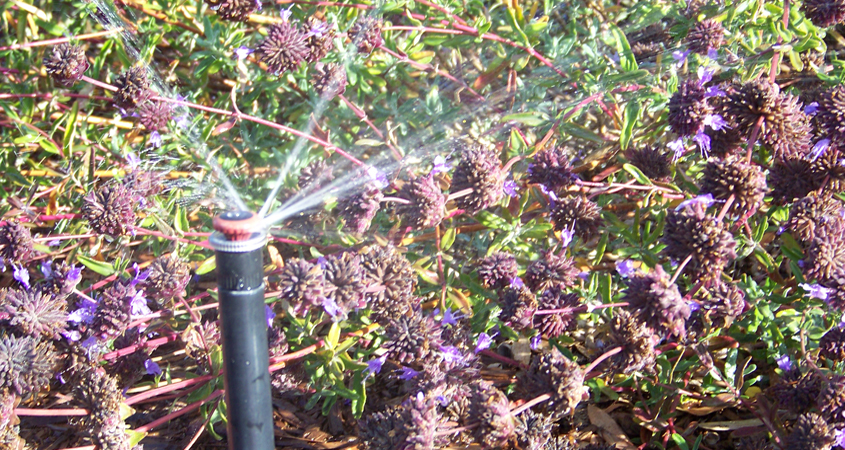
When preparing a hillside for planting, plan your irrigation before doing any work. Low-volume rotating spray heads are ideal for sloped areas, if the space is large and the groundcover is uniform. Inline emitter drip tubing can also be effective, especially for wider-spaced shrubs and trees.
Water can be applied in repeated short periods over the course of 24 hours so it can be fully absorbed between application times. Runoff, erosion, and efficient deep watering should be factored into all landscaping plans, but especially for hillsides.
NOTE: When using a drip irrigation system, emitters should be placed above the plant basin. Spray systems should have check valves in all lower heads to avoid low point runoff. Irrigation for the top of the slope and bottom of the slope should be on separate valves.
This article is part of a year-long series inspired by the 71-page Sustainable Landscapes Program guidebook. The Water Authority and its partners also offer other great resources for landscaping upgrades, including free WaterSmart classes at WaterSmartSD.org.

It has been a very busy few weeks in the water world, with the governor declaring a drought emergency in two Northern California counties and increased discussions across the West about how to manage water through a very dry year.
While the challenges are real in some parts of the state, I applaud Governor Newsom for taking a targeted, flexible, and iterative approach to drought management. This approach provides support for individual regions that are suffering from drought while also recognizing regions like San Diego County that have sufficient water supplies due to three decades of investments in supply reliability.
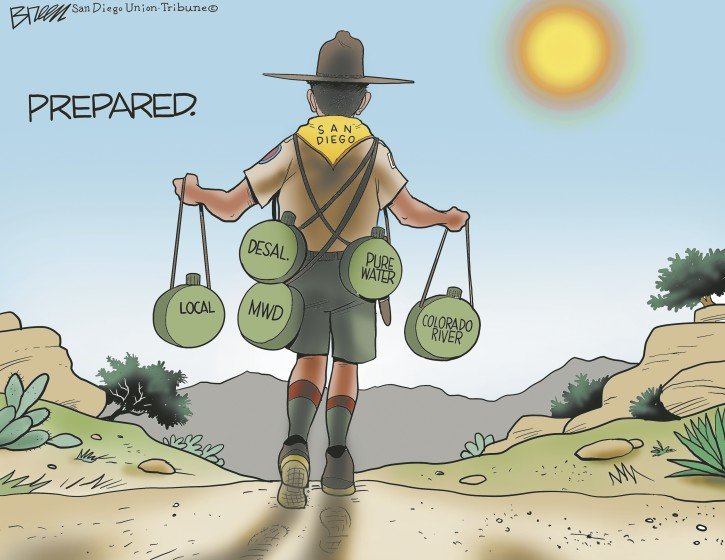
The governor’s Water Portfolio Strategy aligns with our region’s long-term investments in a diversified water portfolio, desalinated seawater, conserved water from Imperial County, local water-use efficiency measures, member agency recycled water and local supply projects, and increased water storage. It’s especially important to highlight the efforts of our ratepayers, who have cut per capita water use by nearly half since 1990. Because of those actions and others, our residents have enough water for 2021 and future dry years.
In addition, the innovative and resilient water supply portfolio created by the Water Authority and its 24 member agencies puts our region in a unique position to provide solutions that can help California weather this drought and future droughts – for instance, by storing water in Lake Mead. We look forward to working with the governor and his staff to collaborate on projects and programs where we can use our assets and experience to help areas that are hit hard by drought in the face of a changing climate.
Finally, I invite you to read my latest commentary in The San Diego Union-Tribune that addresses many of the issues being faced statewide and how that impacts San Diego County.
I hope you also take a moment to appreciate the cartoon in the U-T by Steve Breen, which perfectly captures our investments over the past three decades.

Increasingly ominous signs suggest that we are entering another multiyear drought in California. The State Water Project recently reduced projected water deliveries for 2021 from 10% of requested supplies to 5 percent, and on April 21, Gov. Gavin Newsom declared a regional drought emergency in the Russian River watershed in Northern California.
But it’s a different story in San Diego County.
After recently approving the Bay Area’s first widespread restrictions on water customers amid worsening drought conditions, officials with the Marin Municipal Water District will vote Tuesday on imposing more.
Mired in yet another drought that threatens drinking water, endangered species of fish and the state’s massive agriculture industry, Democrats in the California Senate on Thursday detailed a $3.4 billion proposal designed to gird the state for a new crisis on the heels of a deadly and disruptive pandemic.
The proposal would equal all of the state’s combined spending during the previous drought, which lasted from 2012 to 2016, according to the Legislative Analyst’s Office. That drought occurred after the Great Recession, when California routinely battled multibillion-dollar budget deficits and struggled to pay for state services.
While drought conditions are upon the Bay Area, water officials in Santa Clara County plan to draw from distant reserves for now and seek to increase storage and expand water recycling in the future.
Half of the water in Santa Clara County comes from somewhere else, sometimes hundreds of miles away.
There is dry dirt where water should be at Folsom Lake. A lack of wet weather is taking a toll on the state’s water supply.
Chris Orrock is a spokesperson for the California Department of Water Resources. He said while drought-like conditions are very common for the state, this year is worse than normal, especially considering back-to-back dry winters with little snow and rain.
“In fact, this year is a critically dry year,” Orrock said.
It is so dry, in fact, that DWR canceled Thursday’s snow survey at Phillips Station because there was not enough snow on the ground. Orrock said much of the lower elevation snow is already gone and some of the higher elevation snow is beginning to melt as well.