
Encinitas Landscape Transformation Project Wins Local Contest
Encinitas, Calif. — Olivenhain Municipal Water District’s Board of Directors honored at its July 14 meeting Ken and Susan Terzes as the winner of OMWD’s 2021 WaterSmart Landscape Contest.

Encinitas, Calif. — Olivenhain Municipal Water District’s Board of Directors honored at its July 14 meeting Ken and Susan Terzes as the winner of OMWD’s 2021 WaterSmart Landscape Contest.

As California experiences another drought cycle, homeowners in the San Diego region continue to makeover their landscapes with native plants that need less water. An Escondido couple recently transformed their landscape to save water and won the City of Escondido Landscape Makeover Contest too.
Escondido homeowners Michael and Teresa Everett first learned about the 2021 Escondido Landscape Makeover Contest from Escondido family-owned El Pantio Nursery. It was the motivation they needed to makeover their landscaping with native plants.
“As concerned Californians, we wanted to do our part to lessen our impact on San Diego county’s water resources,” said Teresa Everett. “We decided to switch to a waterwise landscape using all California native plants. Landscaping with native plants can reduce water usage by 60% or more. There is also a reduction in one’s carbon footprint as there is no need for mowing or trimming lawns.”
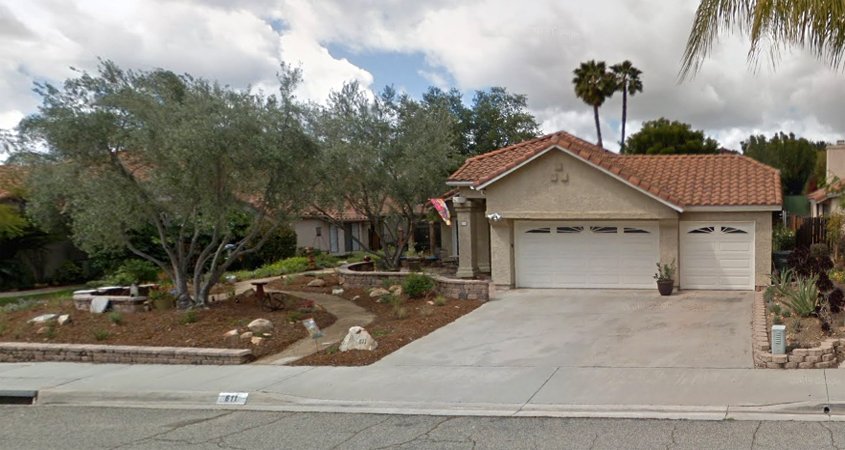
The Everett home before their landscaping makeover. Photo: Courtesy Michael and Teresa Everett
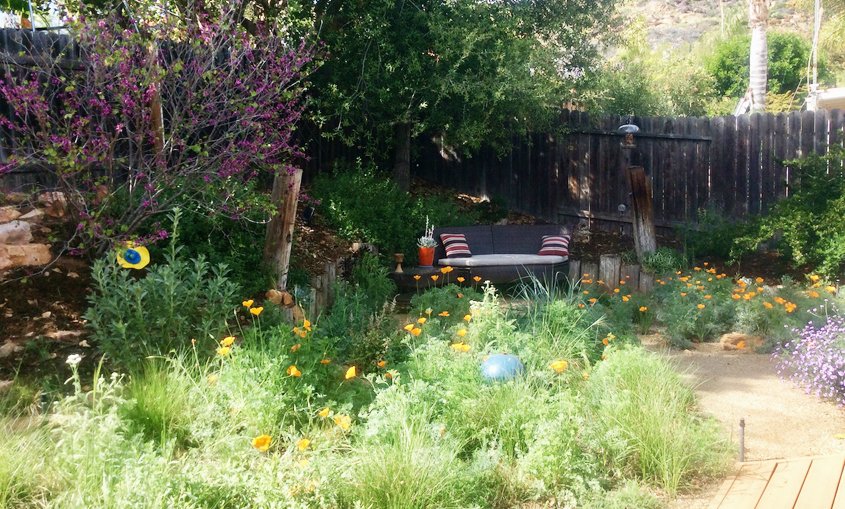
The new garden provides habitat for native insects, birds, animals, and people too. Photo: City of Escondido
The Everetts also reduced yard waste and the need for soil additives since California native plants are adapted to the lean clay soil in San Diego County.
While the environmental reasons were compelling, the Everetts also wanted to create a habitat garden that was both beautiful and supported the local ecosystem.
“California is in the top 25 most bio-diverse areas in the world,” the couple pointed out. “Our housing developments have crowded out native plants. Native plants have evolved to provide exactly the right food in exactly the right package to attract and feed the animals that are unique to our California environment.”
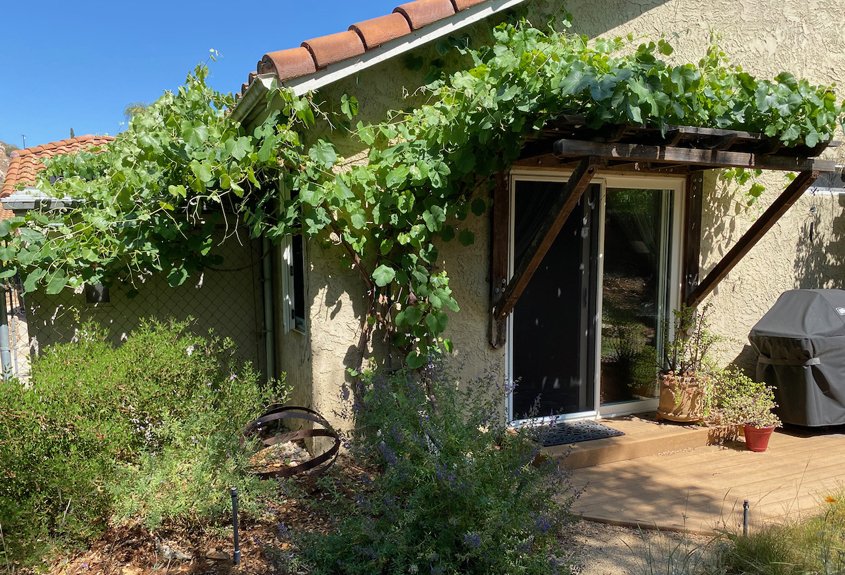
The Everetts’ landscaping shows how to create a lush yard and be waterwise. Photo: City of Escondido
The Everetts planted native trees, including Coastal live oak, Western sycamore, Western redbud, and Palo Verde Desert Museum. They added shrubs, including manzanitas, ceanothus, Mexican elderberry, salvias, desert mallow, and wooly bluecurls. California fuchsias, San Diego sunflowers, and Pacific irises add color. Grasses and vines round out the landscape palette.
“Ever since we re-landscaped, we have observed a huge increase in birds, lizards, butterflies, and other pollinators in our yard. Waterwise native gardens are also extremely beautiful,” said the couple.

Salvias and poppies provide color in the landscaping plan. Photo: City of Escondido
After the makeover, the Everetts rarely need to irrigate their landscape between late fall and late spring. During drier months, the landscape is irrigated twice monthly. The homeowners also maintain a vegetable and herb garden using rainwater collected in two rain barrels with 260-gallon capacity and by hand when necessary.
“We now spend many hours relaxing and bird watching in our yard,” said the Everetts. “Our outdoor space is now a much more enriching experience that gives us a greater sense of our connection to nature and a sense of place.”
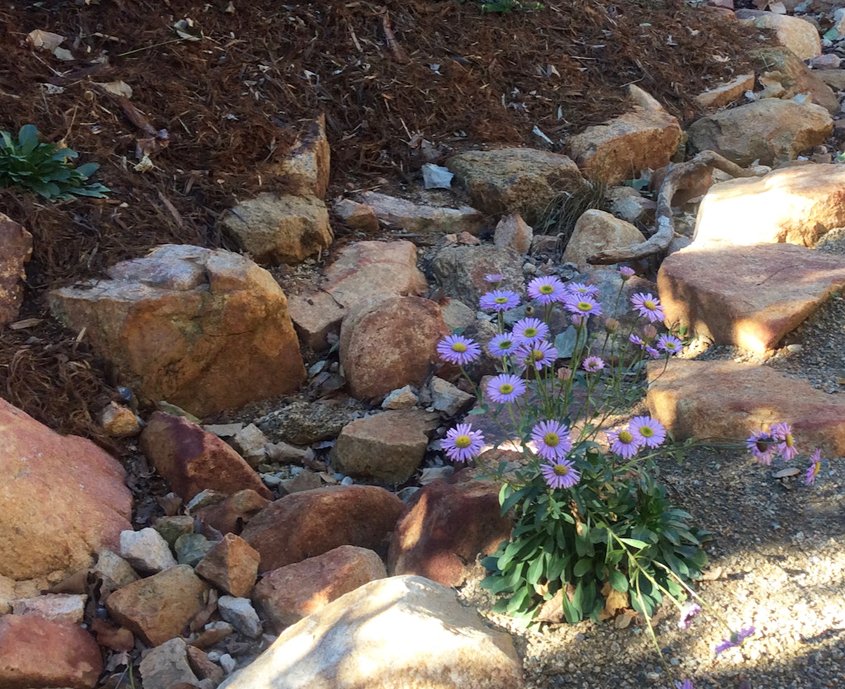
The landscaping plan includes features like this dry riverbed. Photo: City of Escondido
“By re-landscaping our small property, we hope to take one small step in restoring San Diego county’s rich biodiversity. Sharing the successes of our garden with others will hopefully encourage other homeowners to convert their gardens to water and habitat smart landscapes.”
Find tips on how to create a WaterSmart home and garden, including details on rebates: www.watersmartsd.org/
(Editor’s note: The City of Escondido is one of the San Diego County Water Authority’s 24 member agencies that deliver water across the metropolitan San Diego region.)
As California continues to face a drought brought on by record-breaking temperatures, Gov. Gavin Newsom is asking residents to reduce their water usage by 15%. However, this request does not apply to San Diego County.
Sandra Kerl, General Manager at the San Diego County Water Authority, joined KUSI’s Logan Byrnes on Good Evening San Diego to discuss what “America’s Finest City” is doing right.
Kerl explained that due to a “portfolio” of different water supplies and long-term conservation efforts, the city has enough water supply for now, despite the state’s drought.
On July 8, Gov. Gavin Newsom expanded two earlier drought emergency declarations to cover 50 of the state’s 58 counties. In May, he directed state agencies to consider easing requirements for reservoir releases to conserve water upstream, and to make water transfers easier. Both are needed.
Notably, the governor’s emergency proclamation did not impose water conservation mandates. Instead, Gov. Newsom is leaving water conservation to each region — a smart and necessary approach that incentivizes regional investments in water supply.
Emergency conservation orders address short-term water shortages, but don’t move us toward the long-term goal of drought resilience. That requires strategic investments in local drought-resilient water supply projects, costs mostly borne at the local level.
The state recently took a step in the right direction by approving $3.5 billion in budgeted funds for water projects, but the details of how that money will be used are still being worked out. It is important that funds are directed to local drought-resilience projects. That would go a long way toward accelerating the 21st-century water solutions we need.
Consider our two regions: Sacramento and San Diego. We both have dry summers, but our water supplies are very different.
San Diego’s water comes from locally developed and imported water sources. Sacramento’s supplies come from nearby rivers fed by snowmelt and groundwater. That’s why we’ve chosen to solve our water supply challenges very differently.
El Cajon homeowner Christine Laframboise’s water-saving landscape design trading turf for a less thirsty approach was named the Otay Water District’s 2021 WaterSmart Landscape Contest winner.
The annual contest is held by water agencies throughout San Diego County to award one resident from their respective service area for their water-saving landscape. Otay selected Laframboise for her well-thought-out design, plant selection, maintenance, and methods for efficient irrigation.
Gov. Gavin Newsom’s call for all Californians to reduce their water use by 15 percent amid a severe drought across most of the state won’t be met with the same urgency in San Diego County as elsewhere because of a decades-old effort to diversify water supplies here and because of a new court order.
Last month, the U.S. Supreme Court unanimously declined a legal challenge by Imperial Valley farmers that had the potential to threaten the San Diego County Water Authority’s access to Colorado River supplies. This is why San Diego County is being asked to conserve but is not one of 50 counties in the state subject to Newsom’s stricter drought decrees.
Eric Richins looked out from his pontoon boat to the shallows on the lake’s western edge. He squinted and paused as if he had come upon a foreign shore. For the first time in a career navigating the waters of the American West, he didn’t know where he was.
“I could have sworn I was here just six weeks ago catching smallmouth and bigmouth bass,” said the 35-year-old fisherman who runs tours on this 247-square-mile basin where the Colorado River meets the Hoover Dam to form the nation’s largest reservoir.
He pointed ahead to what looked like dozens of tiny steps made from successive layers of dried mud now covered in tall grass and weeds — the effect of rapidly creeping vegetation over a shoreline that has been dropping by nearly a foot a week.
“Now it looks like a lawn. I knew the drought was bad. I didn’t realize it was this bad,” he said. “This place is unrecognizable.”
In the face of rapidly worsening drought conditions this week, Gov. Gavin Newsom urged all Californians to voluntarily cut their water usage by 15% — but what exactly does that mean for the average California household?
The governor made his plea Thursday as he extended a regional state of drought emergency to 50 counties, comprising about 42% of the state’s population. For many, the talk of water reductions reminded them of the shriveled lawns, attenuated showers and water-bucket toilet flushing of the last devastating drought.
It also prompted some to wonder just how much more water Californians can conserve, since they continue to use substantially less water than they did before the 2012-2016 drought.

El Cajon homeowner Christine Laframboise’s water-saving landscape design trading turf for a less thirsty approach was named the Otay Water District’s 2021 WaterSmart Landscape Contest winner.
The annual contest is held by water agencies throughout San Diego County to award one resident from their respective service area for their water-saving landscape. Otay selected Laframboise for her well-thought-out design, plant selection, maintenance, and methods for efficient irrigation.

Christine Laframboise greatly reduced her water use and costs by removing the old lawn. Photo: Otay Water District
“We are proud to have customers like Christine who are committed to outdoor water-use efficiency and can demonstrate the many attractive features that homeowners can incorporate into their WaterSmart landscapes, especially at a time when California is facing drought conditions,” said Otay Board President Tim Smith. “We encourage customers to take advantage of our free resources and rebates to help with their landscaping needs.”
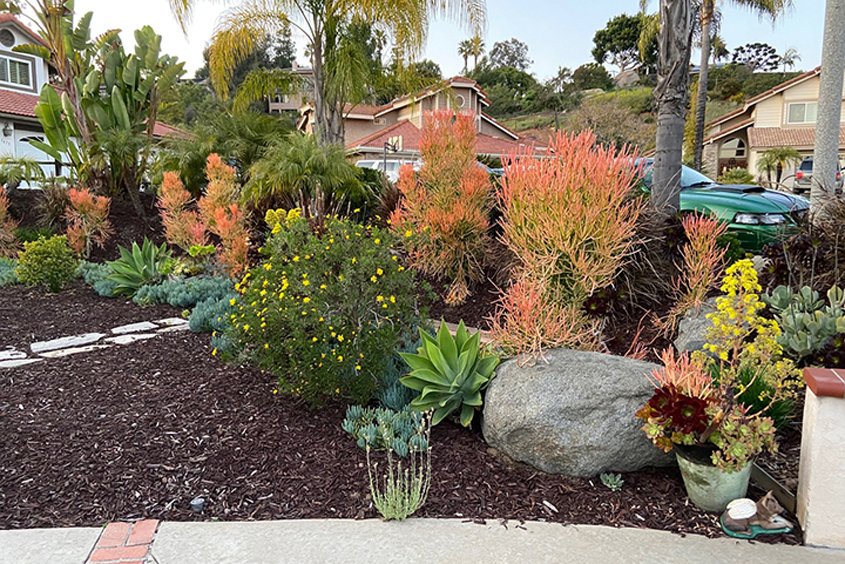
The new landscaping replaced turf with waterwise plants. Photo: Otay Water District
Thirsty lawn once covered Laframboise’s 1,895-square-foot front yard. Its upkeep required large amounts of water. In 2014, she took landscaping classes presented by the San Diego County Water Authority’s WaterSmart Landscape Makeover Program.
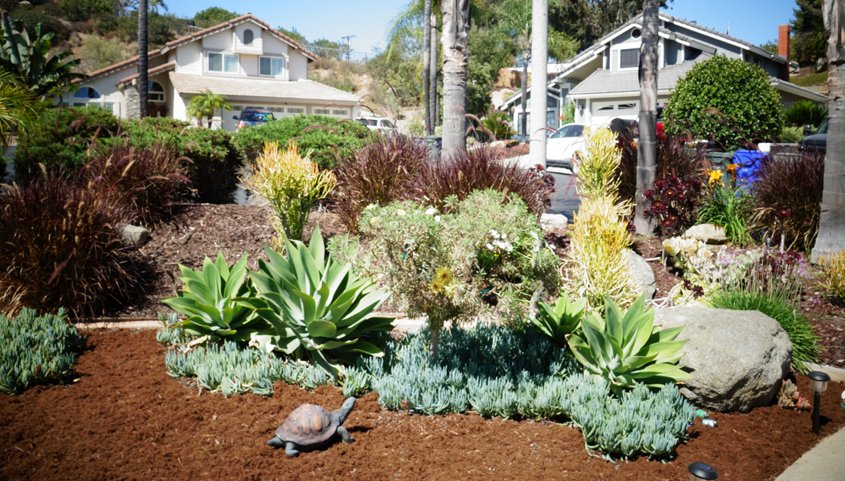
The new landscape now includes a drip-irrigation system, rotating nozzles, and a smart irrigation controller to schedule efficient water use. Photo: Otay Water District
Equipped with a new landscape plan, Laframboise enlisted the help of her husband and son to remove all the grass responsibly. She installed water-wise features such as mulch, stone, and low-water-use plants.
Her landscape now includes a drip-irrigation system, rotating nozzles, and a smart irrigation controller to schedule efficient water use. The El Cajon homeowner decreased her overall water use by an average of 42%. She waters only two or three times a week and especially enjoys the pollinators attracted to her new yard. She can maintain it on her own and no longer needs a lawnmower.
Laframboise’s project qualified for a $2,140 rebate from the Water Authority’s WaterSmart Turf Replacement Program.

The new landscaping continues to evolve with new features. Photo: Otay Water District
“My yard evolves as I learn more about different plants and where I live locally. I recently replaced dyed wood chips for shredded redwood bark. It is safer for pets, children, and wildlife,” said Laframboise. “I also plan to add more natives to attract more wildlife and further reduce my water use.”
The Otay Water District Board of Directors recognized Laframboise at its July 7 meeting with a certificate, a gift certificate to a local nursery of her choice, an “Award-Winner” yard sign to display, and other promotional items.
(Editor’s note: The Otay Water District is one of the San Diego County Water Authority’s 24 member agencies that deliver water across the metropolitan San Diego region.)
Although Southern California is not included in the state’s drought-emergency proclamation, Gov. Gavin Newsom Thursday urged residents across the state to voluntarily cut their water use by 15% amid worsening conditions across the West Coast.
He also called on businesses to slash their water use. According to the governor’s office, a 15% cut in water use would save 850,000 acre-feet of water — enough to supply more than 1.7 million households for a year.
Newsom said residents have responded to drought conditions before, and he was confident they would take steps again to ease their water use.