You are now in News Supply & Demand category.

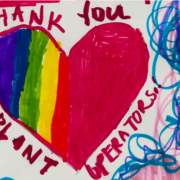
Artwork from Colton, age six, thanking the ten Carlsbad desalination plant workers sheltering in place to maintain operations. Courtesy: Poseidon Water Community Thanks Desalination

Community Thanks Desalination Plant Workers For Sacrifice

Expressions of gratitude and support have poured in from a grateful community to the ten volunteers sheltering in place at the Claude “Bud” Lewis Carlsbad Desalination Plant in San Diego County. As people learned about their effort to maintain plant operations and keep the water flowing during the COVID-19 pandemic, residents responded by expressing their heartful thanks through messages, photos and artwork.

“The desal plant employees were overwhelmed with the community support they have received,” said Jessica Jones, Poseidon Water director of communications. “They read and enjoyed every message, photo, and drawing.  The support was just the boost in morale that they needed to finish out their 21-days onsite.”

The on-site crew has sustained plant operations and maintenance since March 19 to ensure continued production of high-quality drinking water, in compliance with all state and federal drinking water standards.

Messages and artwork shared with the workers
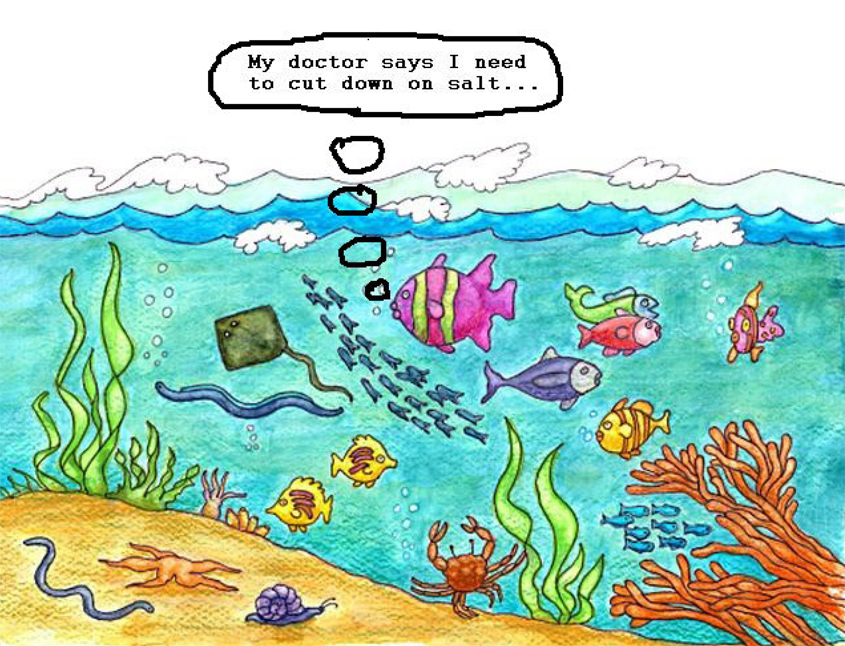
Lori, a resident of Rancho Carlsbad, put her artistic skills to use with this entertaining thank you. Courtesy: Poseidon Water

Rachel Welland, Bay Park: “Each day I think about how crucial our water supply is, as we are all quarantined in our houses. I appreciate what you are all doing to keep us hydrated during these crazy times!”

Lucy Lusk, South Carlsbad: “Well I will never take that water that comes out of the faucet for granted again. Thanks for volunteering to stay at the desal plan to keep it running, we are grateful to you for your service to our community.”

Diane, Spring Valley: “Thank you for providing us clean water. I know how important your job is, because when I was growing up in the Philippines, there was no water, and we have to buy water by the drum. I’m sure your loved ones miss you terribly.”

The Adams Family including Mom, Dad, and three kids ages 7, 10, and 12: “Thank you for your personal sacrifice serving the surrounding communities. Water is precious. Water is life. Thank you for committing to keep our water safe and available.”

Kids put their talents to work

Kids got out their paintbrushes, pens, and even sidewalk chalk to let the workers know how much they were appreciated.

Miles Antoine, age 7, Chula Vista: “Thank you for helping everything grow!”
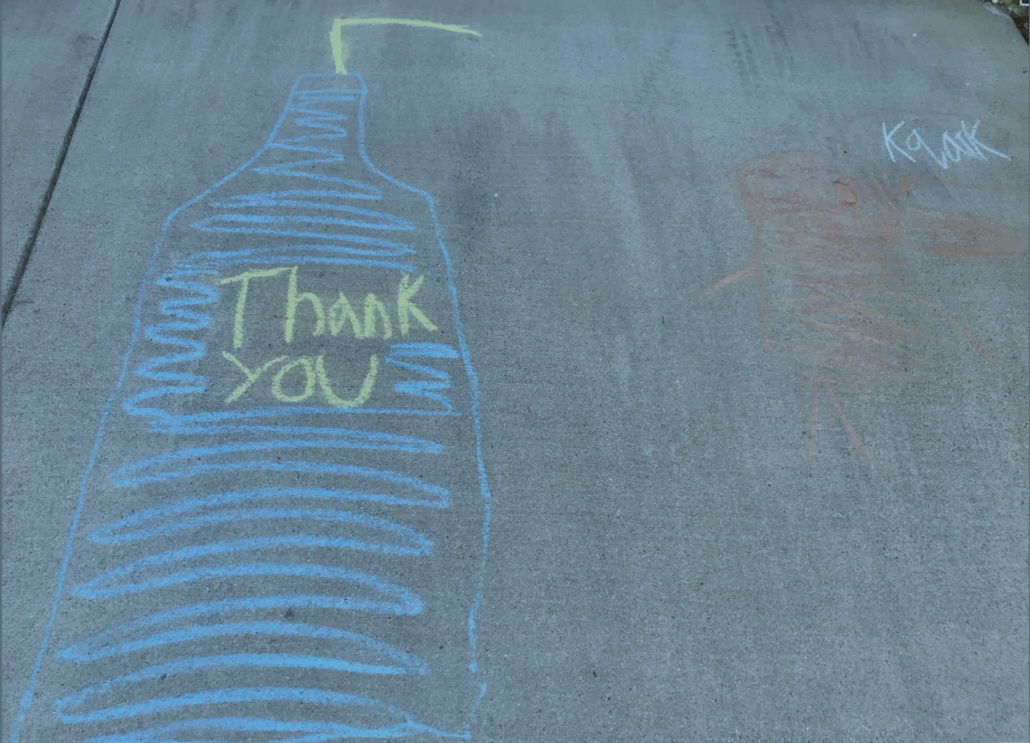
Miles Antoine, age 7, Chula Vista: “Thank you for helping everything grow!” Courtesy: Poseidon Water

Dylan, age 21 months, Carlsbad: “Thank you for helping provide us fresh water.”
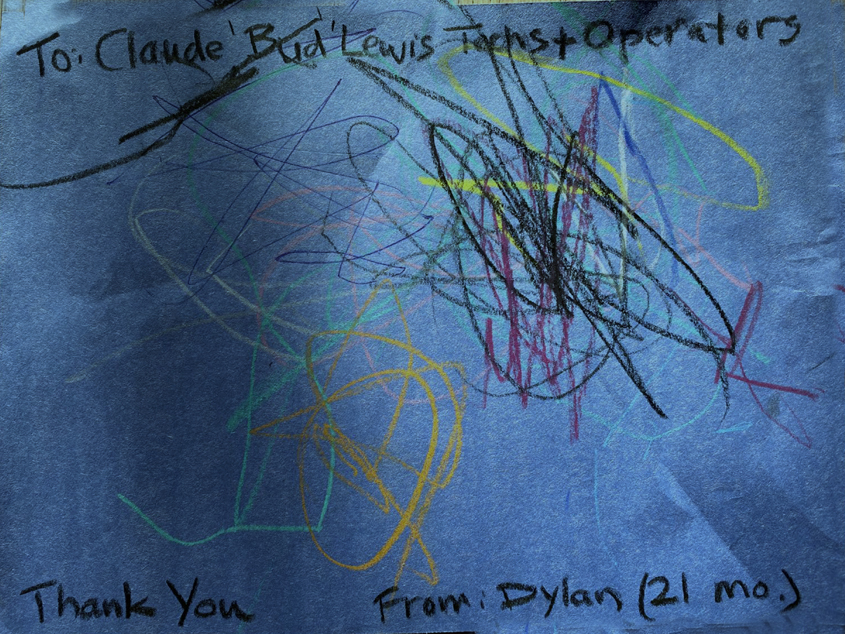
Dylan, age 21 months, Carlsbad: “Thank you for helping provide us fresh water.” Courtesy: Poseidon Water

Zoe, age 10, Encinitas: “Thank you for being away from your families and keeping our water safe.”
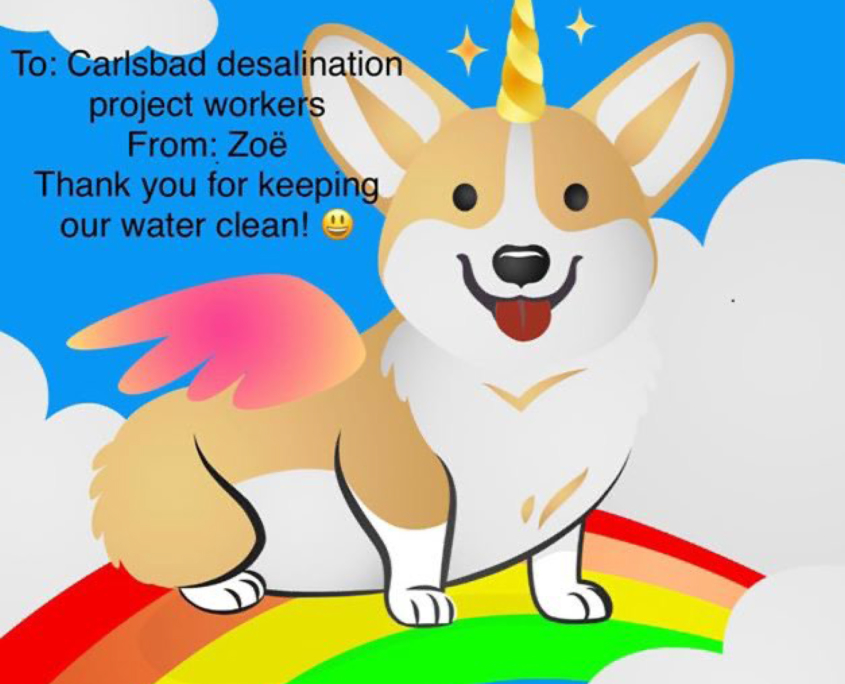
Zoe, age 10, Encinitas: “Thank you for being away from your families and keeping our water safe.” Courtesy: Poseidon Water

Colson Hanson, age 6, Scripps Ranch: “Thank you for the hard work and staying at the plant so we have clean water.”
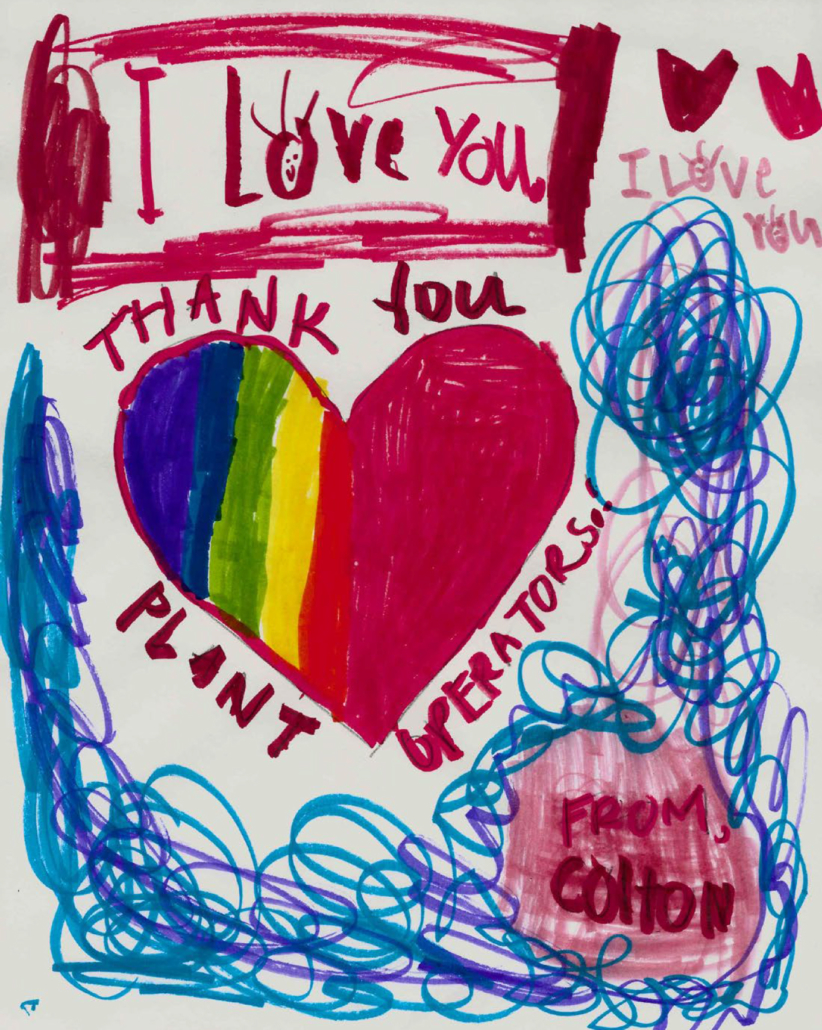
Colson Hanson, age 6, Scripps: “Thank you for the hard work and staying at the plant so we have clean water.” Courtesy: Poseidon Water

Heartwarming expressions of thanks

One resident was moved to write a poem for the desal plant workers.

Samantha, Carlsbad:

“Claude ‘Bud’ Lewis Desal Operators and techs showing some grace,

Changing your lives to Shelter in Place.

Missing your families and your comfortable bed,

I hope the City of Carlsbad keeps you well fed.

Toiling with coworkers for 12 hour shifts,

I only imagine there could be some rifts.

50 million gallons per day you give,

Without this water we could not live.

How long to stay? The time isn’t clear,

For your courage and hard work, I send you good cheer!”

Happy puppy

A 10-month old pup in Little Italy named “Archie Moore” had his owner provide a photographic thank you.
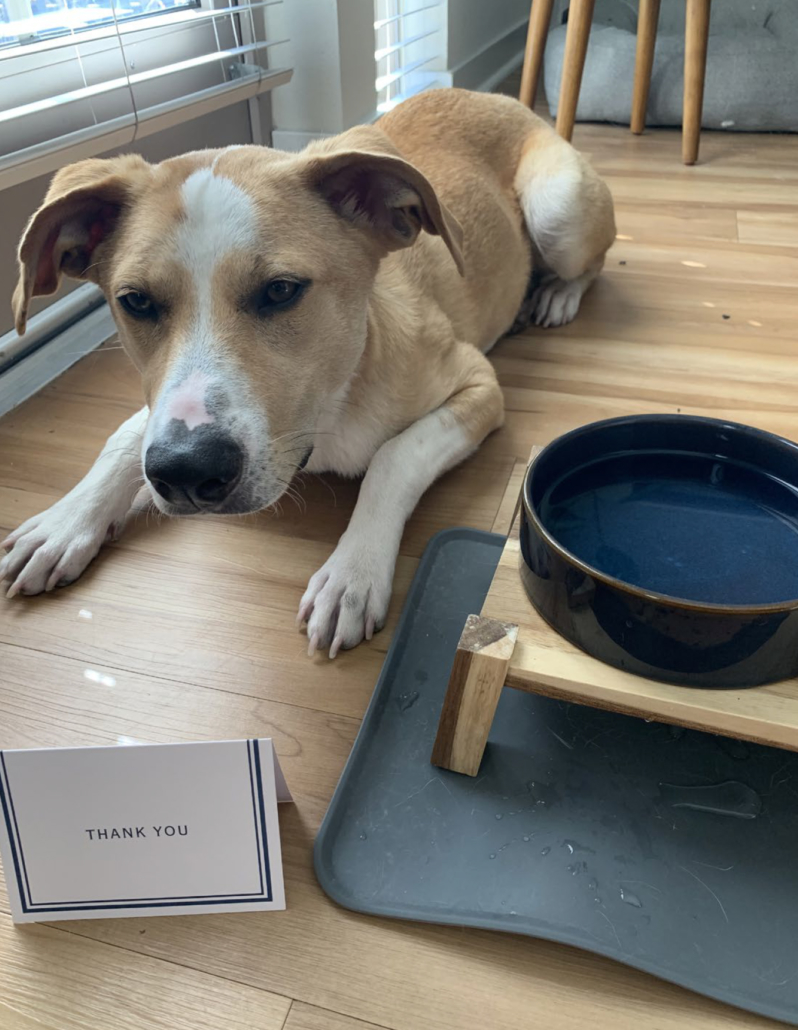
With a little help from his owner, this happy pup is thankful for a full water dish. Courtesy: Poseidon Water

Yen Linh Huynh, California: “Our hearts go out to you at the desal plant. It’s heroes like you that give humanity hope for a better day. Thank you from this family of 4.”

Barbara Blash, Oceanside: “Thank you so much for your efforts to keep our little corner of the world turning. Hope my small note will generate a warm smile until the time when a heartfelt handshake or hug will be delivered.”

Paul Maxwell, San Diego: “Hey Operators I’m a Paramedic in San Diego and you are my hero! Thanks for stepping up!”

Martie Hatcher, Carlsbad: “Please let your families know that they are so appreciated for this gift of you. I know they really miss your hugs, smiles, laughter and company!! On behalf of my husband and I, ‘Tussen tac,’ Norwegian for ‘a thousand thanks!”‘

Melanie, Carlsbad: “The world is better for having people like you in it.”

Another group of employees stands ready to relieve the ten workers later this week when their 21-day commitment ends.

The San Diego County Water Authority purchases up to 56,000 acre-feet of water from the Carlsbad plant per year – enough to serve approximately 400,000 people annually. The plant is a major component of the Water Authority’s multi-decade strategy to diversify the county’s water supply portfolio and minimize vulnerability to drought or other water supply emergencies.

Anza-Borrego Desert Research Center-Sicco Rood-March-2020-WNN water supply

Water Supply Diversification Overcomes Dry Winter

No ‘March Miracle’ for snow and rain in California, but the San Diego County Water Authority has diversified water supply sources to weather the boom-and-bust cycle of California winters.

March brought abundant precipitation throughout California, but not enough to offset a dry February. Most large urban water agencies in the state maintain a reliable water supply in wet and dry years.

“California’s climate variability is why a water resilience portfolio is needed to provide a safe and plentiful water supply,” said Goldy Herbon, Water Authority senior water resources specialist. “Whether a wet or dry year, the Water Authority and its 24 member agencies have successfully diversified water sources to ensure a reliable supply to meet the needs of the region’s 3.3 million people.”

The supply sources include water from the Claude “Bud” Lewis Carlsbad Desalination Plant, where ten workers volunteered to live on-site to keep the water flowing during the coronavirus pandemic.

Lindbergh Field has received 9.76 inches of rain – or 108% of normal – from October 1, 2019 – April 2, 2020. Many areas in the San Diego region received snow in March, including the Anza-Borrego Desert State Park.

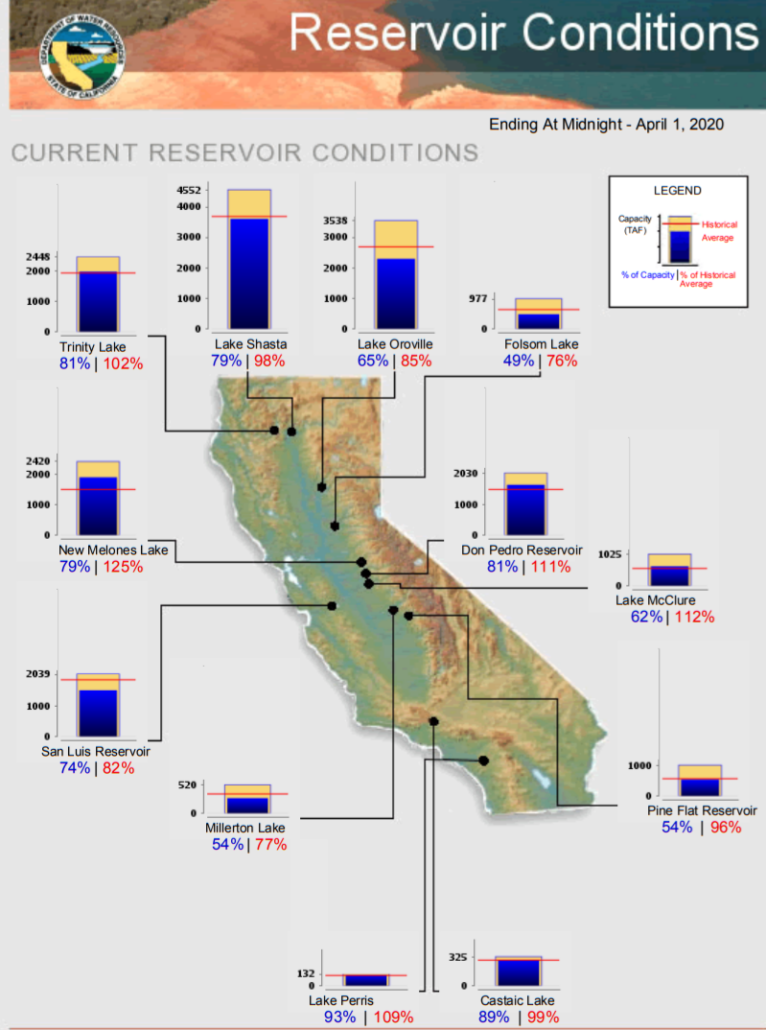
Even with a lackluster winter, the state’s six largest reservoirs hold between 82% and 125% of their historical averages for April 1, according to the California Department of Water Resources. Lake Shasta is 98% of its historical average and is at 79% of capacity.

Major California Reservoirs-April 1 2020-WNN-CA DWR graphic

The Department of Water Resources April 1 conducted the fourth manual snow survey of 2020 at Phillips Station near Lake Tahoe. The manual survey recorded 43.5 inches of snow depth and a snow water equivalent (SWE) of 16.5 inches, which is 66% of the April average for this location.

The SWE measures the amount of water contained in the snowpack, which provides a more accurate forecast of spring runoff. Measurements from the 130 electronic snow sensors, scattered throughout the state, indicate that the statewide snowpack’s water equivalent is 15.2 inches, or 53% of the April average.

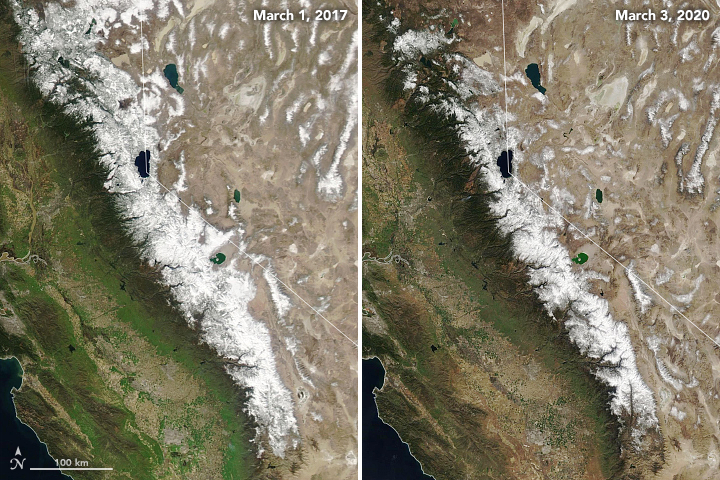
Sierra Nevada Snowpack Comparison-NASA satellite image-WNN-April 2020

The natural-color satellite images above, acquired by the Moderate Resolution Imaging Spectroradiometer (MODIS) instruments on NASA’s Terra and Aqua satellites, show the area covered by snow in March 2020 compared to March 2017 (a record high year). Graphic: NASA/NASA JPL

“While today’s survey results show our snowpack is better off than it was just last month, they still underscore the need for widespread, wise use of our water supplies,” said DWR Director Karla Nemeth. “California’s climate continues to show extreme unpredictability, and February’s record dryness is a clear example of the extremes associated with climate change.”

On average, the snowpack supplies about 30% of California’s water needs as it melts in the spring and early summer, the state agency reported in news release.

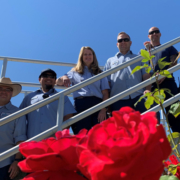
(L to R) Vallecitos Water District employees at the Meadowlark Water Reclamation Facility: Ivan Murguia, Arturo Sanchez, Dawn McDougle, Chris Deering, Marc Smith, and Matt Wiese. Photo: Vallecitos Water District employees

Customer Thanks Vallecitos Water District Employees for Their Efforts

Most Americans take a safe and reliable water supply for granted. Dedicated water and wastewater professionals, including Vallecitos Water District employees, work to provide a secure, plentiful supply of drinking water.

Vallecitos Water District customer Manisha Bambhania has a deeper appreciation. A native of India, Bambhania grew up in a home where running water was only available three hours per day, and sometimes much less.

Bambhania frequently posted favorable comments on Vallecitos Water District Facebook posts. “She would commonly write words like, ‘We all need to conserve, regardless of the drought,’ or ‘Thank you for all you do. We are so grateful for the services you are providing,’” said Public Information Representative Lisa Urabe.

“After more than a year of continued praise from Manisha, the public information staff reached out to her to thank her in person for her comments,” said Urabe. “We met at her house where she proceeded to tell us her story of growing up in India. Even though she lived in an upper middle-class neighborhood, water scarcity and lack of reliable water and wastewater infrastructure was a very real part of daily living.”

Vallecitos staff created a video to share Bambhania’s story about the work of Vallecitos Water District employees.

Vallecitos Water District employees ‘inspired’

Vallecitos employees viewed the video at a recent all-staff meeting. One of those employees is Dennis Richardson, who has worked for the agency the past 13 years.

“I thought it was incredible for a customer to actually thank the employees for the jobs that they do, and also to give us her past life experience of living in India and the importance of the water to the community,” said Richardson. “I was really inspired by her video.”

Other staff were also pleased at the positive remarks for their work.

“We all enjoy our jobs, and take great pride in what we do in serving the public,” said Shawn Askine, a water systems supervisor. “We’re happy citizens recognize the hard work we do providing clean reliable water to your tap everyday.”

The original video featuring Manisha Bambhania has also won statewide recognition from the California Water Environment Association Film Festival.

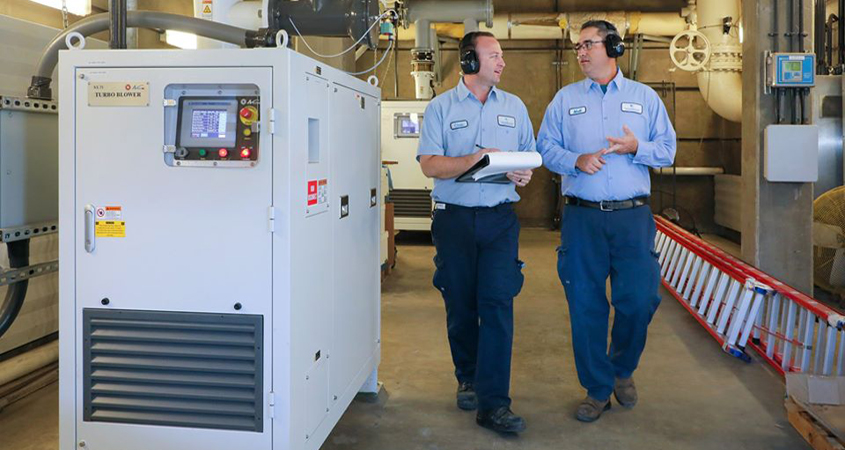
Vallecitos Water District waterwater technicians Chris Deering and Matt Wiess at the Meadowlark Water Reclamation Facility. Photo: Vallecitos Water District employees

Vallecitos Water District wastewater technicians Chris Deering and Matt Wiess at the Meadowlark Water Reclamation Facility. Photo: Vallecitos Water District

Carlsbad Desalination Plant-WNN-primary

Water Utilities Aim to Keep Specially Trained Employees Healthy and Working

Some municipal water utilities are taking emergency measures to sequester some employees to assure that they can keep the water flowing as the coronavirus spreads.

In this country, millions of Americans can follow advice to stay at home so long as the electricity stays on and the water and the phone service. Utility workers need to keep moving about. And to stay on the job, they also need to stay safe. Iowa Public Radio’s Clay Masters reports that some utilities are taking extraordinary measures, including locking in employees at work.

Water utilities take special steps to keep water flowing

MASTERS: I’m standing next to Fleur Drive, which leads into downtown Des Moines. And normally, this is a pretty busy road. It’s not right now because, well, a lot of businesses are shut down. And right next to it is the Des Moines Water Works treatment facility. And what’s different about the grounds right now is that there are 10 campers just parked out front on the lawn.

Water treatment process effective

TED CORRIGAN: At our three treatment plants, we have a total of 21 people who will be living onsite 24/7 in those campers that we’ve placed.

MASTERS: That’s Ted Corrigan. He’s the interim CEO for the Des Moines Water Works that provides drinking water for more than half a million customers. He says they’ve gone deeper into their contagious disease response plan than ever before.

CORRIGAN: But the treatment process is unchanged. It’s unaffected by what’s going on. And it is very effective against viruses, to be sure.

MASTERS: Behind the tall, barbed wire fence, a skeleton crew of operators is doing things like running the control centers and testing the water. Kyle Danley heads water production here. He’s part of the crew that’s putting in at least 12 hours a day before leaving the facility and walking to his isolated camper for the night. He says while some of the workers aren’t used to camper life, the utility can’t take the risk that they get sick. And he says most of the jobs require unique skills and licenses.

KYLE DANLEY: We’re in a specialty field. There’s always a shortage of operators throughout the country, trying to get people interested in this field, but it certainly is something that takes months and years to be able to get those licenses needed. And then just even if you have a license, every plant is specific.

Workers sequester-in-place at Carlsbad Desalination Plant

MASTERS: After two weeks, a new group of workers with the same set of skills, who are currently sitting at home, will switch with the current onsite crew. Something similar is happening at a desalination plant in Carlsbad, California, that produces 50 million gallons of water a day. Ten workers are living there for three weeks. Sandy Kerl is general manager for the San Diego County Water Authority.

SANDY KERL: “These are critical services, highly trained individuals, not easily replaceable, so they have to be protected to ensure that water continues to flow.”

COVID-19: Water Associations Reassure Public Tap Water Safe to Drink

As the global COVID-19 outbreak continues to develop and reports of bottled water shortages make headlines, the National Association of Water Companies, the American Water Works Association and the Association of Metropolitan Water Agencies recently issued a joint statement about the quality of tap water in North America.

According to the U.S. Environmental Protection Agency, America’s drinking water supplies remain a safe and affordable way to access the water needed for drinking, cooking and maintaining personal hygiene during the COVID-19 outbreak.

COVID-19 is not present in drinking water supplies

Americans and Canadians can and should continue to use and drink water from their tap as usual as COVID-19 is not present in drinking water supplies. Disinfection processes like those practiced by water systems across the North America provide protection that includes filtration and disinfection of our surface water supplies and disinfection of our ground water sources. These treatments are effective in removing and/or inactivating viruses.

Efforts by some to profiteer off of bottled water shortages are inexcusable, but drinking water consumers can avoid being taken advantage of by simply using the water that is available in their homes from the tap.

“America’s water companies share a deep understanding of the importance of the reliability of quality water and wastewater services in our daily lives and during a public health crisis and are committed to taking steps to help ensure our water systems are functioning both reliably and safely,” says NAWC President and CEO Robert Powleson.

COVID-19 response efforts by water providers protect public health

The municipalities and private companies that make up the 51,000 community water systems across the U.S. are taking measures to help protect their workforce so they can continue to keep the water flowing during the COVID-19 pandemic.

This means limiting home repair visits and directing customers to pay bills online instead of coming into their water providers’ offices. Because of the outbreak and the need for access to clean water in order to promote personal hygiene and overall public health, many systems across the United States are suspending shutoffs for nonpayments. If you are facing financial difficulty and cannot afford to pay your water bill at this time, please be in direct contact with your water provider.

“Water utilities throughout the United States and Canada are prepared to protect public health in normal conditions and in emergencies, and they are committed to keeping safe water flowing, 24/7,” says AWWA CEO David LaFrance. “During times like these, safe and reliable water service is essential for drinking and food preparation, hand-washing and carrying away waste.”

‘Challenging times’

As COVID-19 response efforts evolve to meet the needs of the American and Canadian people, the member organizations represented by NAWC, AWWA and AMWA will continue to support the water systems by offering all of the water profession’s expertise and resources at their disposal. The agencies added that they’re confident in their ability to serve communities across the country with the highest level of efficiency, empathy and professionalism.

“These are challenging times for our nation, but despite the many uncertainties regarding COVID-19, Americans should take comfort in the fact that the virus does not spread through drinking water supplies. The nation’s water systems remain committed to the uninterrupted delivery of clean and safe drinking water for the duration of this crisis,” says AMWA CEO Diane VanDe Hei.

Imperial Valley farming-Holtville-coronavirus-WNN-2020

Imperial Valley Farmers Step Up Harvesting During Coronavirus Pandemic

With the world struggling through the impacts of the coronavirus pandemic, vegetable growers in the Imperial Valley are continuing to harvest vegetables.

Agriculture remains an essential service to serve California, the nation and the world. The vegetable harvest is ongoing as the Imperial Valley heads toward the final weeks of the winter vegetable crops.

“We have not to this point been impacted,” said farmer Scott Howington, president of the Imperial Valley Vegetable Growers Association. Howington’s farm operation, Oasis Farming Inc., focuses on organic crops.

But Howington said for his own operation, food safety protocols already in place are even more critical in light of the coronavirus.

More precautions for Imperial Valley harvest

When it comes to agriculture, he said, the farming work that goes into the planting of crops typically does not bring workers physically close together; it is the harvesting where there could be potential issues because of the proximity of the crews. That is where additional precautions are necessary due to the coronavirus. Howington said farmers are tailoring these steps to their specific operations.

“What we are doing is making sure the equipment is sanitized several times a day, and we are making sure crews keep the recommended distance from each other,” he said. “We are trying to make sure crews stay healthy.”

However, if workers and staff are feeling sick, they’re told to stay home or are sent home if they come to work and present any signs of illness, Howington said.

Scott Howington-Imperial Valley Vegetable Growers Association-

Imperial Valley farmer Scott Howington, president of the Imperial Valley Vegetable Growers Association. Photo: San Diego County Water Authority

Vegetable farmers navigate through coronavirus

Precautions to make sure staff are healthy are equally important in other aspects of agriculture, including at the coolers where crops are stored, he said.

“It’s an interlocked chain,” said Howington. “You break any part of it, and it will begin to be an issue.”

So far, there have been no noticeable impacts on the vegetable industry in the Imperial Valley.

With the harvesting season still underway, the need for workers — many of them from Mexico — remains high. Howington pointed out that while there are restrictions on border crossings, those restrictions have not involved people crossing to work in the agriculture industry. Under the new conditions, crews from Mexico have been able to cross with just their work permit. But in case his workers need additional proof, Howington said he’s having letters prepared from his company to provide to crews.

Imperial Valley agriculture harvest helps feed world

For now, harvesting will continue into its final weeks of the season, and all food safety protocols are continuing to be followed.

Howington reminds everyone to follow their own safety protocols as they normally should do, from washing their fruits and vegetables, to peeling away top layers of the vegetables they eat.

“Everyone has to use their best judgement,” he said of both farmers and consumers.

As the world navigates through these challenging times and faces a shortage in supplies of basic necessities, the importance of agriculture takes on even greater meaning as consumers look to grocery stores and restaurants for some certainty that food supplies will remain available.

Howington said there has been no reduction in the produce grown and harvested in the Imperial Valley in the wake of the coronavirus. He said the valley continues to provide food that feeds people around the world.

“As a community, something like this does brighten the light on the impact agriculture has to the fabric of the economy and our society,” Howington said. “We are just doing what we normally do.”

Olivenhain Municipal Water District Logo landscape design workshops

OMWD Welcomes Entries in 2020 WaterSmart Landscape Contest

Encinitas, CA—Olivenhain Municipal Water District invites residents with water-efficient gardens to enter the 2020 WaterSmart Landscape Contest. The winning landscape will receive $250. The deadline to apply is April 27, and applications are available at www.landscapecontest.com

San Diego Food Bank-Virtual Food Drive-San Diego County Water Authority

Water Authority Partners with San Diego Food Bank to Fight Hunger

In addition to ensuring a safe and reliable water supply, the Board leadership of the San Diego County Water Authority is joining regional efforts to fight the economic impacts of the pandemic by setting up a virtual food drive in partnership with the San Diego Food Bank 

The San Diego Food Bank helps feed hundreds of thousands of hungry people each year – and the numbers are growing rapidly as economic impacts of coronavirus closures ripple across the region.

The Water Authority’s virtual food drive allows donors to select and purchase items such as canned meats, vegetables, fruits, peanut butter and oatmeal for distribution to needy residents.

Donate to San Diego Food Bank 

The Jacobs & Cushman San Diego Food Bank and its North County Food Bank chapter comprise the largest hunger-relief organization in San Diego County. The Food Bank distributes food to those in need at 200 distribution sites across the county as well as through 500 nonprofits with feeding programs.

Monetary donations received by the Food Bank will be used to purchase food items to be given to those in need.

Virtual food drive during coronavirus pandemic

The virtual food drive is part of an overall effort by the Water Authority during the coronavirus pandemic. The Water Authority and its 24 member agencies have increased regional coordination and communication to ensure the coronavirus pandemic does not impact safe and secure water service for San Diego County.

Public water supplies in the San Diego region remain safe to drink due to numerous robust treatment processes used by local and regional water providers.

To support continued operation of critical infrastructure, the Water Authority has activated its Emergency Operations Center, increasing the region’s ability to respond to any challenges that emerge.

The EOC supports the need for enhanced communication between the Water Authority and its member agencies as the public health crisis evolves. In addition, the agencies have back-up plans to assist each other should key personnel be unable to work.

Water Authority Board of Directors Meeting Will Be Streamed Online

To help protect public health, the monthly Board meeting will be a virtual meeting only – no Board members, member agency staff or members of the public will be able to attend the meeting in person at our Kearny Mesa headquarters. The meeting can be accessed electroncially by going to this web link: https://www.sdcwa.org/meetings-and-documents and then clicking the link below “Live Stream” on the right side of the page. 

Carlsbad Desal Plant Aeria-Coronavirus-WNN-March-2020 primary

Carlsbad Desalination Plant Workers Self-Isolate

In an effort to ensure continuity of operations, ten volunteers are sheltering in place at the Claude “Bud” Lewis Carlsbad Desalination Plant in San Diego County. Poseidon Water‘s Jessica Jones shares this inspiring story of selfless dedication to keeping the water flowing.

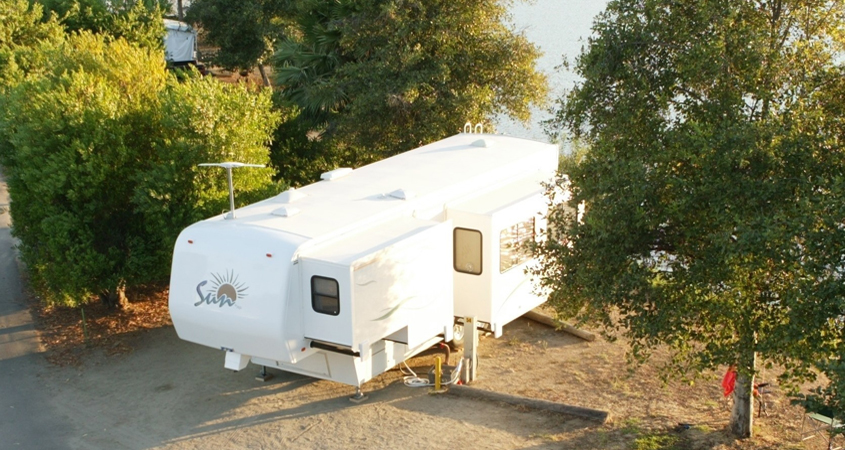
“They did volunteer to operate the plant on-site for 21 days,” said Jones. “There were ten recreational vehicles brought in, so each worker has their own RV and food is delivered for them without human contact.”

With the COVID-19 pandemic, Poseidon Water decided to take this step to ensure there is uninterrupted production and delivery of safe and reliable water for San Diego County.

Ten workers, 12-hour shifts, 21 days

The on-site team will sustain plant operations and maintenance for the duration of the 21-day period to ensure continued production of high-quality drinking water, in compliance with all state and federal drinking water standards.

The plant normally operates with 42 employees. She says the ten workers are able to operate the entire plant.

“They’re doing the job of quite a few people,” Jones told WaterWorld.

The three-week period started Thursday, March 19, the first day of spring. Jones said another group of employees are ready to relieve the ten workers during or after the 21 day period if needed.

Jones said the ten employees are working 12-hour shifts. The interview with Jones is part of WaterWorld Magazine’s on-going coverage of COVID-19.

Ten volunteers shelter in place at the Claude “Bud” Lewis Carlsbad Desalination Plant

Watch the interview between Jessica Jones and WaterWorld Editorial Director Angela Godwin here: https://bit.ly/33K5HbU

The San Diego County Water Authority purchases up to 56,000 acre-feet of water from the Carlsbad plant per year – enough to serve approximately 400,000 people annually.

The plant is a major component of the Water Authority’s multi-decade strategy to diversify the county’s water supply portfolio and minimize vulnerability to drought or other water supply emergencies.