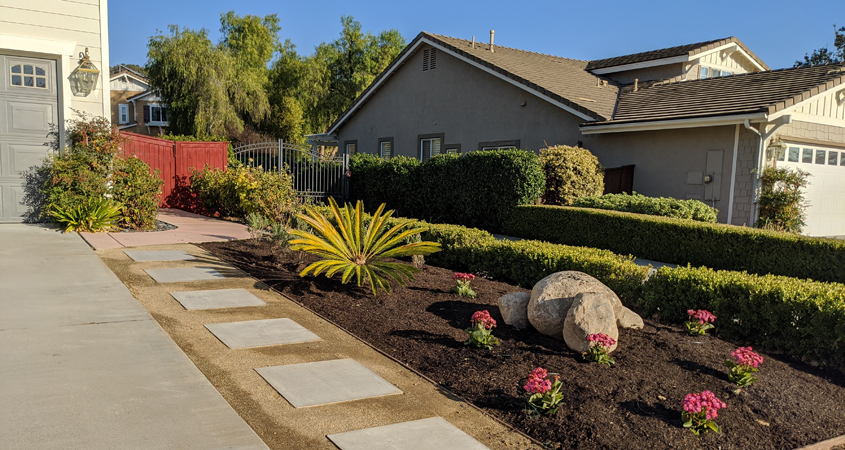
Vallecitos Water District Development Services Coordinator Eileen Koonce transformed the front yard at her new home into a beautiful water-efficient design with help from the San Diego County Water Authority’s Landscape Makeover Program.
As a new homeowner, when Koonce received her first water bill, she decided to figure out a way to reduce her water bill and her water usage. She realized the thirsty lawn covering the front yard had to go.
“As an employee of the District, we are always talking to customers about how they can reduce water use in their landscape, and what better time to put that theme to use than in my own yard,” said Koonce.
https://www.waternewsnetwork.com/wp-content/uploads/2024/04/WNN-Horizontal-White-Blue2.png00Mike Leehttps://www.waternewsnetwork.com/wp-content/uploads/2024/04/WNN-Horizontal-White-Blue2.pngMike Lee2020-03-02 08:20:342020-03-11 12:57:23Vallecitos Water District Employee Leads By Example With WaterSmart Landscaping Makeover
Vallecitos Water District Development Services Coordinator Eileen Koonce transformed the front yard at her new home into a beautiful water-efficient design with help from the San Diego County Water Authority’s Landscape Makeover Program.
As a new homeowner, when Koonce received her first water bill, she decided to figure out a way to reduce her water bill and her water usage. She realized the thirsty lawn covering the front yard had to go.
“As an employee of the District, we are always talking to customers about how they can reduce water use in their landscape, and what better time to put that theme to use than in my own yard,” said Koonce.
Homeowner Eileen Koonce discovered watersmart landscaping can be colorful and attractive. Photo: Vallecitos Water District
Koonce said she enjoyed working with the instructors.
“They bring the language down to the do-it-yourselfers,” she said. “They walk you through every part of it and if you have questions, they can help you out. You feel empowered because you can understand the process.”
Koonce tackled most of the design work herself with the help of instructors, who are licensed landscape architects. They also helped Koonce pick out the plants and choose an irrigation system.
She also applied for a turf rebate through the Metropolitan Water District’s Turf Rebate Program. Koonce said the application process was easy for her to follow, and she met all the criteria for acceptance into the program.
Video tour of Eileen Koonce’s new landscaping
New landscape a pollinators’ paradise
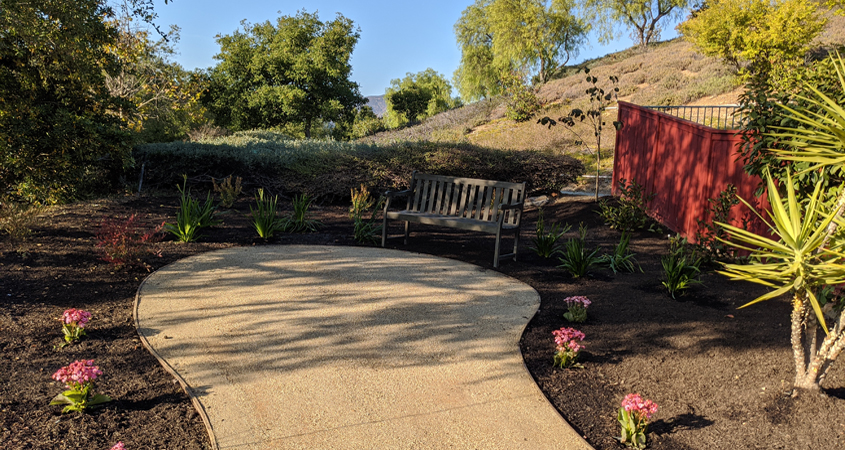
Koonce wanted a garden that would attract butterflies and birds, especially hummingbirds. She says her top takeaway from the WaterSmart course is how many attractive landscape options exist. Many beautiful, flowering plants do not require a lot of water.
“The WaterSmart Landscape Makeover Series is a great way to gather the skills needed to make your front yard transformation happen,” said Michelle Landis, course instructor and Registered Landscape Architect. “The WaterSmart Landscape Makeover Series also teaches the skills needed to tap into the new, local turf removal rebates. We invite you to join us for one of the sessions above to transform your front yard into money-saving, WaterSmart design.”
Koonce said she realizes a $70 per month savings on her water bill since her landscape makeover. And no longer spends time mowing a lawn.
Register now for workshops and class series
Eileen Koonce says she was able to install her own landscaping with the help she received from instructors. Photo: Vallecitos Water District
The WaterSmart education program offers free three-hour workshops and a four-class landscaping makeover series. Three-hour workshops are scheduled on weeknights and Saturdays from March through October.
The four-class series is currently enrolling participants for March in Encinitas and in El Cajon. The series is also open in Oceanside and San Diego in April. Find participation requirements and register for the free series online at WaterSmartSD.org.
https://www.waternewsnetwork.com/wp-content/uploads/2020/02/VWD-Landscaping-path-845X450.jpg450845Gayle Falkenthalhttps://www.waternewsnetwork.com/wp-content/uploads/2024/04/WNN-Horizontal-White-Blue2.pngGayle Falkenthal2020-02-29 13:07:542020-02-29 14:42:40Vallecitos Water District Employee Leads By Example With WaterSmart Landscaping Makeover
To protect its employees, members of the public, and the environment from any accidental chemical releases or exposure, the Vallecitos Water District has established its own internal Hazardous Materials Response Team or HAZMAT team.
https://www.waternewsnetwork.com/wp-content/uploads/2024/04/WNN-Horizontal-White-Blue2.png00Mike Leehttps://www.waternewsnetwork.com/wp-content/uploads/2024/04/WNN-Horizontal-White-Blue2.pngMike Lee2020-02-24 15:27:132020-02-28 10:00:20Vallecitos Water District HAZMAT Team Ready to Respond
To protect its employees, members of the public, and the environment from any accidental chemical releases or exposure, the Vallecitos Water District has established its own internal Hazardous Materials Response Team or HAZMAT team. Maintaining its own internal team allows a 24-hour response capability.
Common hazardous chemicals play vital roles in the water and wastewater industry for disinfection and odor control. They are also used in fueling and maintaining agency vehicles, generators, pumps, and motors.
A HAZMAT team is an organized group of professionals who receive special training to handle hazardous materials or dangerous goods. A HAZMAT team responds to oil, chemical and other liquid spills, industrial and military explosions and accidents during transportation, and similar incidents.
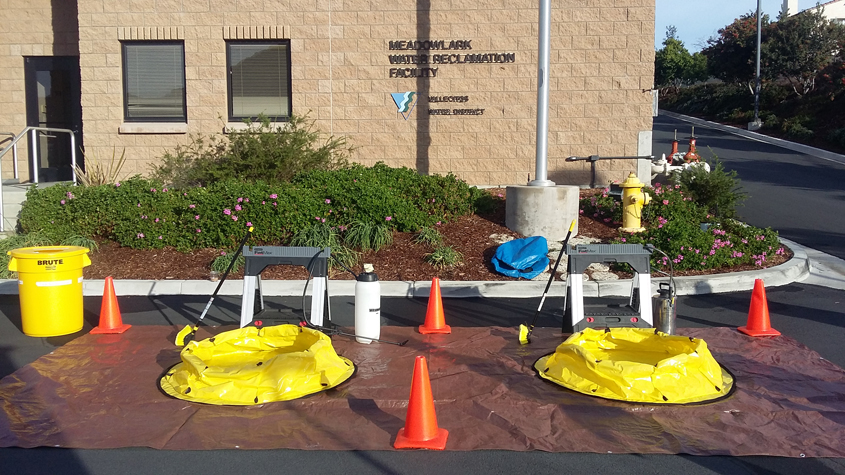
Decontamination equipment is ready to treat HAZMAT team personnel following exposure to toxic chemicals. Photo: Vallecitos Water District
The Vallecitos Water District HAZMAT team consists of 20 members from different departments. They complete U.S. Occupational Safety and Health Administration Hazardous Waste Operations and Emergency Response training, which provides a set of guidelines regulating hazardous water waste operations and emergency services in the U.S.
When an emergency call requires HAZMAT team response, individual members move from their regular job assignments to the HAZMAT Response Trailer. The team then mobilizes to the site of the emergency.
HAZMAT team protects people and the environment
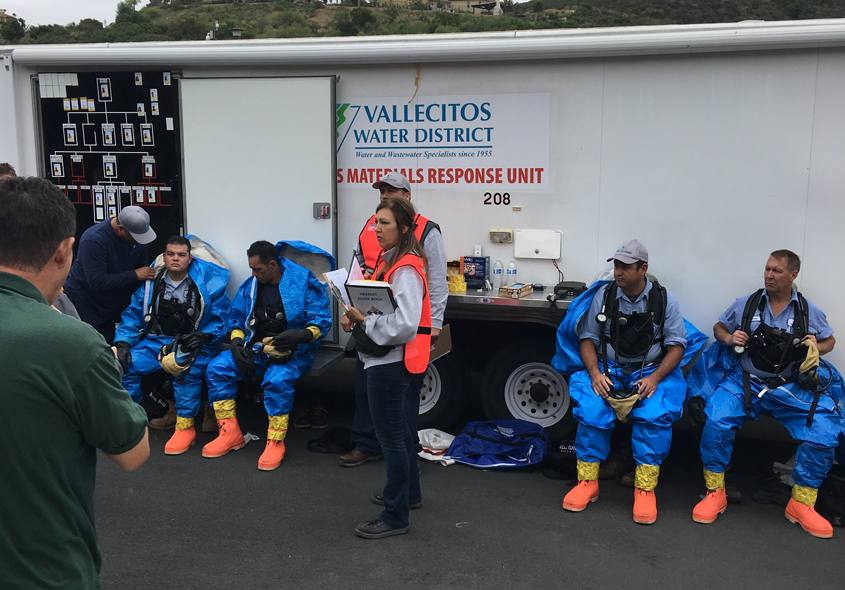
Vallecitos Water District HAZMAT team members conduct a debriefing after a training drill. Photo: Vallecitos Water District
“It’s a great honor just knowing we’re here to protect people in the surrounding areas, to protect the environment, and to know we’re here to jump into action in case there’s an issue,” said Matthew Wiese, senior plant operator at the Meadowlark Treatment Facility. “We’ve trained and we’ve gone through scenarios. Being able to act with confidence, it’s a great thing to be a part of that team.”
Vallecitos Water District HAZMAT team members wear specialized personal protective equipment and clothing to make safe entries into potentially hazardous areas. If a leak or spill of chemicals occurs, the HAZMAT team uses specialized tools and equipment to identify, and stop the release and spread of any contamination as quickly as safely possible.
Team members conduct monthly drills on common scenarios.
“If there was a release of chlorine gas which we use to conduct our wastewater treatment activities, we have specialized equipment and materials to lock down those cylinders so we can stop the release,” said Trisha Woolslayer, risk management supervisor. “We practice on a regular basis so we react quickly if an accidental release were to occur.”
Watch video of a recent training exercise.
Following each exercise, all team members hold a debriefing to discuss their observations, and how procedures might be improved.
Woolslayer said swifter response times and cost savings offset the investment in training and equipment by the District.
“It allows us to respond quickly, to stop whatever spill it is and protect the environment,” she said. “There are also cost savings. We spend on training and equipment, but it is a small amount compared to having a response contractor on call.”
https://www.waternewsnetwork.com/wp-content/uploads/2020/02/VWD-Hazmat-Decon-845X450.jpg450845Gayle Falkenthalhttps://www.waternewsnetwork.com/wp-content/uploads/2024/04/WNN-Horizontal-White-Blue2.pngGayle Falkenthal2020-02-24 08:34:392020-02-24 08:34:39Vallecitos Water District HAZMAT Team Ready to Respond
Mission Hills High School student Jordan Chan of San Marcos won third-place in the statewide 2020 California Special Districts Association video scholarship competition. The “Districts Make The Difference” contest is designed to promote public awareness and understanding of the special districts providing communities with essential services like water, sanitation, healthcare, fire protection, and parks.
Chan received his $500 scholarship prize at the February Vallecitos Water District board meeting. He received recognition from state legislators and CSDA representatives. Chan was honored with a proclamation from San Marcos Mayor Rebecca Jones, and certificates of recognition from the offices of State Senator Brian Jones and State Assemblywoman Marie Waldron.
Mission Hills High School student Jordan Chan of San Marcos won third-place in the statewide 2020 California Special Districts Association video scholarship competition. The “Districts Make The Difference” contest is designed to promote public awareness and understanding of the special districts providing communities with essential services like water, sanitation, healthcare, fire protection, and parks.
Chan received his $500 scholarship prize at the February Vallecitos Water District board meeting. He received recognition from state legislators and CSDA representatives. Chan was honored with a proclamation from San Marcos Mayor Rebecca Jones, and certificates of recognition from the offices of State Senator Brian Jones and State Assemblywoman Marie Waldron.
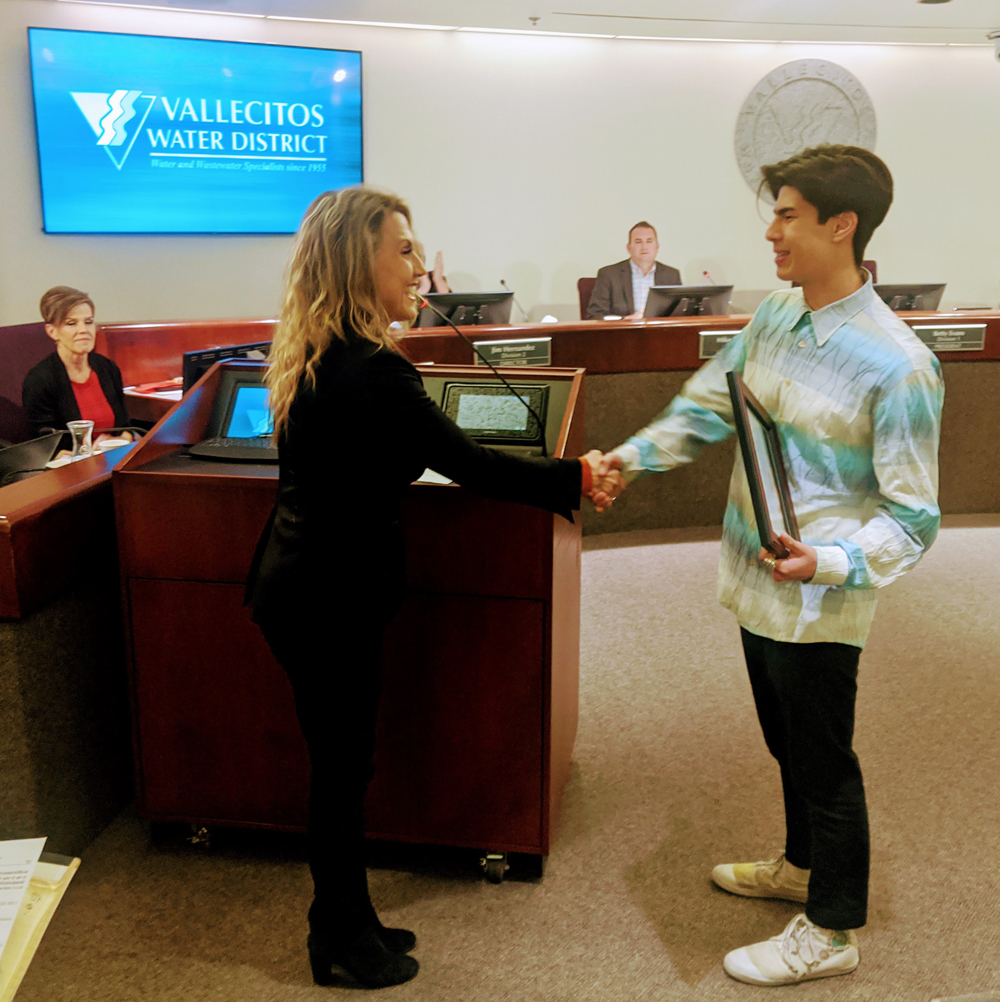
San Marcos Mayor Rebecca Jones presents winner Jordan Chan with a certificate of appreciation at the Vallecitos Water District’s February board meeting. Photo: Vallecitos Water District
“Jordan is clearly a talented young Californian whose academic career the California Special Districts Association is proud to support,” said Kyle Packham, CSDA advocacy and public affairs director. “Jordan’s video will raise awareness and understanding of the special districts serving our community and encourage other students like him to become more civically engaged.”
Chan’s video showcased his skill and creativity by using a Wild West time travel theme to illustrate the importance and variety of special districts serving San Marcos and other communities throughout California, which includes the Vallecitos Water District.
Watch Jordan Chan’s CSDA winning video here.
CSDA’s statewide “Districts Make the Difference” video contest encourages high school and college students to learn about the local governments serving their classmates and families. Students were challenged to create a 60 to 90-second video highlighting how special districts have enhanced the lives of Californians through the delivery of local services and infrastructure to their community.
Students throughout California participated in the 2020 contest. Entries were scored by CSDA officials based on four criteria: accuracy and effectiveness, creativity and originality, production quality, and entertainment value. The five videos with the highest overall scores competed for public votes at the Districts Make The Difference website, where all the winning videos are posted.
In addition to Chan’s third-place win, Erubiel Monterosa of Bakersfield won first place, and Maryam Aslam of Sacramento placed second.
“Districts Make the Difference” is a public outreach campaign sponsored by CSDA to increase public awareness and understanding of special districts and promote civic engagement.
https://www.waternewsnetwork.com/wp-content/uploads/2020/02/Chen-VWD-172206-845X450.jpg450845Gayle Falkenthalhttps://www.waternewsnetwork.com/wp-content/uploads/2024/04/WNN-Horizontal-White-Blue2.pngGayle Falkenthal2020-02-12 06:42:512020-02-14 15:31:08San Marcos Student Jordan Chan Wins Statewide Video Contest
A new pipeline inspection tool being used by contractors working for the Vallecitos Water District to determine pipeline integrity could become a standard tool saving time and money.
After nearly completing construction in 2008, developers walked away from the 500-acre High Point subdivision in the City of Escondido. Water facilities installed for the subdivision were left unused for ten years.
A new pipeline inspection tool being used by contractors working for the Vallecitos Water District to determine pipeline integrity could become a standard tool saving time and money.
After nearly completing construction in 2008, developers walked away from the 500-acre High Point subdivision in the City of Escondido. Water facilities installed for the subdivision were left unused for ten years.
Two developers CalWest and TrueLife Communities recently decided to complete the project. They approached Vallecitos to determine what is needed to complete water service.
The mains for the project, made of ductile iron pipe, had not been used for ten years. Vallecitos needed to determine the condition of the pipes. Infrastructure Engineering Corporation and subcontractor PICA Corporation are now testing and assessing the integrity of the water main including the pipeline appurtenance (blow-offs, air vacs, and fire hydrants) connections to the main pipeline.
Early damage detection prevents pipeline failures
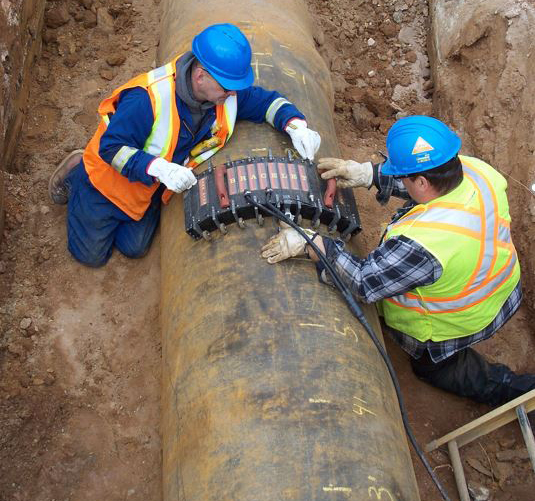
A pipeline’s condition is assessed to determine its condition before being put into service in the Vallecitos Water District. Photo: Vallecitos Water District
Several processes are included in the High Point Pipeline Assessment project. Crews insert a tool developed by PICA Corporation called a “SeeSnake” into the pipeline, and data indicates the condition of the pipes. The SeeSnake uses an electromagnetic method on iron pipes, which can “see” past cement mortar, epoxy, or polyethylene lining to detect and size any corrosion damage to the iron structure of the pipe itself.
The SeeSnake tool is pulled through the pipe at 17 feet per minute, delivering data as the inspection is being performed in real-time. The technology helps expedite information, saving time and costs by accelerating the process without sacrificing attention to detail. Vallecitos is then able to assess the pipeline’s wall thickness, potential iron loss, and any other anomalies to determine the condition of the existing pipeline.
See video demonstrating the SeeSnake pipeline assessment.
“Good decisions start with good information,” said Kris Embry, PICA regional manager. “Our ultimate goal in testing this new system is to quickly and efficiently secure accurate condition assessment information, allowing the Vallecitos Water District to address any weak links and prevent potential pipeline failures long before they happen.”
When the inspection is completed, the repair process begins.
Two water pipelines are being inspected for the condition analysis, one running along Woodland Heights Glen starting at Briar Patch Glen, and one running along Elderwood Glen, totaling approximately 3,067 feet. The larger 2,300 feet section of pipe is near the District’s existing Palos Vista.
Preventive measures save water and costs
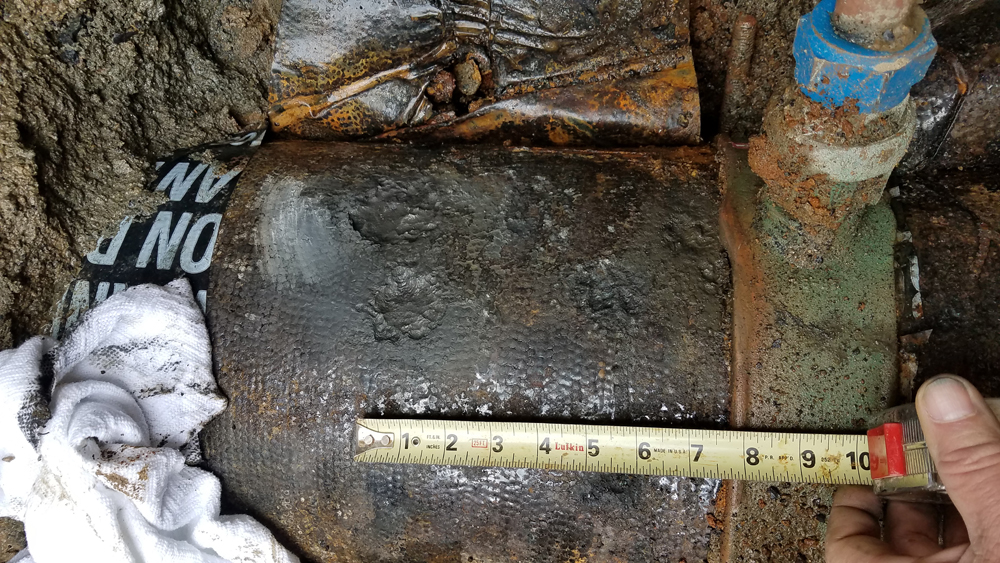
Over time, pipelines are exposed to corrosion from aggressive soils, electrical currents, damage to coatings or linings, physical force, or other factors. Photo: Vallecitos Water District
Over time, pipelines are exposed to corrosion from aggressive soils, electrical currents, damage to coatings or linings, physical force, or other factors. The result could be a pipeline break which could case other infrastructure damage, interruption to water service, a loss of water, or monetary losses.
When an inspection finds corrosion, the affected section of iron pipeline is isolated, removed, and replaced by PVC pipe. Because iron pipelines can be susceptible to corrosion from multiple causes, they are no longer installed in the Vallecitos Water District.
The inspection found two badly corroded areas of pipeline and excavations verified the accuracy of the data. The Vallecitos Water District continues testing the new process and the accuracy of the data to determine whether to adopt the new technology for future working pipeline assessments.
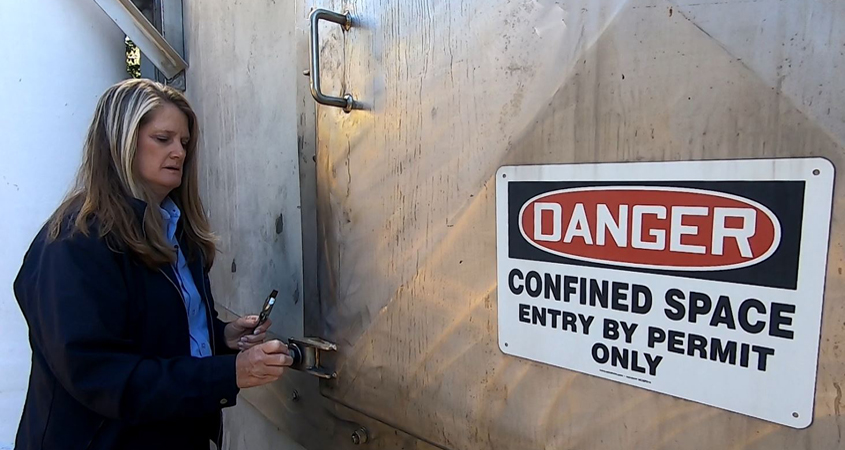
North San Diego County fire agencies teamed up in November with the Vallecitos Water District for confined space training drills. The drills, held over a two-week period, prepare firefighting professionals to respond to emergencies in facilities such as wastewater treatment plants and maintain their confined space certification.
https://www.waternewsnetwork.com/wp-content/uploads/2024/04/WNN-Horizontal-White-Blue2.png00Mike Leehttps://www.waternewsnetwork.com/wp-content/uploads/2024/04/WNN-Horizontal-White-Blue2.pngMike Lee2020-01-07 09:50:272020-01-23 11:43:51Vallecitos Water District Training Preps Firefighters for Wastewater Plant Emergencies
North San Diego County fire agencies teamed up in November with the Vallecitos Water District for confined space training drills. The drills, held over a two-week period, prepare firefighting professionals to respond to emergencies in facilities such as wastewater treatment plants and maintain their confined space certification.
The recent training took place at the Vallecitos Water District’s Meadowlark Reclamation Facility. Firefighters saw how the wastewater plant operates while getting a walk through of the facility. Fire personnel worked with Vallecitos staff and both groups benefited from the opportunity to understand each other’s equipment and protocols.
Meadowlark Wastewater Plant Supervisor Dawn McDougle led the confined space training with North County firefighting agencies on behalf of the Vallecitos Water District. Photo: Vallecitos Water District
“The confined space training with the fire agencies has helped prepare us for future scenarios that could happen at the plant,” said Dawn McDougle, wastewater plant supervisor.
Video of the training drills conducted by the fire agencies and Vallecitos Water District.
The Meadowlark facility was chosen because it provided both vertical and horizontal confined spaces for training drills. McDougle suggested the facility storm wet well be used for the confined space exercise since it is relatively environmentally clean.
Collaboration results in more efficient response to emergencies
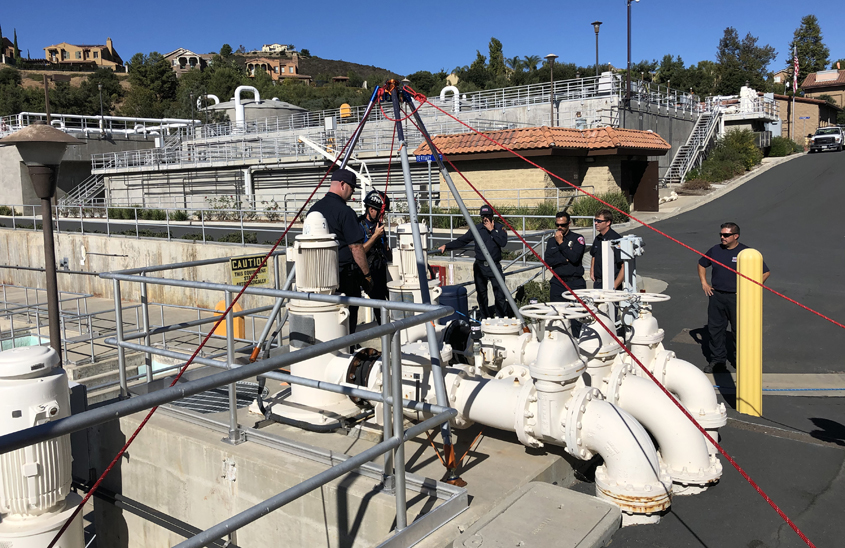
Firefighters are briefed at the Meadowlark Reclamation Facility as part of confined space training drills conducted with the Vallecitos Water District. Photo: Vallecitos Water District
Eight different fire agencies trained during morning or afternoon sessions, breaking up groups for various skill set station drills. Stations included an “Arizona vortex,” a new piece of equipment fire agencies use for rescues; a review of confined space rescue equipment; and training in confined space permit requirements. Confined space permits are required by OSHA before making any kind of confined space entry or rescue.
Meadowlark staff reviewed the conditions and possible actions within filter station space with fire crews. Staff also explained decision-making for confined space entry, and conditions they might encounter, such as chemical exposure, and lock-out/tag-out requirements.
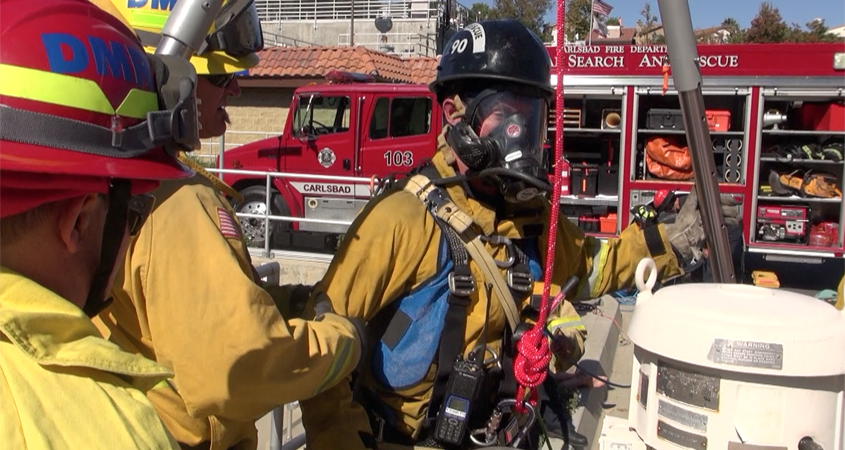
A firefighter prepares to access the Meadowlark Reclamation Facility as part of confined space training drills conducted with the Vallecitos Water District. Photo: Vallecitos Water District
The training wrapped up with an all-hands mock confined space drill scenario at the Meadowlark storm wet well. Participants were required to respond to a simulated mechanical failure with a station pump, leaving Vallecitos staff “trapped” in a hole. First responders needed to “rescue” Vallecitos staff. Fire department personnel used the vortex system to rescue personnel trapped in the stormwater wet well. As part of the rescue scenario, fire teams incorporated Vallecitos staff involvement in the rescue mission.
Vallecitos wastewater collection crews also completed the confined space training with the firefighters.
Fire agencies were impressed with the staff and their operation of the Meadowlark Reclamation Facility. As a result of training, fire agencies can now respond more efficiently and with confidence.
“We appreciate the collaboration with fire agencies and the time they took to explain their procedures to Vallecitos District staff,” said McDougle. “We look forward to future training with the fire agencies.”
Firefighting agencies participating in the training included crews from the cities of Carlsbad, San Marcos, Del Mar, Vista, Escondido, Oceanside, Encinitas, Solana Beach, Rancho Santa Fe, Valley Center, and crews from North County Fire (Fallbrook), San Pasqual and Rincon.
https://www.waternewsnetwork.com/wp-content/uploads/2019/12/VWD-Firefighters-2-845X450.jpg453845Gayle Falkenthalhttps://www.waternewsnetwork.com/wp-content/uploads/2024/04/WNN-Horizontal-White-Blue2.pngGayle Falkenthal2020-01-06 08:12:372020-01-07 16:53:20Vallecitos Water District Training Preps Firefighters for Wastewater Plant Emergencies