San Diego May Propose 28 Percent Sewer Rate Hikes for Single-Family Homes
Sewer rates for San Diegans in single-family homes would increase nearly 19 percent next year and a total of 28 percent over the next four years under a new city proposal.
Landscaping plants have different water needs. The water requirement of each plant in your landscaping can be determined by gathering information about the plant and then comparing it to the amount of water needed by the cool-season grass growing in your climate zone.
Take a tip from landscaping professionals. They use a resource called the Water Use Classification of Landscape Species to classify plants according to their water requirements, called Plant Factors.
These water requirements divide plant species into four categories: Very Low, Low, Moderate, and High.
When you are selecting plants for your landscaping, use the classification to choose low water use plants for your landscaping. You can also use it to group a handful of higher water use plants together if you want to indulge in a few favorites.
When you have decided on your plant palette and placement, you can now figure out the water use of your entire landscape area. This will help you plan out your artificial irrigation.

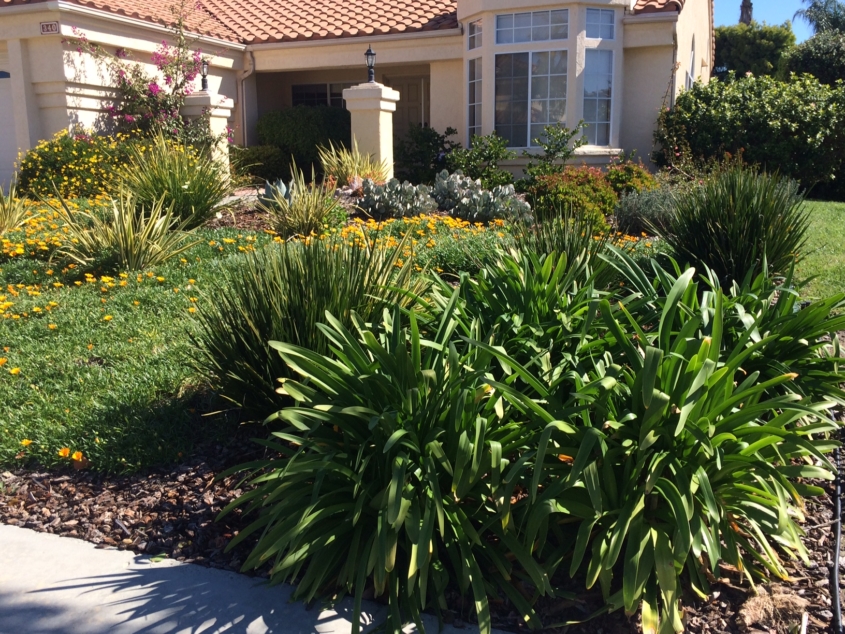
Determine water use before choosing plants for your new sustainable landscaping. Photo: San Diego County Water Authority
Watering needs for landscape plants use a measuring stick based on cool-season turf. It’s because cool-season turf is extremely thirsty.
When you replace turf areas with climate-appropriate plants that use less water and irrigate them with more efficient systems, you can conserve a tremendous amount of water. You don’t need to turn your landscaping into a dry and dusty area to do it.
High Plant Factor: Plants needing 60 to 100 percent of the water needed for a grass lawn (PF of 0.6 – 1.)
Moderate Plant Factor: Plants needing 30 to 60 percent of the water needed for a grass lawn (PF of 0.3 – 0.6)
Low Plant Factor: Plants needing 10 to 30 percent of the water needed for a grass lawn (PF of 0.1 – 0.3)
Very Low Plant Factor: Plants needing 10 percent or less of the water needed for a grass lawn (PF of less than 0.1)
According to the San Diego County Water Authority’s Sustainable Landscaping guidebook, plant selections are colored-coded to identify their water needs under this system. It gives you an easy way to group plants by their water requirements in your new landscaping, so you can irrigate them more efficiently.
This article is part of a year-long series inspired by the 71-page Sustainable Landscapes Program guidebook. The Water Authority and its partners also offer other great resources for landscaping upgrades, including free WaterSmart classes at WaterSmartSD.org.
San Diego County Water Authority crews recently replaced two pickup truck-sized valves at the agency’s Pressure Control and Hydroelectric Facility in central San Diego – each valve weighing about 35,000 pounds. The pressure-control facility is a key piece of the Emergency and Carryover Storage Project, which ensures water is available around the region if imported water deliveries are disrupted.
The U.S. Bureau of Reclamation has awarded three San Diego County water agencies a total of $2,788,500 in 2021 WaterSMART Water and Energy Efficiency Grants. A total of $42.4 million in grants was given to 55 projects across 13 states to improve water reliability and efficiency, conserving more 98,000 acre-feet of water per year.
“The Water Authority and its member agencies have been leaders in helping customers improve water efficiency, which ultimately helps our communities become more resilient to both dry years and the large-scale impacts of climate change,” said Water Authority Board Chair Gary Croucher. “This grant money is added value for our region as we continue to do our part for people and the planet.”
The Bureau of Reclamation grants support the new Executive Order on Tackling the Climate Crisis at Home and Abroad to increase resilience to climate change impacts. The agency’s WaterSMART program works cooperatively with states, tribes, and local entities to plan and implement actions that increase water supply reliability through investments to modernize existing infrastructure and attention to local water conflicts.
March 24, 2021 – The U.S. Bureau of Reclamation has awarded three San Diego County water agencies a total of $2,788,500 in 2021 WaterSMART Water and Energy Efficiency Grants. A total of $42.4 million in grants was given to 55 projects across 13 states to improve water reliability and efficiency, conserving more 98,000 acre-feet of water per year.
San Diego County Water Authority crews recently replaced two pickup truck-sized valves at the agency’s Pressure Control and Hydroelectric Facility in central San Diego – each valve weighing about 35,000 pounds.
The replacement project took place during a scheduled shutdown of a portion of Pipeline 5, which delivers untreated water throughout the county. The pressure-control facility is a key piece of the Emergency and Carryover Storage Project, which ensures water is available around the region if imported water deliveries are disrupted.
Several large-diameter valves in the facility control the pressure and quantity of water delivered to reservoirs and water treatment plants in eastern and southern parts of the county. In addition, a hydroelectric turbine in the facility generates supplemental electricity that reduces the Water Authority’s energy costs while supplying surplus power to the region.
“The new valves will allow the facility to function efficiently at both low and high water flows, depending on regional demand,” said Kirk Whitaker, a senior engineer at the Water Authority. “The project is part of ongoing improvements that enhance the flexibility of our regional water delivery system.”
To perform the valve replacement, a large crane lifted the existing valves out of the facility through the roof and placed them onto flatbed trucks for delivery to a disposal and recycling site. The new valves were then lowered into the facility through the roof and fitted with new 42-inch pipeline sections. Concrete was poured to build pedestals that secure the valves in place.
The new valves were produced in Germany and transported to San Diego by ship. The valve installation process took four days to complete.
The Pressure Control and Hydroelectric Facility serves an important function in improving aqueduct operations and enhancing the flexibility of the Water Authority’s extensive water delivery system. The $21 million facility was completed in 2007 and pressurizes a 22-mile-long section of the Water Authority’s large-diameter Pipeline 5 between San Marcos and Mira Mesa.
The pipeline previously conveyed water in one direction only, from north to south, by gravity. This limited the Water Authority’s ability to move water around the county in the event of a supply disruption. Upgrades to Pipeline 5 now allow water to be transported either north or south using water stored at San Vicente Reservoir, which greatly improves pipeline operations and ensures that water can continue flowing to member agencies.
Ismahan Abdullahi was seated on the Board of Directors on January 25, 2021, representing the City of San Diego. Director Abdullahi serves on the Administrative and Finance and Engineering and Operations committees for the Water Authority.
Helix Water District will use $2.8 million received from the San Diego County Water Authority as part of a legal settlement with the Metropolitan Water District of Southern California to reduce future water rates for the district’s customers.
Padre Dam Municipal Water District’s Board of Directors has unanimously approved using the recently received $1,157,552 rebate from the San Diego County Water Authority to offset the District’s next pass-through rate increase from the CWA. This action will result in a direct benefit to customers by the reduction or potential elimination of a water pass through rate hike in 2022.