Lake Hodges Water Levels Dry Up Prospects for Grebes
For years, pairs of grebes would zoom across the water at Lake Hodges in a dazzling mating dance, and then build their nests on mats of dried brush suspended above the waterline.

For years, pairs of grebes would zoom across the water at Lake Hodges in a dazzling mating dance, and then build their nests on mats of dried brush suspended above the waterline.

The Water News Network top stories of 2020 reflect the San Diego region’s interest in water conservation, the environment and efforts to diversify water supply sources. But the year was dominated by the coronavirus pandemic, which impacted water infrastructure and operations.
As one of essential sectors of the economy, the water and wastewater industry took added COVID-19 precautions. The essential employees of the San Diego County Water Authority and its 24 member agencies worked to ensure the continued safety and reliability of the region’s water supply. In some cases, that meant sheltering-in-place, which employees of the Claude “Bud” Lewis Carlsbad Desalination Plant did in March. For agencies operating multiuse recreational facilities, such as Lake Jennings, the pandemic also caused frequent schedule changes.
To reassure users about the safety of the water supply, the Water Authority and its member agencies shared a series of videos with the public, featuring Switchfoot’s Jon Foreman, to let people know they can “Trust the Tap.”
Reservoirs and lakes operated by water agencies in San Diego County were closed or had varying schedules due to the coronavirus pandemic. The impact of the pandemic on recreational facilities in the region was the most viewed story of 2020.

Paddleboarders enjoy Lake Hodges before the City of San Diego closed the lake due to the coronavirus pandemic. Photo: City of San Diego
The City of San Diego’s reservoirs and lakes are closed due to the coronavirus pandemic. The city closed the reservoirs to the public on March 18 to protect the public and minimize the spread of the COVID-19 virus. The nine water supply storage reservoirs are operated by the City’s Public Utilities Department.
Popular overnight campsites remain open at Santee Lakes, owned and operated by the Padre Dam Municipal Water District.
“Camper well-being is important to us and Santee Lakes didn’t want to displace people,” said Melissa McChesney, Padre Dam communications manager. She said that includes long-term campers who spent winter at the lake.
At Lake Jennings, Recreation Manager Kira Haley says eight volunteers continue to live and work from their campground homes in recreational vehicles and campers. She said their days remain “pretty typical” even though they see more wildlife and not people.
COVID-19 played a part in the second most viewed Water News Network story in 2020.
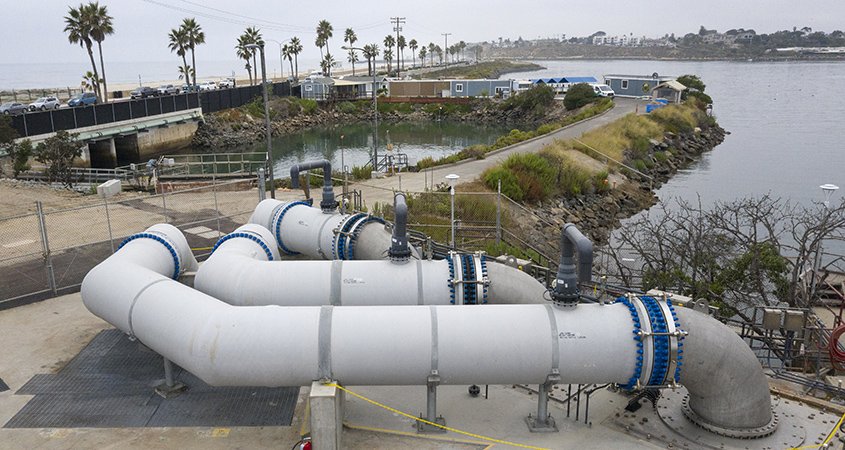
Three new fish-friendly seawater intake pumps commissioned at the Claude “Bud” Lewis Carlsbad Desalination Plant, are among the most environmentally advanced intake pumps in the world. The pumps are part of a broader effort to ensure the long-term health of the marine environment near the Plant, which sits on the shores of Agua Hedionda Lagoon. Photo: San Diego County Water Authority
July 22, 2020
New fish-friendly seawater intake pumps recently commissioned at the Carlsbad Desalination Plant are among the most environmentally advanced intake pumps in the world.
The three intake pumps, manufactured by Indar, are part of a broader effort to ensure the long-term health of the marine environment near the Claude “Bud” Lewis Carlsbad Desalination Plant, which sits on the shores of Agua Hedionda Lagoon.
Installation of the new intake pumps is part of a phased program to replace the existing seawater intake and discharge facilities with state-of-the-art technology to protect marine life that wasn’t available when the plant was operating with source water from the Encina Power Station. The closure of the power station in December 2018 led to temporary intake-discharge operations until the new intake pumps came online. The next steps include adding new intake screens, designed to prevent any sea-life larger than 1 millimeter (thicker than a credit card) from entering the plant.
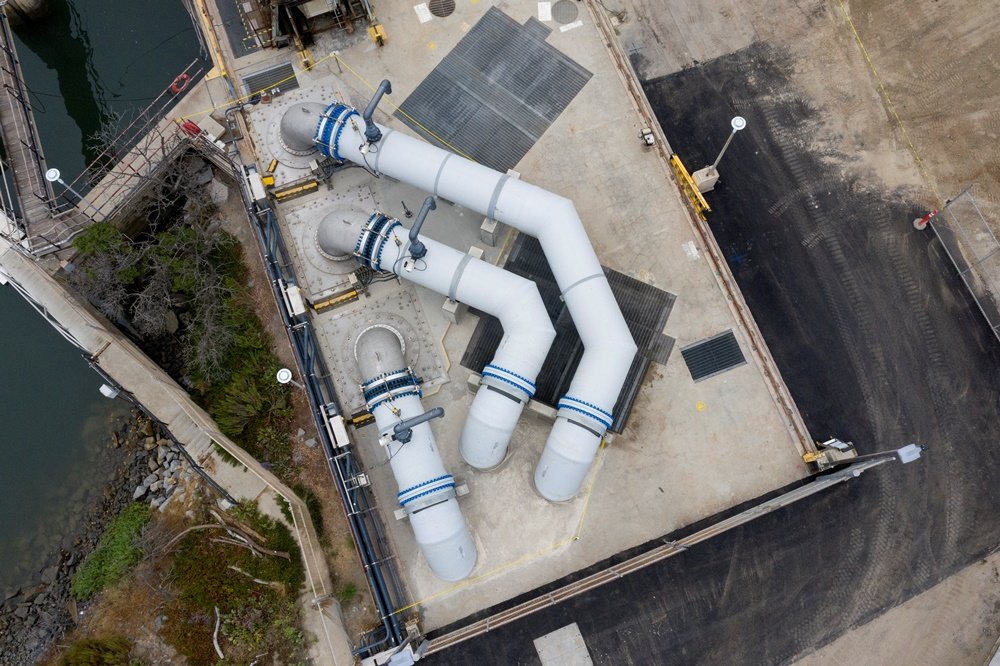
The new intake screens are the final part of upgrades, which when complete in 2023, will make the Carlsbad Desalination Plant the first desalination facility in California to comply with the 2015 California Ocean Plan Amendment, which is among the most advanced sea-life protection measures in the world. Photo: San Diego County Water Authority
The work to complete the construction and commissioning of the new fish-friendly seawater intake pumps was part of the essential work allowed under California guidelines during the COVID-19 pandemic. The contractor, Kiewit–Shea Joint Venture, worked in accordance with guidelines adopted by the State Building and Construction Trades Council and approved by Governor Gavin Newsom for essential construction. The contractor worked uninterrupted to complete the project per the June 30, 2020, deadline set by the Regional Water Quality Control Board without any health or safety violations.
The groundbreaking for the Pure Water Oceanside project was the third most read story of 2020 on the Water News Network.

Construction is underway on the $67 million Pure Water Oceanside project, which is scheduled to be completed in 2021. Photo: San Diego County Water Authority
City of Oceanside officials and regional water industry leaders gathered today to break ground on Pure Water Oceanside, the first advanced water purification facility in San Diego County. The $67 million project – scheduled to be completed in 2021 – will purify recycled water sourced from the San Luis Rey Water Reclamation Facility.
“Today, we put Pure Water Oceanside on the map and are one step closer to achieving the goal of greater water-independence for our city, residents and businesses,” said Cari Dale, Oceanside’s water utilities director. “This future-focused project will provide multiple benefits by reusing our water resources to their full potential.”
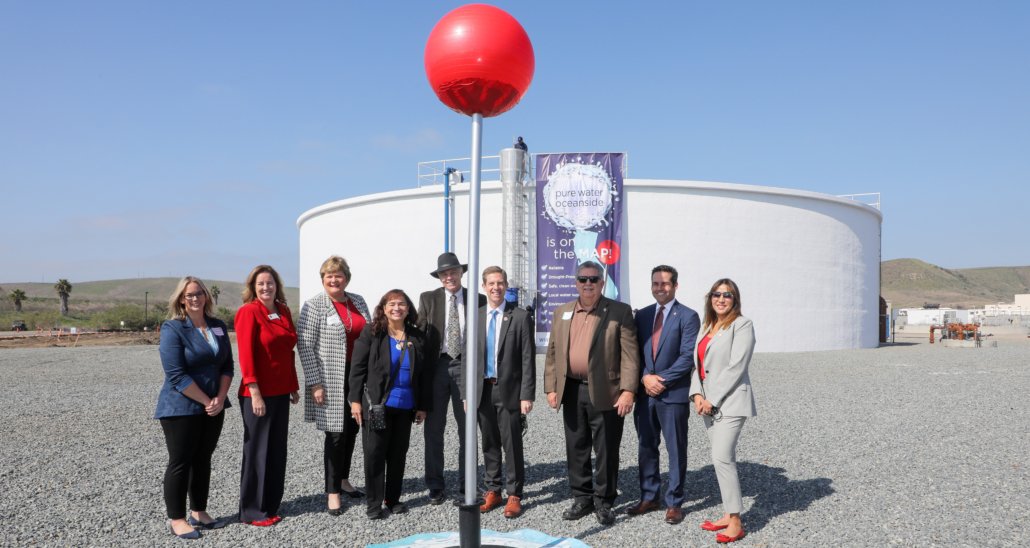
City leaders and water experts placed a giant Google Maps “location pin” into the ground at the San Luis Rey Water Reclamation Facility, which marked that the new recycled water project is now officially on the map. Photo: San Diego County Water Authority
The local project will reduce Oceanside’s dependence on imported water by more than 30%. The purification process is inspired by the natural water cycle and reduces the amount of recycled water discharged into the ocean.
The project is partially funded by the Local Resources Program through the San Diego County Water Authority and Metropolitan Water District of Southern California.
“The tremendous conservation focus, water infrastructure planning and investment by the Water Authority and its 24 member agencies has put our regional supplies in solid standing,” said Water Authority General Manager Sandra L. Kerl. “The mission of providing reliable water supplies to San Diego County can be likened to a puzzle; there are many pieces that fit together to create an overall solution. Our next increment of supply in the San Diego region is from potable reuse projects.”
Other top stories in 2020 covered by the Water News Network included updates on several water reuse and recycling projects, including:
Construction of Phase 1 of the Pure Water Program is scheduled to begin in early 2021. Phase 1 will include a full-scale, 30-million-gallon-per-day Pure Water Facility that will use the five water purification steps modeled at the Demonstration Facility.
The East County AWP will be one of the first potable reuse projects in California to use new reservoir augmentation regulations. The program will meet up to 30% of East San Diego County’s drinking water demands, almost 13,000 acre-feet of water per year, and eliminate the discharge of 15 million gallons of partially treated wastewater into the Pacific Ocean.
The Santa Margarita River Conjunctive Use Project is a joint project with Marine Corps Base Camp Pendleton, and will eventually supply about 30% of the Fallbrook Public Utility District’s water, and virtually all of Camp Pendleton’s water.
The San Diego County Water Authority and three of its member agencies were recognized Dec. 17 by the Public Relations Society of America San Diego/Imperial Counties chapter for outstanding work in public outreach and education efforts.
The 2020 PRSA Bernays Awards were presented for communication on a variety of platforms, all designed to inform stakeholders and ratepayers about initiatives ensuring a safe and reliable water supply.
Earlier this year, the city of San Diego filed a lawsuit against San Diego Gas & Electric in a dispute over the utility’s underground infrastructure obstructing the construction of a $1.4 billion water recycling project.
Now, a second and separate lawsuit has been filed on behalf of a San Diego resident claiming an agreement between the city and SDG&E to help get the project started is illegal.

The San Diego County Water Authority and three of its member agencies were recognized Dec. 17 by the Public Relations Society of America San Diego/Imperial Counties chapter for outstanding work in public outreach and education efforts.
The 2020 PRSA Bernays Awards were presented for communication on a variety of platforms, all designed to inform stakeholders and ratepayers about initiatives ensuring a safe and reliable water supply. Awards were presented virtually via live Twitter feed.
The Silver Bernays Award of Merit for “Engaging Hispanics on Water Quality Issues.” Photo: PRSA SD/IC
The Water Authority received the Silver Bernays Award of Merit for Multicultural Public Relations for “Engaging Hispanics on Water Quality Issues,” and a Bronze Award of Merit in the Research/Evaluation category for “Researching Themes for Hispanic Outreach for Water Quality.” The agency’s Water News Network received a Bronze Award of Merit in the Websites category.
Earlier this year, the Water News Network was named “Best Website” among California public agencies in the California Association of Public Information Officials EPIC Awards competition. The website was also awarded first place as “Best Public Service or Consumer Advocacy Website” in the 2020 San Diego Press Club Journalism Awards.
“During the initial outbreak of the COVID-19 pandemic, it was more important than ever for the Water Authority to intensify its efforts to communicate with our audiences and assure them that the virus was not transmitted through the public water system and the essential work to provide a safe, reliable water supply continued without interruption,” said Denise Vedder, director of the Water Authority’s Public Affairs Department. “In partnership with our member agencies, the Water News Network and our Hispanic outreach initiative played a key role in achieving this goal, and it is rewarding to be recognized by PRSA San Diego/Imperial Counties chapter for those results.”
Padre Dam Municipal Water District and the cities of San Diego and Oceanside also received awards for outreach and education programs.
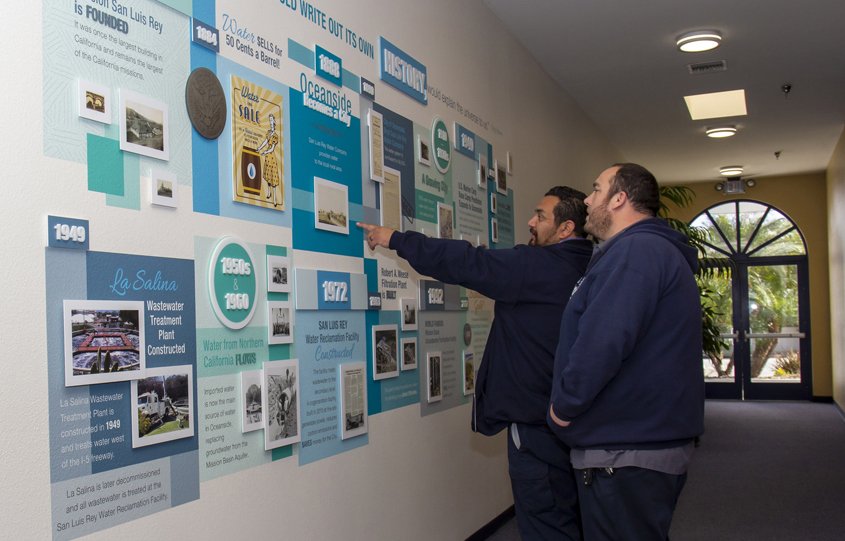
Oceanside employees Carlos Raymundo (front right) and Shawn Alonzo view the Pure Water Oceanside wall art project. Photo: City of Oceanside
The City of Oceanside and NV5 Inc. recognized in three categories for Pure Water Oceanside:
Silver Award of Excellence, Campaigns: Events and Observances – Less Than Seven Days – “Pure Water Oceanside is on the Map!”
Bronze Award of Merit, Creative Tactics – “Wall Art Tells Story of Water’s Past, Present, & Future”
Bronze Award of Merit, Video – “Pure Water Oceanside Video”
“The City of Oceanside is proud to put Pure Water Oceanside on the map,” said Cari Dale, water utilities director, City of Oceanside. “Once complete, Pure Water Oceanside will provide more than 30% of Oceanside’s water supply. Our staff and consultants are dedicated to providing Oceanside with innovative solutions to water reliability and continued water reuse education.”
The City of San Diego, along with Katz & Associates, received a Silver Bernays Award of Merit in Campaigns, Events, and Observances – Less Than Seven Days for its “2020 Pure Water San Diego Virtual Contractor Expo.”
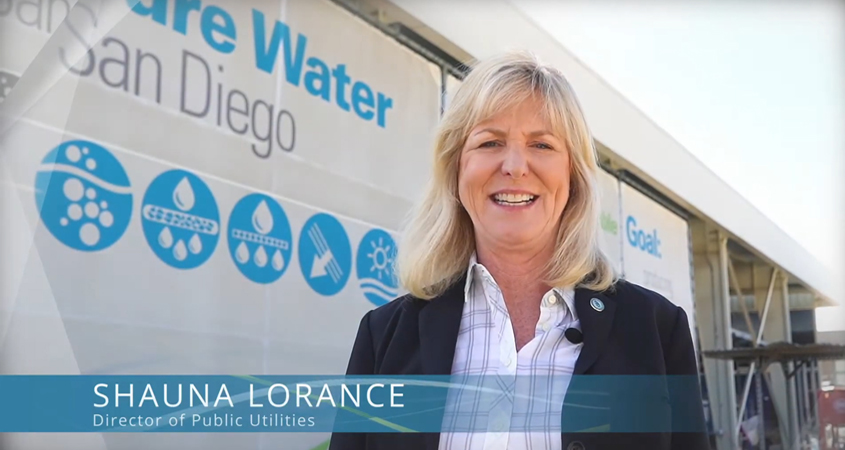
City of San Diego Director of Public Utilities Shauna Lorance welcomes viewers to the new virtual tour. Photo: City of San Diego
“Outreach remains a key element of our Pure Water program,” said Shauna Lorance, director of public utilities for the City of San Diego. “When the pandemic made in-person engagement impossible, our community outreach and project management teams rose to the challenge and implemented a successful 2020 Pure Water Virtual Contractor Expo. Providing the personal outreach to potential contractors allows the contractors to develop the best bids possible and helps ensure a successful Pure Water project.”
The Padre Dam Municipal Water District won a Bronze Award of Excellence for its 2019 Annual Report.
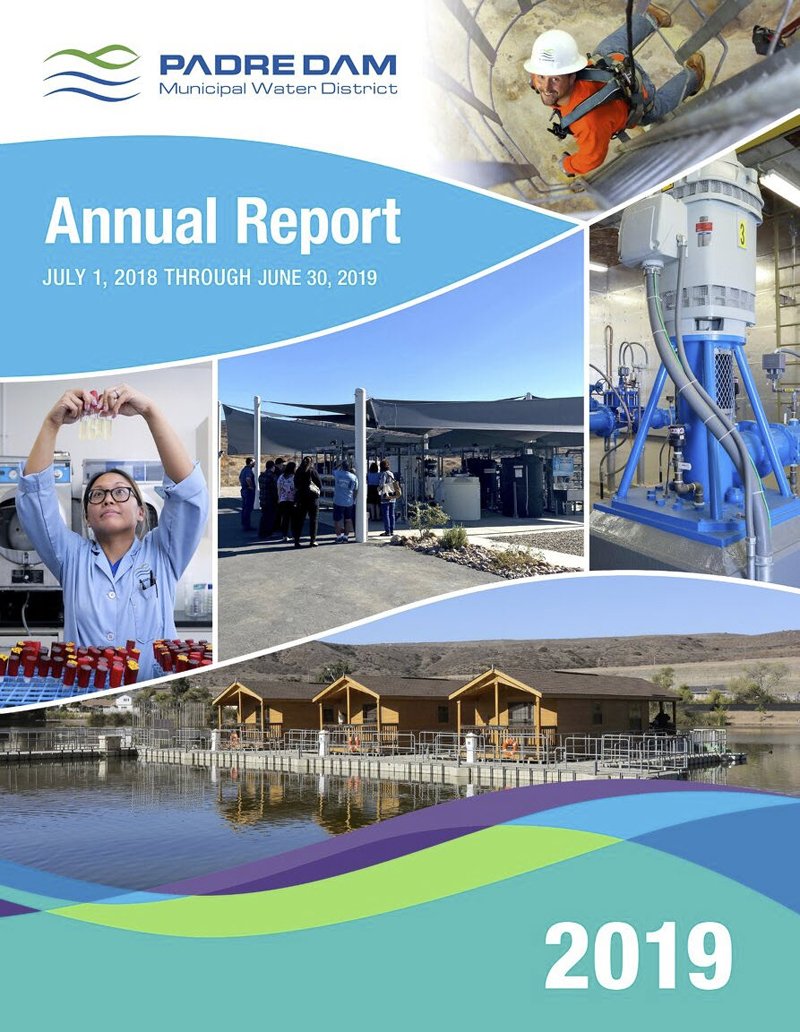
The award-winning Padre Dam Municipal Water District 2019 annual report. Photo: Padre Dam Municipal Water District
“Padre Dam is proud of our communications team for the great thought, creativity, and appreciation of the District’s work that is put into projects like the annual report,” said Melissa McChesney, communications manager for the Padre Dam Municipal Water District. “They do all of this in order to share with our customers the important work and services we provide to our community.”
The SCOOP SD program and Tracks PR received a Silver Bernays Award of Excellence in Campaigns: Events and Observances – Less than Seven Days, Business, and a Bronze Bernays Awards of Merit in Creative Tactics, both for “Sweet Relief for Small Biz During COVID.”
San Diego is participating in a statewide program to monitor its untreated wastewater for the virus that causes COVID-19, it was announced Tuesday.
City staff have been monitoring for severe acute respiratory syndrome coronavirus 2, or SARS-CoV-2, in untreated wastewater at the Point Loma Wastewater Treatment Plant this month.
For 60 years, Miramar Reservoir has been an integral part of the City of San Diego’s drinking water system and offers San Diegans a popular recreational area. Now, the reservoir is being called into service to play a vital part in San Diego’s future Pure Water system to sustain a reliable water supply.
The City of San Diego is commemorating the 60th anniversary of Miramar Reservoir, its role in the region’s history, and the part the reservoir will play in the future.
For 60 years, Miramar Reservoir has been an integral part of the City of San Diego’s drinking water system and offers San Diegans a popular recreational area. Now, the reservoir is being called into service to play a vital part in San Diego’s future Pure Water system to sustain a reliable water supply.
The City of San Diego is commemorating the 60th anniversary of Miramar Reservoir, its role in the region’s history, and the part the reservoir will play in the future.
“We celebrate not only Miramar Reservoir’s past, but the critical role it will play when the Pure Water system is completed,” said Shauna Lorance, director of the San Diego Public Utilities Department. “Miramar Reservoir will continue to be a key part of our water system for many years to come.”
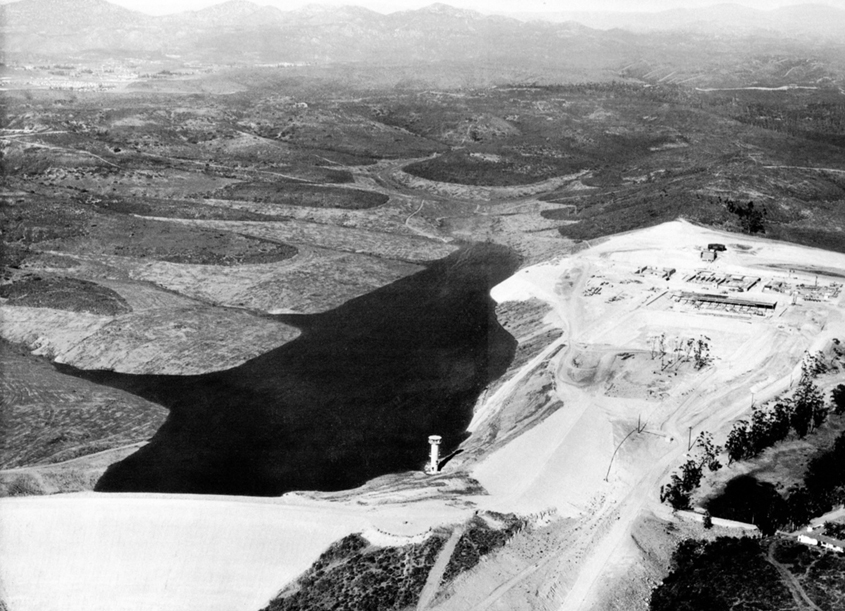
An aerial view of the Miramar Reservoir under construction in 1960. Photo: Jeff Pasek/City of San Diego
Miramar was the last of the City’s nine reservoirs to be developed. It was completed in 1960 as part of the second San Diego Aqueduct. The location previously had been the site of a small reservoir serving the vast ranch of newspaper publisher Edward W. Scripps.
Water flowing south to the reservoir originates from both the Colorado River Aqueduct and the California Aqueduct. The earthen embankment dam has a maximum height of 165 feet measured from the downstream toe, and has a base of 1,180 feet.

Dignitaries attend the Miramar Reservoir dedication ceremony in 1960. Photo: Jeff Pasek/City of San Diego
It was constructed by contractors Einer Brothers Inc. of Escondido and McCammon Construction, for $1.42 million. Land acquisition and engineering costs were approximately $730,000. Funds for the project came from an $11 million water bond approved by San Diego voters in June 1958.
When full, the reservoir covers 274 surface acres, reaches a maximum water depth of 114 feet, and has four miles of shoreline. Miramar Reservoir has a water storage capacity of 6,682 acre-feet.
Miramar Water Treatment Plant, which was completed in 1962 at a cost of $3.5 million, and expanded and upgraded in 2010, treats and filters drinking water distributed to customers in the northern part of San Diego.
Since the mid-1960s, the reservoir has been a popular recreational destination. An estimated 100,000 people visit Miramar each year to enjoy jogging, walking, biking, fishing, boating, picnicking, among other activities.
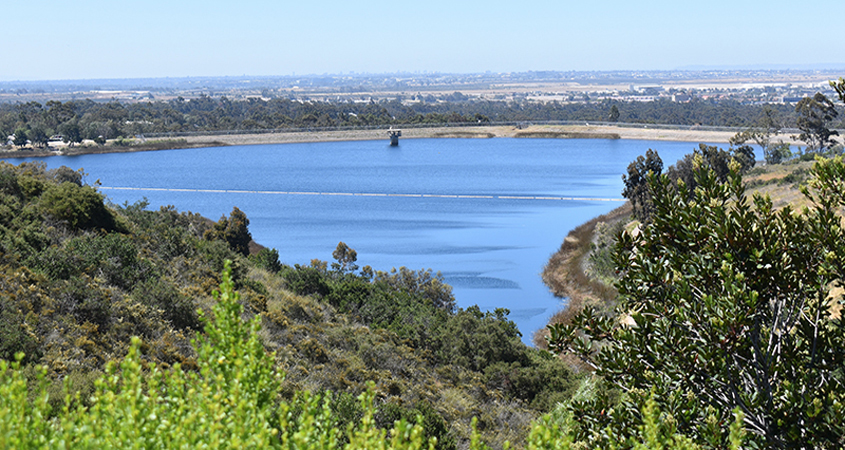
The Miramar Reservoir is poised to play a key role in the Pure Water San Diego project. Photo: City of San Diego
When the Pure Water system comes online, Miramar Reservoir will switch from holding imported water to holding purified water received through a pipeline from the planned North City Pure Water Facility. After water has been purified at the North City Pure Water Facility, it will then be transferred via pipeline to Miramar Reservoir. The Miramar Water Treatment Plant will clean the water again, and the water will be distributed to homes and businesses throughout northern San Diego.
Miramar Reservoir will continue use into the foreseeable future as it helps provide one-third of San Diego’s water supply locally by the end of 2035.
How should power over water decisions in San Diego be divided?
Should the city of San Diego, which represents almost 40 percent of the region’s water consumers, have the most sway?
Or should smaller cities be on equal footing when the outcome of a decision could harm towns with less people and money?
That is the question facing San Diego County Water Authority once again, after the latest vote over a $5 billion duplicate pipeline to the Colorado River. Directors voted down spending $1.7 million more to study the project further, in raw numbers. Twenty of the agency’s 36 directors said no to the pipeline, and 14 said yes.
San Diego County is already working on another climate action plan, hoping they can finally come up with one that stands up to legal scrutiny.
The county has, over the past 10 years, put together four climate action plans. Each was a spectacular failure.