The San Diego County Water Authority’s Board of Directors today made a comprehensive settlement offer to the Metropolitan Water District of Southern California that would conclude every rate case between the two agencies, improve the transparency of MWD’s ratemaking process, and provide $140 million in payments for San Diego County water ratepayers in addition to benefits already secured in court. It also would provide certainty about how much MWD charges to transport the San Diego region’s independent water supplies.
“The Water Authority’s proposal would benefit residents across San Diego County, enhance understanding of how MWD’s rates are set, and provide more opportunities for our agencies to collaborate in ways that would benefit water management across the Southwest,” said Water Authority Board Chair Jim Madaffer.
https://www.waternewsnetwork.com/wp-content/uploads/2019/10/WA-Square-Logo.jpg200200Mike Leehttps://www.waternewsnetwork.com/wp-content/uploads/2024/04/WNN-Horizontal-White-Blue2.pngMike Lee2019-12-19 18:57:292019-12-19 18:59:51Water Authority Offers Settlement to End MWD Litigation, Focus on Future
At their December 18, 2019 meeting, Helix Water District’s board of directors unanimously elected Director Mark Gracyk to serve as board president in 2020 and Director DeAna Verbeke to serve as the board’s vice president.
Vista Irrigation District invites local high school seniors to compete for scholarships from the district. Up to six scholarships may be awarded; the minimum scholarship award amount is $1,000 and the maximum scholarship award amount is $3,000. The purpose of the scholarship program is to encourage students to learn more about water-related issues impacting their community.
https://www.waternewsnetwork.com/wp-content/uploads/2018/09/Vista-Irrigation-District.png200200Gayle Falkenthalhttps://www.waternewsnetwork.com/wp-content/uploads/2024/04/WNN-Horizontal-White-Blue2.pngGayle Falkenthal2019-12-18 15:11:542019-12-26 15:13:24Water District to Sponsor Scholarship Contest
Encinitas, CA—Representatives from the Escondido Creek Conservancy presented Olivenhain Municipal Water District’s Board of Directors with the “Business of the Year” award at OMWD’s December 11 meeting. OMWD received the award for its support of the Conservancy’s education program. The program has become increasingly successful each year, and today brings thousands of local students annually to Elfin Forest Recreational Reserve to learn about water quality and habitat protection.
https://www.waternewsnetwork.com/wp-content/uploads/2018/04/Olivenhain-Logo-Square.jpg200200Gayle Falkenthalhttps://www.waternewsnetwork.com/wp-content/uploads/2024/04/WNN-Horizontal-White-Blue2.pngGayle Falkenthal2019-12-11 21:23:212019-12-11 21:23:23OMWD Named “Business of the Year” for its Protection of Escondido Creek Watershed
Two projects underway will enhance fish habitat and water quality at Murray Reservoir.
The reservoir in Mission Trails Regional
Park is owned by the City of San Diego and operated by its Public Utilities
Department.
“As stewards of the area, it is important for us to improve and enhance the environment in and around Murray Reservoir,” said Shauna Lorance, director of the San Diego Public Utilities Department. “Working closely with state and local agencies allows us to better achieve this goal.”
Removing invasive plants
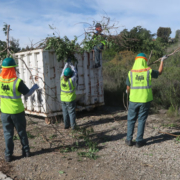
Over the next six months, the Urban Corps of San Diego County will remove non-native plants and trees along Airoso Avenue to Murray Dam as part of the Chaparral Canyon Habitat Restoration Project.
The removal of invasive plants and native habitat restoration will directly benefit the City of San Diego and the San Diego River Conservancy by improving water quality in the San Diego River, reducing the canyon’s vulnerability to wildfires.
In addition, the city is working with California Department of Fish and Wildlife on a fisheries habitat enhancement project at Murray Reservoir through June 2020. The project is intended to increase fish abundance and angling opportunities for the public by adding fish habitat structures to the reservoir.
The fish habitat structures, including brush and synthetic materials, will provide the type of physical cover that several fish species prefer to nest near. The new structures are intended to increase reproduction and provide additional areas where juvenile and adult fish can avoid predation.
Murray Reservoir is open daily from sunrise to sunset and closed on Christmas and New Year’s Day. A valid California Fishing License is required for anglers 16 years of age or older.
https://www.waternewsnetwork.com/wp-content/uploads/2019/12/IMG_4299-845x450.jpg450845Mike Leehttps://www.waternewsnetwork.com/wp-content/uploads/2024/04/WNN-Horizontal-White-Blue2.pngMike Lee2019-12-11 16:04:332019-12-11 16:04:34San Diego Projects Improve Water Quality, Fish Habitat
The National City Fire Department is learning more about the water system it relies on, thanks to some specialized training for firefighters from Sweetwater Authority staff.
Firefighters wanted to learn more about the water distribution system and where the city’s water originates. The department also wanted to review the location of Sweetwater Authority’s treatment facilities, pump stations, and learn about any areas of lower water pressure or dead-end hydrants.
The design of water distribution system facilities such as pipes, tanks, and pumps is dictated by fire protection requirements.
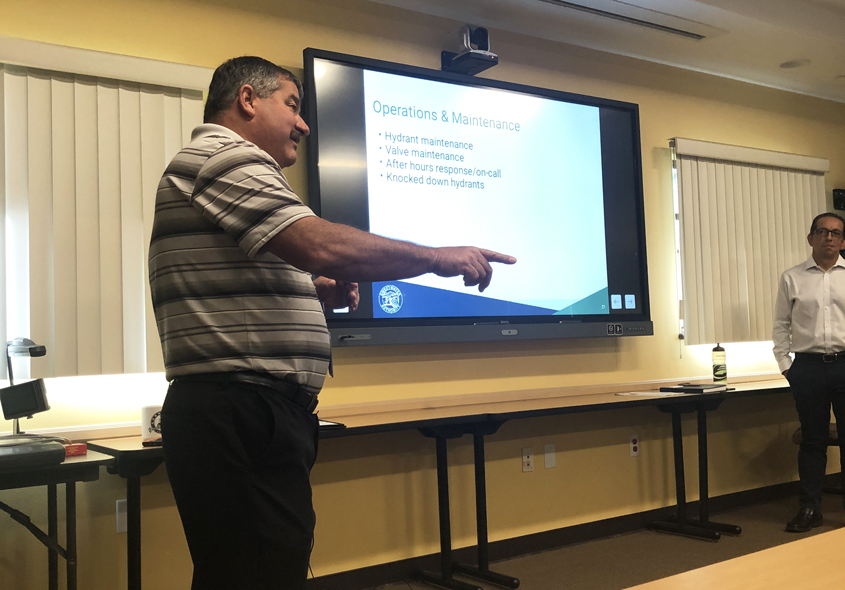
Sweetwater Authority Engineering Manager Luis Valdez and Director of Distribution Greg Snyder created and held three training sessions at Fire Station 34 in October and November to accommodate the department’s three shifts of 40 firefighters.
“The training provides the opportunity to work closely with National City Fire Department, providing detailed information about the water system we manage and operate,” said Snyder. “Through this training, stronger working relationships are formed, which improves the flow of information between agencies. When communities are served by local agencies working together collaboratively it gives our community a high level of service.”
Communication aids mutually beneficial partnership serving National City
Sweetwater Authority Director of Distribution Greg Snyder (left) and Engineering Manager Luis Valdez train National City firefighters at Station 34. Photo: Sweetwater Authority
“Sweetwater Authority supports the fire department by designing, operating, and maintaining a reliable water system to allow the fire department to fulfill its core mission of fire protection and safety,” said Valdez. “The Authority also supports the department by providing expertise to confirm that fire protection requirements established by the fire department can be met by existing and planned water facilities.”
Valdez said the training gave firefighting personnel specific knowledge of its city’s water system, ranging from an overall perspective of the water supply, to the specific design and operational details of its water facilities and how they impact firefighters ability to protect the community.
“A fire department equipped with good knowledge of the water system that knows how to effectively coordinate with Sweetwater Authority during routine and emergency events will be more effective in providing fire protection and safety for its customers,” said Valdez.
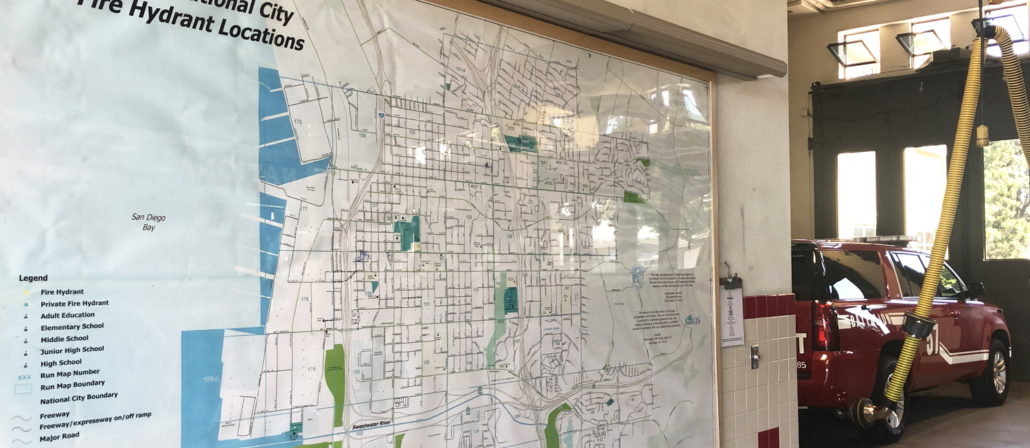
A map at Station 34 displays the location of all city fire hydrants. Photo: Sweetwater Authority
Ongoing communication with Sweetwater Authority personnel during an incident response can offer firefighters options to improve distribution system operations. Depending on the nature of the emergency, coordinated responses may range from system operation changes to the mobilizing of emergency power generations to keep facilities in service.
https://www.waternewsnetwork.com/wp-content/uploads/2019/12/NCFD_4133-845X450.jpg450845Gayle Falkenthalhttps://www.waternewsnetwork.com/wp-content/uploads/2024/04/WNN-Horizontal-White-Blue2.pngGayle Falkenthal2019-12-11 08:17:182019-12-11 08:17:20National City Firefighters Get WaterSmart with Sweetwater Authority
The City of San Diego’s Public Utilities Department last week took a major step toward completing an innovative project to improve water quality in Lake Hodges. A newly installed oxygenation system, designed by city engineers, will introduce highly oxygenated water to the bottom of the reservoir to reduce the accumulation of excess nutrients and harmful algae growth.
The increase of nutrients and algae in the water has been caused by human activities in the watershed upstream of the reservoir, including residential and commercial development, agriculture, and land clearing. Degraded water quality can restrict the ability to move water in and out of the reservoir.
“The ‘Speece cone’ is a fairly unique method for adding oxygen to a reservoir – there are only a few of them in the world,” said Jeff Pasek, project manager at the City of San Diego Public Utilities Department. “This project derived from a planning study that was done about five years ago, which identified oxygenation using the ‘Speece cone’ as being the most cost-effective way of addressing the water quality problems in Hodges.”
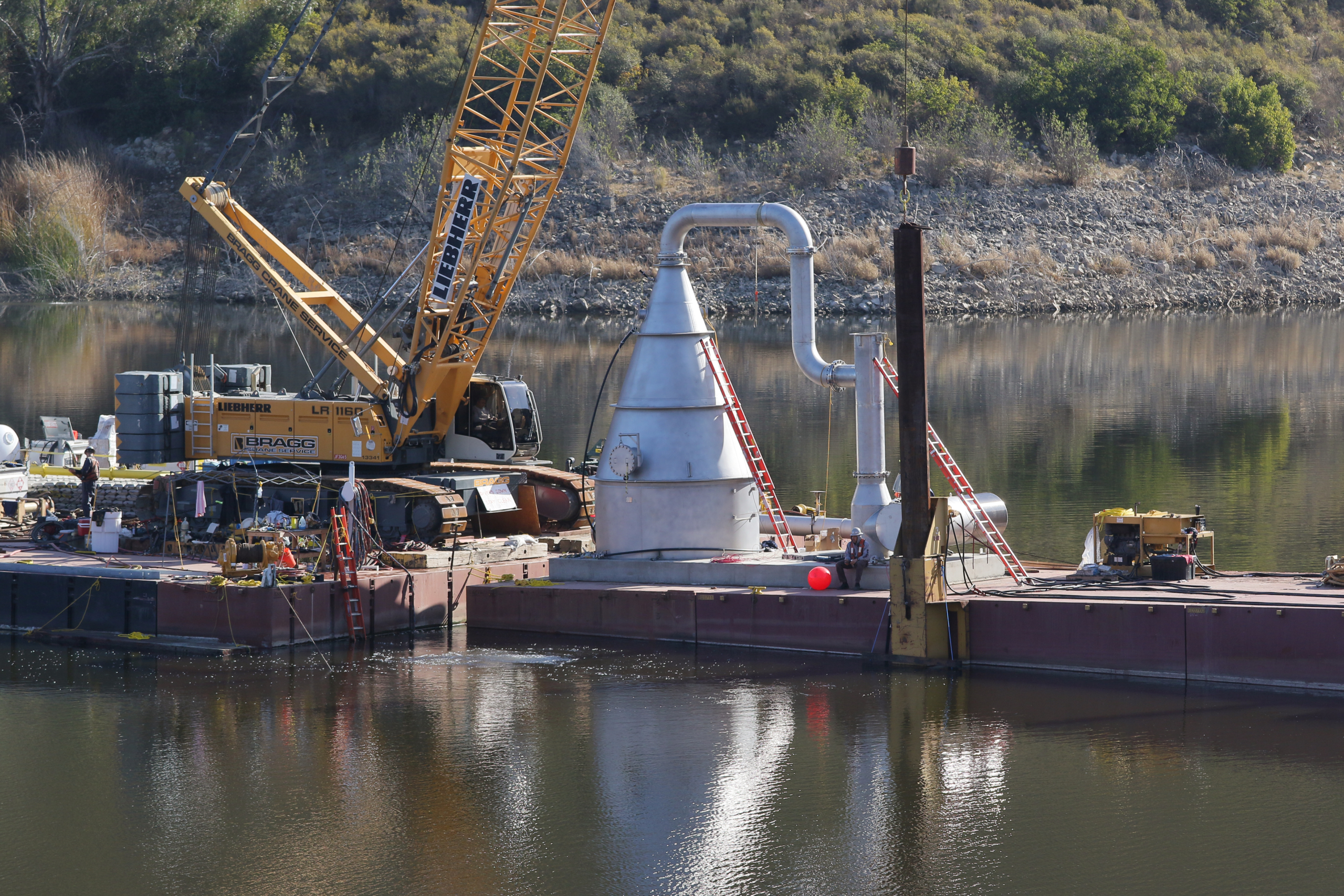
Last week, the 130,000 pound cone – named after the inventor of the technology, Richard Speece – was lowered eighty feet to the bottom of the reservoir.
Streamlined operation for maximum efficiency
The precisely coordinated operation involved lifting the 20-foot tall stainless steel cone with a large crane, while simultaneously driving a barge out from underneath. Once the cone was lowered into the water, divers headed to the bottom of the reservoir to unhook the cone from the crane, check to make sure it settled in the correct spot, and fasten it down.
In order to build a solid foundation underwater, crews excavated approximately 11 feet of silt from the bottom of the reservoir and constructed a concrete base. Before submerging the cone, crews installed and tested a pump that will move water through the cone. A large diffuser pipe was then lowered and connected to the cone by divers. The diffuser will distribute the oxygen-rich water throughout the reservoir.
Now underwater, the cone will distribute oxygen-rich water throughout the reservoir to reduce the accumulation of excess nutrients and prevent harmful algae growth. Photo: Water Authority
Local and regional benefits at Hodges Reservoir
Hodges Reservoir is owned and operated by the City of San Diego, and it serves the San Dieguito Water District and the Santa Fe Irrigation District. It is connected to the San Diego County Water Authority’s Olivenhain Reservoir as part of the Emergency & Carryover Storage Project, which is designed to ensure regional water reliability in case of emergencies or if the region is cut off from imported water supplies.
“There are multiple benefits to this project – first and foremost being the water quality improvements for Hodges Reservoir,” said Goldamer Herbon, a senior water resources specialist at the Water Authority. “Ancillary benefits include operational flexibility for regional supply benefits and preventing the accumulation of mercury, which can be harmful to people and wildlife that eat fish from the reservoir.”
The California State Department of Water Resources awarded the City of San Diego a $3.4 million grant funded by the San Diego Integrated Regional Water Management program to complete the oxygenation project, which began in February 2019.
https://www.waternewsnetwork.com/wp-content/uploads/2019/12/SpeeceConeAerial_845x450-scaled-e1575410592641.jpg450845Kristiene Gonghttps://www.waternewsnetwork.com/wp-content/uploads/2024/04/WNN-Horizontal-White-Blue2.pngKristiene Gong2019-12-03 17:26:002019-12-06 15:23:32New Oxygenation System to Improve Reservoir Water Quality
The San Diego County Water Authority Board of Directors Nov. 21 approved a new and permanent Special Agricultural Water Rate program structure that offers lower water rates to farmers in exchange for lower water supply reliability.
Unlike the current temporary program, the structure of the new water rate program will let new participants join as a way to strengthen the region’s multi-billion-dollar agriculture industry.
New ag water program rates will be determined in the spring of 2020 as part of the Water Authority’s annual rate-setting process. The program will take effect January 1, 2021, replacing the current program that sunsets at the end of 2020. Additional program details, such as the signup process and qualifying criteria, also will be developed early next year.
Special water rate program supports regional farm economy
Farmers and growers who participate in the new program will continue to receive a lower level of water service during water shortages or emergencies, allowing the Water Authority to reallocate those supplies to commercial and industrial customers, who pay for full reliability benefits. In exchange, participating farmers are exempt from fixed water storage and supply reliability charges. Under the current temporary program in 2020, participants will pay $1,231 per acre-foot for treated water, while municipal and industrial users will pay $1,686 per acre-foot.
“Creating a permanent program will benefit all regional water users,” said Water Authority Board Chair Jim Madaffer. “It helps farmers sustain their operations – and thousands of jobs – while providing a benefit to residential and commercial water customers in the event of future water supply reductions.”
San Diego County leads nation in production of nursery crops and avocados
“Every farmer in the county supports the special rate,” said Hannah Gbeh, executive director of the San Diego County Farm Bureau. “The agriculture community stands ready to provide significant water cutbacks in times of need, such as drought or emergency repairs.”
San Diego County is unusual among major metropolitan areas in the United States because it includes one of the nation’s most valuable and productive farm sectors adjacent to one of the nation’s largest cities.The region sustains 3.3 million people and a $231 billion economy thanks to decades of regional investments in water supply reliability projects, including the nation’s largest seawater desalination plant and the biggest conservation-and-transfer agreement in U.S. history.
Input from growers and farmers for agricultural water rate program
The Water Authority has provided lower-cost water to growers in exchange for lower reliability since October 2008, when the Metropolitan Water District of Southern California phased out a similar program. Since that time, the temporary Water Authority program has continued with a series of extensions set to expire at the end of 2020.
The new program was developed by the Water Authority’s Fiscal Sustainability Task Force, which is assessing a variety of issues to ensure the agency’s long-term financial health. Regional farming leaders provided input to the task force on the parameters of the new program.
https://www.waternewsnetwork.com/wp-content/uploads/2019/11/SAWR-2-WNN--e1574358020455.jpg449845Mike Leehttps://www.waternewsnetwork.com/wp-content/uploads/2024/04/WNN-Horizontal-White-Blue2.pngMike Lee2019-12-02 10:03:242019-12-02 10:03:24New Agricultural Water Rate Program Benefits San Diego County Growers
The San Diego County Water Authority’s Board of Directors last week approved a new and permanent Special Agricultural Water Rate structure that offers lower water rates to farmers in exchange for lower water supply reliability.
https://www.waternewsnetwork.com/wp-content/uploads/2019/10/WA-Square-Logo.jpg200200Mike Leehttps://www.waternewsnetwork.com/wp-content/uploads/2024/04/WNN-Horizontal-White-Blue2.pngMike Lee2019-11-27 09:14:172019-12-03 09:20:27New Agricultural Water Program Benefits San Diego County Growers
Chula Vista, CA – Sweetwater Authority (Authority) is now accepting entries for its 2020 High School Photo Contest. The annual contest aims to showcase and celebrate through photography how safe, reliable water service supports everything we do.
https://www.waternewsnetwork.com/wp-content/uploads/2019/06/SWAbluelake-LR.png200200Gayle Falkenthalhttps://www.waternewsnetwork.com/wp-content/uploads/2024/04/WNN-Horizontal-White-Blue2.pngGayle Falkenthal2019-11-26 09:33:092019-12-03 09:37:37Sweetwater Authority’s High School Photo Contest Promotes Creativity, Importance of Water




 Sweetwater Authority Logo 2019
