You are now in Features From the Archives category.

San Vicente Aqueduct

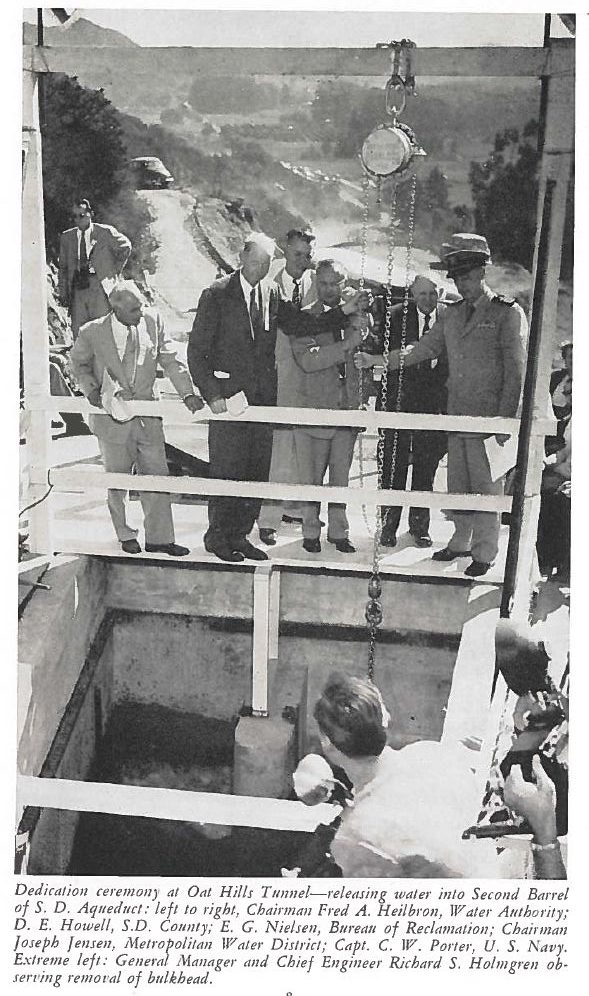
1951: Construction Milestone for Pipeline 2, San Vicente Aqueduct

When World War II concluded, most experts expected San Diego’s population to decrease, but that was not the case. Pipeline 1 proved inadequate to meet the region’s water needs. Drought years in 1950-51 increased concerns about water shortages.

The Water Authority appealed to the U.S. Navy to help build a second pipeline. It was willing, but its hands were tied by the Bureau of Reclamation, which built the first pipeline because of the wartime emergency. With the war over, it could not fund the project unless Congress authoritzed the Navy to request it.

The first chairman of the San Diego County Water Authority, Fred Heilbron, undertook the effort to create consensus to build Pipeline 2. Among his tactics: crashing a breakfast meeting between the Secretary of the Navy and then president of the Metropolitan Water District board of directors; and enlisting help lobbying Congress including Senator Richard M. Nixon.

The effort paid off. Officials celebrated every milestone of construction, including the installation of the first section of pipe.

Love Your Lawn-Conservation Corner-Love your lawn organically

The Right Way to Remove Your Lawn

If you have made the decision to replace your thirsty, water-guzzling grass, you need to plan your grass removal process carefully to ensure you leave healthy living soil ready for new landscaping in its place.  

Here’s how to do it: 

First, keep your grass moist until you remove it. Don’t withhold irrigation and let it turn brown as it dies off. Healthy microbes in your soil will die off along with the lawn. You want to work with those microbes to help create healthy soil for your new plants. It’s also a lot easier to remove fresh, moist grass than to try and pry out dead dry grass and weeds in hard dry soil.  

Keep your soil microbes healthy to support your new landscaping

Along the same lines, don’t “solarize” your landscaping in the effort to remove your lawn. Solarizing is sometimes used as a way to remove grass with chemicals. It uses a covering such as a heavy black plastic tarp to broil the lawn at high temperatures using sunlight and kill it. But that process kills everything, including healthy microbes you need for healthy soil. Yes, you can replace them with compost, but you will need to invest in a lot of compost to restore the good microbes after you’ve removed the grass by solarizing. 

 Solarizing also backfires because sterilized soil is ideal for weeks. The moment you remove the plastic, opportunistic weeds will move in fast to try and take over the ground. It isn’t because you failed to kill the weed seeds in the soil. New weeds can arrive in a flash, and there is nothing to prevent them taking over.  

Avoid compacting or tilling your soil when removing old turf

Avoid compacting your soil. If you use heavy equipment to remove your old turf, the weight of the equipment will compact the soil underneath. Try to minimize the use of heavy equipment and use walk-behind equipment with hand tools where possible, reserving the use of a tractor or scraper only where necessary.  

Avoid tilling your soil. Tilling soil breaks up and kills your soil microbes. Without the microbes, you’re guaranteed to have those weeds pop up for a long time until new soil microbes develop.  

When removing your grass, protect your trees. If you want to preserve your healthy trees while removing your lawn, you need to be careful with their roots. Don’t use any heavy equipment to remove turf around your trees. Avoid the entire area under the canopy of the tree’s branches. Tree root structures extend all the way out to the drip line at the edge of the leaves. Keep your trees well-watered during the removal process to help minimize root shock.  

Guard against shock to trees from reduced irrigation

When your new sustainable landscaping is installed, your previously existing trees may go into shock when irrigation is reduced overall in your garden. After all, this is one of the reasons for removing your lawn. Pay special attention to keeping the trees watered during the first year after your grass is removed, even if you remove the surrounding original irrigation.  

A good way to hand-water trees is to punch holes in a five-gallon plastic bucket. Fill the bucket, set it down at the edge of the tree canopy, and let the water slowly seep into the ground. Repeat the process three to four times to water your beautiful mature trees. This mimics the natural rainfall Mother Nature provides.  

READ MORE: Gardening Like A Wise Old OWL

This article was inspired by the 71-page Sustainable Landscapes Program guidebook available at SustainableLandscapesSD.org. Hardcopies are available free of charge at the Water Authority’s headquarters, 4677 Overland Ave., Kearny Mesa. The Water Authority and its partners also offer other great resources for landscaping upgrades, including free WaterSmart classes at WaterSmartSD.org.   


1920s: Crouch Well, Emerald Hills Country Club

The area which constitutes Emerald Hills in San Diego County was once a Kumeyaay Indian burial site. The modern neighborhood is named for the Emerald Hills Country Club and Golf Course, established in the area in 1929 by Art Cloninger, a well-known restauranteur of the era. The hilly area had a magnificent view of the downtown San Diego area and San Diego Bay.

In the 1920s, all water was still procured locally in San Diego County. To develop his golf course, a well was dug on the property, known as the Crouch Well.

The club was sold in 1939 to build a transmitter site for new radio stations KFSD-AM/FM. Due to the proximity to the Chollas Naval Towers, the KFSD towers were not built until 1948. During World War II, the golf course remained in operation. After the radio transmitter facility was built, Emerald Hills was lowered from an 18 hole course to a nine-hole course. The remaining golf course was sold to developers to be used for homes in 1958, and the community is still named for the golf course, Emerald Hills.

Conservation Corner-mulch-landcape-WaterSmartill you need? It depends on how you'll be using it in your sustainable landscaping. Photo: Phil Roeder/Flickr-Creative Commons License mulch master plan

More About Mulch You Need To Know

 When using mulch in your landscaping, how much mulch do you need? It depends on what job you want it to perform. 

  • To hold in moisture and keep down weeds: Use three to six inches of mulch on top of the soil. 
  • To maintain planting beds: Maintain two to four inches of mulch on beds at all times.

Remember to keep mulch one to six inches away from plant stems. Mulch can cause plants to rot. 

How Much Mulch Do I Need? 

A few simple measurements and calculations will help you determine your mulch needs. Graphic: Water Authority How much mulch

A few simple measurements and calculations will help you determine your mulch needs. Graphic: Water Authority

You first need to know these numbers: 

  • Square footage of your landscaping  
  • Thickness of your mulch cover in inches

Then take your square footage, multiplied by mulch thickness, and divide it by 12. This will give you your amount of mulch in cubic feet. 

For instance, 891 square feet of land, multiplied by one inch of mulch, divided by 12 = 74.25 cubic feet of mulch.  

Avoid These Mulch Types Around Plants 

Inorganic mulches don’t decompose to feed soil microbes and keep your plants and garden healthy and thriving. There are also some organic mulches containing dyes or other chemicals. Other mulches, such as shredded redwood, take a very long time to break down. These are the types of mulches you should use only in areas without plants, such as in pathways or dry decorative areas: 

  • Shredded redwood 
  • Dyed wood mulch 
  • Decomposed granite 
  • Gravel 
  • Rubber pellets 

Read more about sustainble landscaping: Take The Soil Test

 This article was inspired by the 71-page Sustainable Landscapes Program guidebook available at SustainableLandscapesSD.org. Hardcopies are available free of charge at the Water Authority’s headquarters, 4677 Overland Ave., Kearny Mesa. The Water Authority and its partners also offer other great resources for landscaping upgrades, including free WaterSmart classes at WaterSmartSD.org.   


The winning WaterSmart landscaping project created by Bill and Rachel Williams. Photo: Vista Irrigation District

Vista Irrigation District Announces WaterSmart Landscape Contest Winner

Vista, Calif. – The Vista Irrigation District board of directors recognized one of its customers for their entry in the district’s WaterSmart Landscape Contest.

The contest recognizes outstanding water-wise residential landscapes based on the criteria of overall attractiveness, appropriate plant selection, design, appropriate maintenance, and efficient methods of irrigation.

Bill and Rachel Williams received the “Best in District” award. During the height of the drought, the
Williamses decided to replaced their water-intensive front and back lawn with a water-efficient landscape. After
hiring professionals to remove over 2,500 square feet of grass and install drip irrigation, the Williamses designed
the layout and chose the water-wise plants themselves. By adding fun elements, such a horseshoe pit and outdoor
seating area surrounding a fire pit, the Williamses transformed unused space into a backyard with utility.

The Williams’ backyard prior to their WaterSmart landscaping project. Photo: Vista Irrigation District

The result was an eye-catching design incorporating decomposed granite, cactus and splashes of vibrant color from the aloe
and agave families, including Coral Aloe as well as Foxtail and Century Agaves; plant selection also included
Aeonium, Rosemary, Senecio and Firestick.

WaterSmart project creates new backyard haven for homeowners

The Williamses “couldn’t be happier with the results”, and their WaterSmart project turned their water
thirsty lawn into a low maintenance, low cost and water efficient haven where they can relax and enjoy a game of
horseshoes.

Another view of the new WaterSmart landscaping installed by the Williams family of Vista. Photo: Vista Irrigation District

With a majority of residential water use in San Diego County attributed to watering landscapes, regional
water efficiency efforts focus on outdoor water use. By showcasing their beautiful landscape in the WaterSmart
Landscape Contest, these district customers provide other homeowners with ideas and incentives to reduce their
own outdoor water use by installing attractive and efficient water-wise landscaping.

“Replacing your lawn with a WaterSmart landscape is a beautiful way to save water and money at the same
time,” said Brent Reyes, water conservation specialist for the district.

Vista Irrigation District part of effort to showcase residential water-wise landscapes

The district joined eleven other local agencies that held landscape contests this year, providing an
opportunity to showcase residential water-wise landscapes throughout the region. Participating agencies (besides
Vista Irrigation District) include Helix Water District, Olivenhain Municipal Water District, Otay Water District,
Padre Dam Municipal Water District, San Dieguito Water District, Sweetwater Authority, Vallecitos Water District,
California American Water, and the cities of Escondido, Oceanside and San Diego.

For more information about the contest and to see more examples of WaterSmart landscaping, visit
www.landscapecontest.com. Visit the district’s web site (www.vidwater.org) or call (760) 597-3107 to find out
more ways to save water.

The Vista Irrigation District is a public agency governed by an elected five-member board. The district
provides water service to more than 133,000 people in the city of Vista, and portions of San Marcos, Escondido,
Oceanside, and unincorporated areas of San Diego County.

1916: Record Rainfall Damages Dams, Causes Flooding

Despite the construction of magificent new dams, the San Diego region suffered from lack of water supplies due to a ten-year drought. Desperate for rain, the City of San Diego hired rainmaker Charles M. Hatfield in December 1915 for $10,000 with the promise he could fill the Morena Reservoir.

From January 15 – 20, 1916, it rained throughout San Diego County. The San Diego River rose six feet, creating a mile-wide flood in Mission Valley. Roads and bridges throughout the county were wiped out. But the Morena Reservoir wasn’t full. Citizens wanted the City Council to stop paying Hatfield to make rain, but it refused.

From January 25 – 30, it rained another 14 inches in the mountains. Flooding damaged the Sweetwater Dam, and destroyed the Lower Otay Dam. Bridges, railroads and highways were gone. Fourteen people died in the flooding.

Whether it was simply a coincidence, or whether Hatfield really did make it rain, no one will ever know for sure. San Diego County has never recorded a wetter two-week period in the 102 years since January 1916.


While compost and mulch may seem interchangeable, they have distinctly different uses in your sustainable landscaping. Photo: Water Authority Compost vs. Mulch

Compost vs. Mulch: What’s the Difference?

Compost and mulch may seem like interchangeable terms for the same thing. But they are two different things with different uses in your landscaping. 

Compost is a soil amendment. It is made of organic matter such as food scraps, landscape debris, or livestock manure that have already been partially consumed and mostly decomposed by microorganism. You cannot tell the original source of compost. Good quality compost brings the helpful “OWL” formula of oxygen, water, and life together in one package. 

Mulch is a soil topping. Mulch can be either organic or inorganic material that covers soil. The original recycled debris source of mulch is often identifiable. Mulch can be made from organic sources (grass clippings, leaf and yard litter, shredded wood trimmings) or inorganic sources such as gravel or decomposed granite (sometimes called “DG” for short).  

The microbes in healthy, biologically diverse mulch will “knit” the organic material together, forming a thick blanket. This mulch cover protects the soil and plant roots from temperature swings, retains moisture by slowing down evaporation from the surface of the soil, and keeps weeds from sprouting by reducing sunlight penetration to the soil surface. 

How to Use Compost 

You can buy commercially produced compost, or you can make it at home. The compost-making process, or composting, involves creating the optimal conditions for the microbes to do their transformative work. 

When compost looks like soil, you can work it directly into the soil. When compost is more coarse or has visible bits of the original materials, the most likely it is used on top of the soil instead of as an incorporated soil amendment worked in. 

Compost works in several ways. The compost itself contains particles that improve soil structure. Next, as compost decomposes in soil, it encourages the formation of soil macroaggregates. These macroaggregates are composed of existing soil particles and decomposed organic matter, which combine to create a more stable and better-functioning soil structure. 

How to Use Mulch 

Mulch always stays on the surface of your soil. It is never worked in. Recycled organic material is the most effective type of mulch, because it builds soil structure over time and provides a durable, protective barrier. The smaller the debris pieces are and the more mixed the organic pieces are such as leaves with wood chips, the faster it decomposes. When building your soil, small mixed mulch is best. 

Composted materials, especially coarse composts such as decomposed granite, can also be used as mulch. Artificial and inorganic mulches (DG, gravel, rubber chips) are mainly decorative. They do not contribute to soil life or plant health. They are best used in limited applications, such as creating natural pathways.  


Maile Guerrero of La Mesa was honored for her photo of Sutherland Reservoir. Photo Contest

Regional Photo Contest Awards Top Prizes To Shots of Sunset Cliffs, Sutherland Reservoir

A beauty shot of an East County reservoir and a portrait of a young couple at Sunset Cliffs took the top prizes in the San Diego County Water Authority’s “Brought to You by Water” photo contest in honor of Water Awareness Month in May.

Dozens of photographers from across the San Diego region putting their focus on water as a subject put their skills to the test in the Water Authority’s annual photo competition, highlighting the importance of safe and reliable water supplies. The Water Authority received nearly 80 entries in the contest, which is part of the Water Authority’s new outreach and education program called Brought to You by Water. More than 2,700 votes in the form of follower ‘likes’ were cast on the Water Authority’s Instagram page @sdcwa

See the winning entries here.

  • First Place: "Sunset Cliffs" by Kris Dailey

  • Second Place: "Sutherland Reservoir" by Maile Guerrero

  • Third Place: Ed Henderson, Cedar Creek Falls

  • Fourth Place: David Norris, San Diego Zoo

  • Honorable Mention: Heidi Couture, South County Reservoir

Photos featured the best of San Diego County from ocean to desert, and a few places farther afield. Subjects included everything from flowers and waterfalls, to wildlife and children, as photographers used their images to describe ways in which water plays a vital role in their favorite activities and quality of life.

“This contest is a fun opportunity for our community to come together and reflect on the importance of this precious resource,” said Mark Muir, chair of the Water Authority’s Board of Directors. “It’s inspirational to see all the ways people interact with and value water.”

Kris Dailey of San Diego won the first grand prize, as selected by Instagram user likes. Her photo of a Sunset Cliffs sunset featured Kris with her husband in the contest’s most liked photo. Water plays a background role in Dailey’s image, accompanied by the caption: “Water is like my spouse, without it I can’t live.”

Maile Guerrero of La Mesa won second prize as selected by a panel of Water Authority judges based on its originality, composition and connection to the contest theme. Guerrero’s image of Sutherland Reservoir near Ramona was accompanied by the caption, “Fresh water reservoirs in the county are a vital resource for our drinking water infrastructure.”

The Water Authority also recognized Ed Henderson of San Diego as the third-place winner for a photo of Cedar Creek Falls, a popular backcountry hiking destination. Fourth place went to David Norris of San Diego for an underwater scene shot at the San Diego Zoo. Honorable mention went to Heidi Couture of Santee for an image of a rainbow over a South County reservoir.

Winners received prizes generously donated by SeaWorld San Diego, San Diego Zoo Global, Balboa Park Cultural Partnership, the USS Midway Museum and Water Authority Director Lois Fong-Sakai. In addition, eligible contestants received tickets to the San Diego County Fair or the Fleet Science Center in Balboa Park.

For more information on the Water Authority’s Brought to You by Water outreach and education program, go to B2UbyH2O.org. All contest entries can still be viewed and enjoyed at https://www.instagram.com/sdcwa/


Early outreach project at the Del Mar Fair in summer 1965, promoting 'pure Northern California water.'

1965: Outreach Efforts at the Del Mar Fair

In the summer of 1965, the San Diego County Water Authority held one of its first outreach events at the Del Mar Fair – long before it was called the San Diego County Fair and before the Water Authority had a formal public relations department. For the Fair’s summer run, a 2,500-gallon stainless steel tank trunk was hired to deliver ‘pure Northern California water’ to 30,000 fairgoers from June 25 to July 5, 1965. The event was designed to showcase State Water Project supplies which would eventually be delivered through the California Aqueduct. A new brochure was also developed and distributed to 7,000 people.

Use a soil probe to test how well irrigation dispenses into your landscape. Photo: Courtesy University of Florida/Creative Commons use soil probe

Take the Test: Use a Soil Probe

If you want to create a healthy, thriving landscape full of beautiful plants, you need to know how to use an important soil management tool: a soil probe. 

Irrigation is essential to keep your landscaping green and growing. But to do so, you need to know as much as possible about your soils. One way is to use the Jar Test.

You should also use a soil probe. A soil probe lets you determine a lot more information about the soils in your landscaping. It helps you learn whether your irrigation water is successfully reaching the roots of your plants, or even if it soaks in too deep past the reach of plant roots.  

Without a good picture of your soil profile, you can’t answer questions about effective irrigation. Variability across your landscape could result in different types of soils in different areas, or in soil layers extending different depths.  

A good soil probe will help you figure out when irrigation water has reached the right depth for landscaping plants. It is a simple process with the right tools. 

When your soil is moist, a soil probe should go into the ground easily. Your soil probe will stop when it hits hard, dry dirt and won’t go further.  

How Low Should Your Irrigation Go?  

If your probe stops, it could be hitting a rock, so you may want to reposition it a few inches away and try again. If you are confident you’ve just hit dry soil, put your fingers around the probe at the soil surface, and pull it out. Measure the depth in inches to learn how deep your irrigation penetrates the soil. 

To properly irrigate your plants, understand the depth of their roots. Trees send their roots much deeper into the soil than shrubs, and shrubs have deeper roots than bedding plants like annual and perennial flowers or vegetables.  

Most plants will do fine as long as the top foot of soil is filled with water when you irrigate. Shrubs should be irrigated to a depth of two feet, and trees irrigated to a depth of three feet.  

You can purchase a soil probe at any general hardware story or gardening center. A basic soil probe costs between $30 and $80, but there are high-tech probes costing up to $300.  

This article was inspired by the 71-page Sustainable Landscapes Program guidebook available at SustainableLandscapesSD.org. Hardcopies are available free of charge at the Water Authority’s headquarters, 4677 Overland Ave., Kearny Mesa. The Water Authority and its partners also offer other great resources for landscaping upgrades, including free WaterSmart classes at WaterSmartSD.org.