California Gov. Gavin Newsom ended some of the state’s water restrictions on Friday because a winter of relentless rain and snow has replenished the state’s reservoirs and eased fears of a shortage after three years of severe drought.
He also announced local agencies that supply water to 27 million people and many farmers would get much more from state supplies than originally planned. But Newsom did not declare an end to the drought, warning much of the state is still suffering from its lingering effects.
“Are we out of a drought? Mostly — but not completely,” Newsom said Friday from a farm northwest of Sacramento that has flooded its fields to help replenish groundwater.
Newsom said he would stop asking people to voluntarily cut their water use by 15%, a request he first made nearly two years ago while standing at the edge of a nearly dry Lopez Lake in the state’s Central Coast region — a lake that today is so full from recent storms it is almost spilling over. Californians never met Newsom’s call for that level of conservation — as of January the cumulative savings were just 6.2%.
https://www.waternewsnetwork.com/wp-content/uploads/2024/04/WNN-Horizontal-White-Blue2.png00Mike Leehttps://www.waternewsnetwork.com/wp-content/uploads/2024/04/WNN-Horizontal-White-Blue2.pngMike Lee2023-03-26 10:19:092023-03-26 10:25:08California Ends Some Water Limits After Storms Ease Drought
“It’s snowing!” is how Imperial Irrigation District Water Manager Tina Shields began her hydrology report at the March 21 regular meeting. The water manager’s monthly reports have taken a turn to the positive after years of dire Lake Mead elevation readings.
Although Central California irrigates with water from different sources other than the Colorado River, the Valley’s sole source of water, Shields reported the continuous atmospheric rivers have been devastating to the Central Valley farmland with reports of flooding and washing out of ground.
“Every drought is followed by a flood,” she said. “They have had 250% above average of rain, the photos of two-story houses buried in snow and ski lifts unusable because they are covered in snow are crazy. They are actually talking about Fourth of July skiing and that fields will stay flooded for months. It is all time record breaking.”
https://www.waternewsnetwork.com/wp-content/uploads/2024/04/WNN-Horizontal-White-Blue2.png00Mike Leehttps://www.waternewsnetwork.com/wp-content/uploads/2024/04/WNN-Horizontal-White-Blue2.pngMike Lee2023-03-26 10:18:252023-03-26 10:26:36Snow Readings Give Reprieve to Colorado River Shortage
Gov. Gavin Newsom on Friday relaxed drought rules in California amid a winter season filled with atmospheric river storms, flooding and a massive Sierra Nevada snowpack — soaking conditions that followed three dry, grueling years that had been marked by water shortages, extreme wildfires and heat waves.
Fix a Leak Week is an opportunity for all water users to repair leaks and save our most precious resource. The week (March 20-26) is a reminder every March to check indoor and outdoor plumbing systems for costly, wasteful water leaks.
Increasing awareness of opportunities to repair leaks is supported by the San Diego County Water Authority and its 24 member agencies, and by other regional WaterSense partners throughout North America.
Fix a Leak Week is an opportunity for all water users to repair leaks and save our most precious resource. The week (March 20-26) is a reminder every March to check indoor and outdoor plumbing systems for costly, wasteful water leaks.
Increasing awareness of opportunities to repair leaks is supported by the San Diego County Water Authority and its 24 member agencies, and by other regional WaterSense partners throughout North America.
“While Fix a Leak Week is a reminder to save water by repairing leaks, San Diegans continue to be WaterSmart by upgrading plumbing devices with high-efficiency toilets and low-flow showerheads, and by using smart irrigation controllers that automatically adjust with the weather,” said Water Resources Specialist Debby Dunn, with the San Diego County. “We encourage residents and businesses to take advantage of the rebates available to save water indoors and outdoors.”
Minor leaks, water waste
Minor water leaks account for more than a trillion gallons of water wasted each year in homes across the United States. For example, repairing a leaky toilet can save up to 500 gallons of water a day. In just a month, that’s enough to fill a backyard swimming pool.
According to the EPA, an average household’s leaks can account for nearly 10,000 gallons of water wasted every year. Homes with easily correctable leaks can waste 90 gallons or more per day. By fixing easily correctable leaks, consumers can save water cut an average of 10% off their monthly water bill.
Upgrade or repair leaking fixtures indoors and outside
Adding water efficient upgrades will help meet long-term regional conservation goals. Photo: San Diego County Water Authority
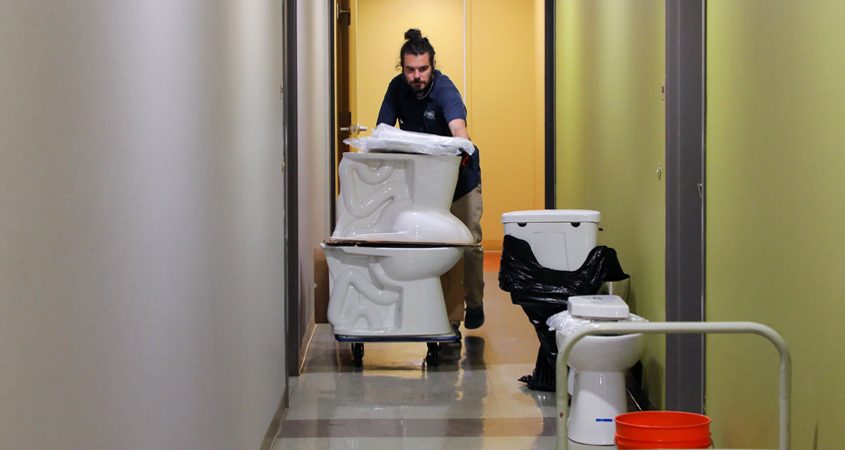
The Water Authority has partnered with San Diego Gas and Electric to install nearly 4,000 WaterSense-labeled showerheads and 2,213 water-efficient toilets for residents. A $3 million grant from the California Department of Water Resources Urban Community Drought relief grant program will fund the installation of 7,300 additional toilets and smart irrigation controllers. The upgrades will save about 6,000 acre-feet of water. Replacing inefficient or leaking toilets with high-efficiency models reduces water use by 60%.
March Fix a Leak Week 2023
Regional water agencies help customers save water and money
The Vallecitos Water District added a new video for 2023 to its award-winning series helping customers find and fix leaks to save water and money. This year, Vallecitos Water District asks viewers to take the “10 Minute Challenge.”
The Sweetwater Authority is offering tips for consumers and rebates of up to $75 for leak repairs made through June 30. Consumers can schedule a free water audit by calling the Water Efficiency Hotline at 619-409-6779 or email waterefficiency@sweetwater.org.
The Sweetwater Authority also offers customers a $75 rebate to replace or install a new pressure-reducing valve at their home. The valves help to address high pressure that can cause increased wear on fittings, making them more prone to leaks.
A rebate of up to $100 is also available for qualifying leak detectors and flow monitors, which can alert customers to potential leaks through an app on their smartphone. Check out all the water efficiency rebates: www.sweetwater.org/rebates.
Minor water leaks account for more than a trillion gallons of water wasted each year in homes across the United States. Photo: Rajesh Balouria
The Otay Water District offers helpful tips to fix leaks and save water on its website and its social media, including:
Check your water meter before and after a two-hour period when no water is being used. If the meter changes, you may have a leak. Visit otaywater.gov/how-to-read-your-meter to learn how to track your water use.
Place a few drops of food coloring in the toilet tank and wait 10 minutes without flushing. If color appears in the bowl, you have a leak.
Examine faucet gaskets and pipe fittings for any water on the outside of the pipe to check for surface leaks.
Easy fix for some leaks
Leaky showerheads or dripping faucets are often easy to fix, requiring common tools and hardware that can pay for themselves in water savings. How much? According to the EPA Fix-A-Week-Leak website, each average household with unaddressed leaks can account for 10,000 gallons of water loss every year, enough to wash 300 loads of laundry.
Investing just 10 minutes to perform a quick search of your home and fixing them can save an additional 10% on your water bill.
Check WaterSmartSD.org for tips and for more information about Fix a Leak Week.
To educate water users and promote the importance of repairing leaks to conserve and protect the water supply, Fix a Leak Week was created in 2009 by the Environmental Protection Agency WaterSense program.
(Editor’s note: The Vallecitos Water District, Otay Water District and Sweetwater Authority are three of the San Diego County Water Authority’s 24 member agencies that deliver water across the San Diego County region.)
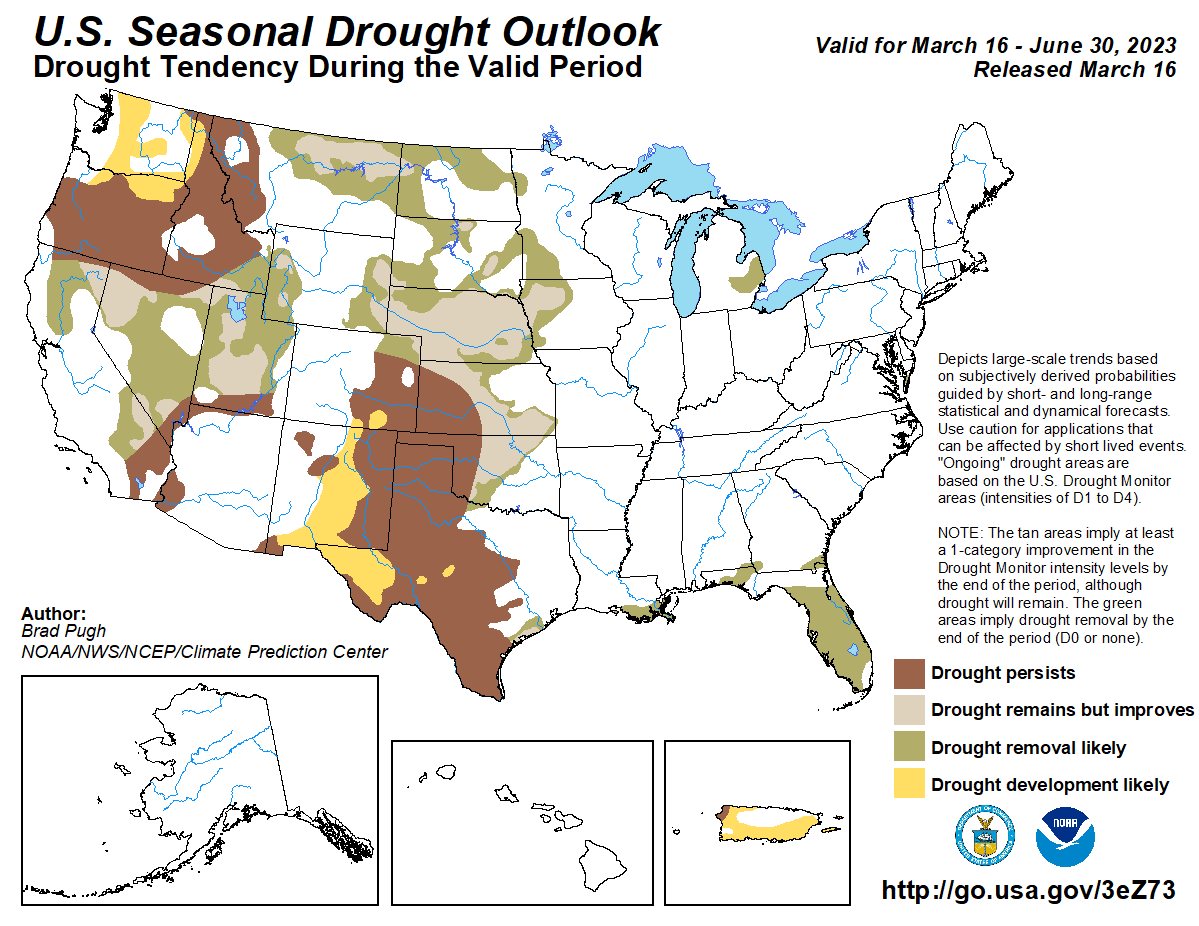
NOAA’s U.S. Spring Outlook indicates the abnormally wet winter will further improve drought across much of the western U.S. as the snowpack melts in the coming months. Winter precipitation, combined with recent storms, wiped out exceptional and extreme drought in California for the first time since 2020, and is expected to further improve drought conditions this spring.
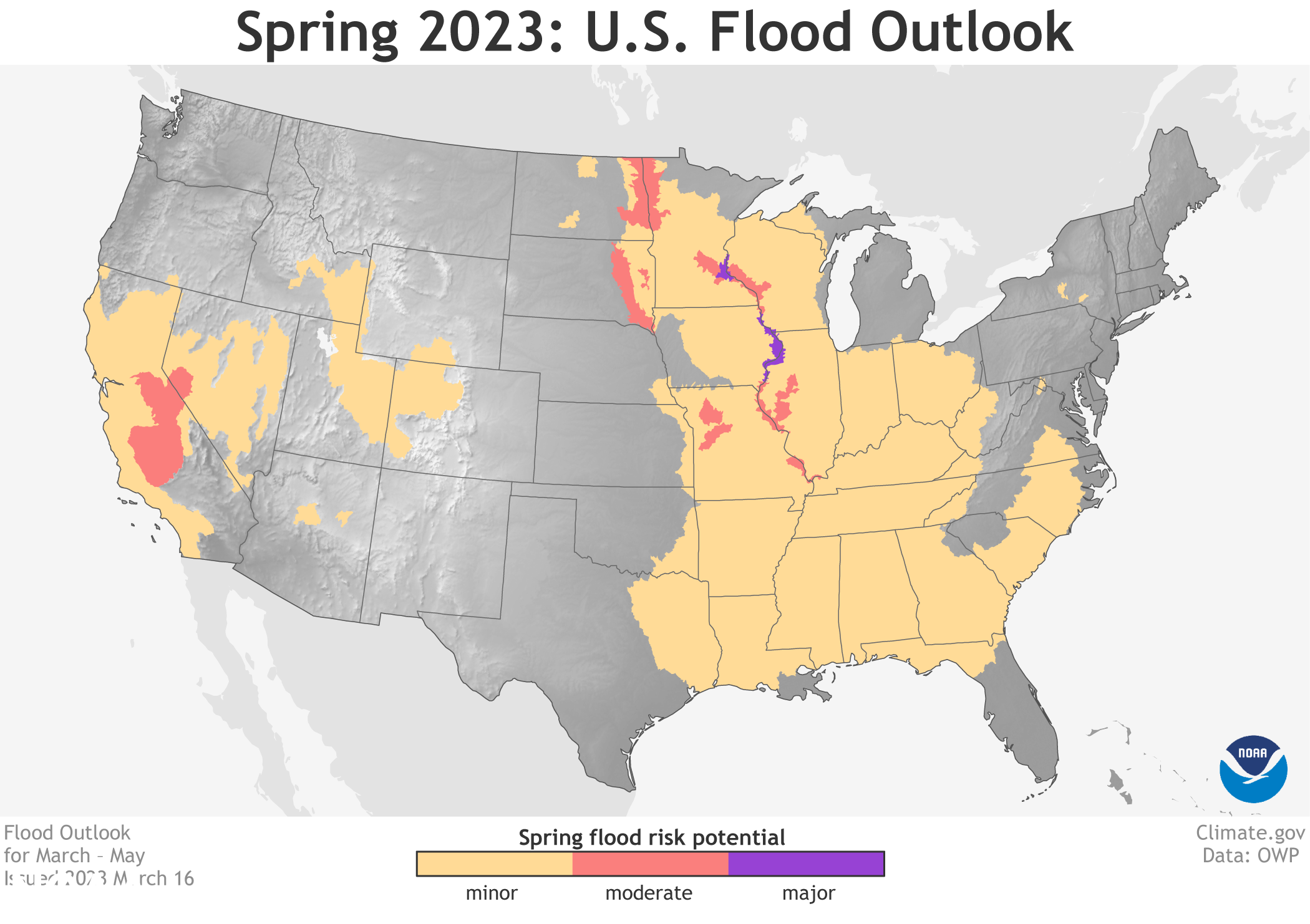
Significant flooding in the western U.S., especially in California, followed another series of strong Pacific storms that battered the region in March, and piled on to an already historic snowpack.
NOAA’s U.S. Spring Outlook highlights temperature, precipitation, drought and flood predictions for April through June to help the nation prepare for potential weather and climate threats to lives and livelihoods.
Climate change – wet and dry extremes
“Climate change is driving both wet and dry extremes, as illustrated by NOAA’s observations and data that inform this seasonal outlook,” said NOAA Administrator Rick Spinrad, Ph.D. “Under the Bipartisan Infrastructure Law and Inflation Reduction Act, and in support of the Biden Administration’s priority to tackle the climate crisis, NOAA will invest significant resources to build a Climate-Ready Nation that gives communities tailored information about changing conditions so that residents and economies are protected.”
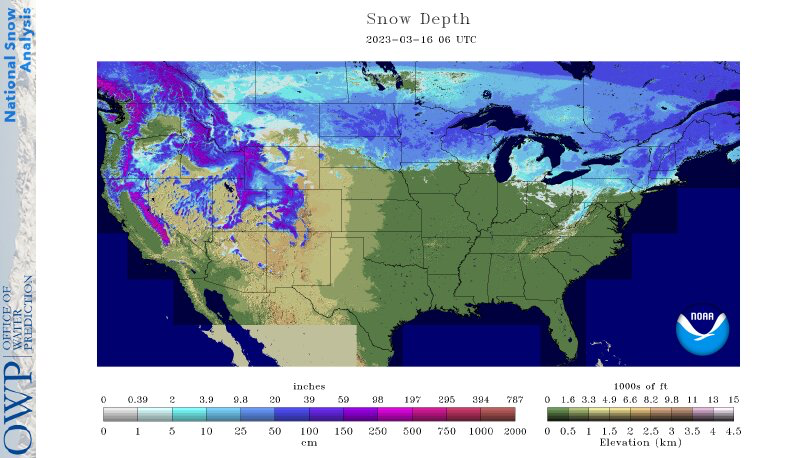
March Snow Drought Update
While the Snow Piles Up Across California and the Great Basin, Snow Drought Concerns Have Popped Up in Parts of the Northwest and Southern Colorado
Spring Outlook for drought, temperature and precipitation
On March 9, NOAA forecasters declared La Niña over. The El Niño-Southern Oscillation (ENSO) is a climate pattern, based on changes in rainfall and sea surface temperatures across the equatorial Pacific Ocean, that influences temperature and precipitation around the world. La Niña occurs when ocean temperatures are cooler than normal and rainfall is reduced in the eastern to central Pacific Ocean.
El Niño and La Niña
“La Niña has finally ended after being in place nearly continuously for more than two years,” said Jon Gottschalck, chief of the operational prediction branch at NOAA’s Climate Prediction Center, a division of the National Weather Service. “ENSO-neutral — the transition period between El Niño and La Niña — is likely to continue into the early summer with elevated chances of El Niño developing thereafter. ENSO-neutral is factored into NOAA’s Spring Outlook.”
Moderate to exceptional drought coverage across the U.S. is at its lowest since August 2020 and is likely to continue improving, or end entirely, across much of California and the Great Basin. The spring wet season is expected to improve drought conditions across parts of the northern and central Plains. Current drought conditions in Florida are expected to improve or go away during the next three months.
Areas of extreme to exceptional drought across parts of the southern High Plains are likely to persist through the spring season, with drought also expected to develop into parts of New Mexico. Across parts of the Northwest U.S. and northern Rockies, drought conditions are also expected to continue. Drought may develop into parts of Washington state.
Above-average temperatures are favored for much of the southern and eastern half of the U.S. For April through June, the greatest chance for above-average temperatures exists from the southern High Plains eastward to Florida, and northward along the East Coast. Above-average temperatures are also likely for Hawaii and northern parts of Alaska. Below-average temperatures are predicted for the central Great Basin and the northern Plains.
California endures flooding, landslides, and evacuations
Parts of central and southern California that were still reeling from heavy snowfall earlier this month received yet another powerful atmospheric river which exited the region on March 15. Flooding, landslides, power outages, and evacuations are among the many impacts residents faced from the recent storm. The above graphic depicts most of the state receiving between 300-600% of normal precipitation over the last seven days. — USDA Water and Climate Update
Below-average precipitation like for the Southwest
NOAA forecasters predict above-average precipitation this spring across the Great Lakes, Ohio Valley, and into parts of the mid-Atlantic and Northeast. Below-average precipitation is most likely for the Southwest and parts of the Pacific Northwest.
https://www.waternewsnetwork.com/wp-content/uploads/2023/03/DWR-March-3-2023-snow-survey-Primary-1.jpg450845Mike Leehttps://www.waternewsnetwork.com/wp-content/uploads/2024/04/WNN-Horizontal-White-Blue2.pngMike Lee2023-03-16 15:00:592023-03-16 17:26:55NOAA Spring Outlook: California Drought Cut by Half with More Relief to Come
A new recycled water pipeline is being tapped by Olivenhain Municipal Water District customers for landscape irrigation.
Olivenhain Municipal Water District has successfully converted Westmont of Encinitas to recycled water for landscape irrigation. The assisted living facility is the first of many customers along the Manchester Avenue and South El Camino Real corridor to tap into the newly installed recycled water pipeline.
https://www.waternewsnetwork.com/wp-content/uploads/2024/04/WNN-Horizontal-White-Blue2.png00Mike Leehttps://www.waternewsnetwork.com/wp-content/uploads/2024/04/WNN-Horizontal-White-Blue2.pngMike Lee2023-03-16 10:20:532023-03-16 12:49:28Recycled Water Pipeline Benefits Olivenhain Municipal Water District Customers
Encinitas, Calif. — Olivenhain Municipal Water District has successfully converted Westmont of Encinitas to recycled water for landscape irrigation. The assisted living facility is the first of many customers along the Manchester Avenue and South El Camino Real corridor to tap into the newly installed recycled water pipeline.
Additional customers along the corridor are working to convert their irrigation systems to accommodate the new recycled water supply, which will ultimately reduce demand for imported potable water by more than 27 million gallons every year. As the impact of California’s drought continues to be challenging, projects like this that help save potable water are even more urgent.
https://www.waternewsnetwork.com/wp-content/uploads/2018/04/Olivenhain-Logo-Square.jpg200200Mike Leehttps://www.waternewsnetwork.com/wp-content/uploads/2024/04/WNN-Horizontal-White-Blue2.pngMike Lee2023-03-15 16:57:162023-03-15 16:57:16OMWD Converting More Customers to Recycled Water
Despite a rainy and snowy winter out west, Lake Powell and Lake Mead, the reservoirs that provide water for 40 million Americans, are at record low levels due to the ongoing megadrought. Arizona is set to lose over 20% of its Colorado River water allotment this year alone. As Stephanie Sy reports, that’s leaving communities across the state scrambling to find alternatives.
https://www.waternewsnetwork.com/wp-content/uploads/2024/04/WNN-Horizontal-White-Blue2.png00Mike Leehttps://www.waternewsnetwork.com/wp-content/uploads/2024/04/WNN-Horizontal-White-Blue2.pngMike Lee2023-03-14 09:52:502023-03-14 10:46:49Persistent Drought and Overdevelopment Cause Record Low Water Levels for Tens of Millions
Encinitas, Calif. — In order to promote outdoor water use efficiency, Olivenhain Municipal Water District, San Dieguito Water District, and Santa Fe Irrigation District invite members of the public to attend a free WaterSmart landscape design workshop on Monday, April 3, from 5:30 p.m. to 7:30 p.m. The event will be held at the Encinitas Community and Senior Center at 1140 Oakcrest Park Drive in Encinitas.
Steve Sherman of California Landscape Technologies will provide an informative and interactive workshop that will feature methods to reduce outdoor water use and increase irrigation efficiencies. The workshop will provide homeowners simple, step-by-step approaches for creating attractive, water-wise landscapes that are easy to maintain.