Tag Archive for: Bureau of Reclamation

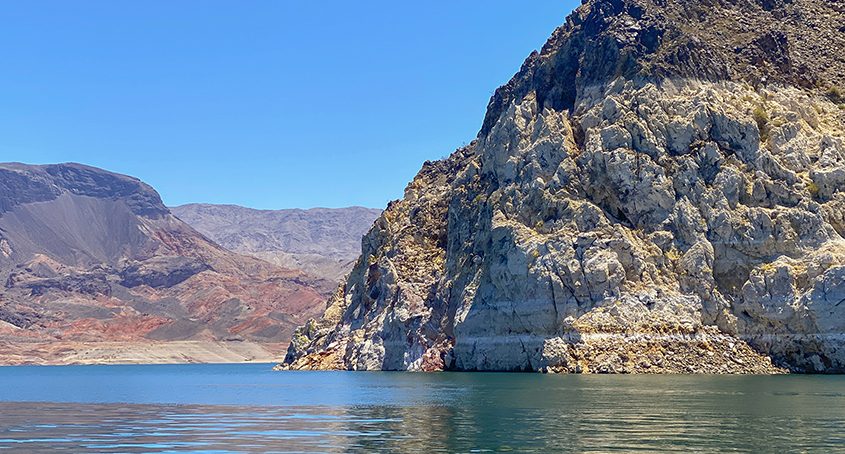
Low water conditions reveal the light-colored rink traces along the rock-wall shoreline at Lake Mead, showing the decreased water level from years of drought conditions in the Colorado River basin. Innovative water sharing agreements can help to mitigate this. Photo: Christopher Clark / U.S. Department of the Interior - Bureau of Reclamation

Board Approves Federal, Interstate Partnership on Colorado River

The San Diego County Water Authority’s Board of Directors today unanimously approved a landmark agreement to explore an interstate water transfer and exchange pilot program with the U.S. Bureau of Reclamation, the Metropolitan Water District of Southern California, and agencies in Nevada and Arizona.

The memorandum of understanding (MOU) – which still needs to be ratified by the other agencies – creates a pathway that could eventually allow the Water Authority to “move” water from the nation’s largest seawater desalination plant in Carlsbad to areas in the drought-ravaged Colorado River Basin that need more water. If successfully developed, this would create the first program to transfer water across state lines within the basin.

Such a program could help reduce water costs for working families in San Diego County by optimizing the region’s investments in reliability. Water purchases from the Claude “Bud” Lewis Carlsbad Desalination Plant would generate new revenues and offset costs for residents, improving regional water affordability.

“This agreement could be a gamechanger for San Diego County and the entire Southwest because it creates the possibility of a new, collaborative path for moving water where it’s needed most while keeping reliability and affordability at the center for ratepayers,” said Water Authority Board Chair Nick Serrano. “Leveraging existing resources like our Carlsbad desalination plant in this moment simply makes sense for everyone.”

Water transfers or exchanges would occur “on paper,” meaning agencies would access supplies through existing infrastructure and avoid costly new infrastructure.

The demand is clear: In recent years, agencies in Arizona and Nevada have sought ways to tap the Pacific Ocean, but the costs of construction are prohibitive. The Arizona Department of Water Resources, Central Arizona Water Conservation District and Southern Nevada Water Authority are part of the new MOU.

For more than 20 years, the seven states in the Colorado River Basin have wrestled with drought conditions that have created growing imbalances between water supplies and demands. As the Bureau of Reclamation, Basin States, Mexico, and tribal nations consider new operating guidelines for the river, new management strategies and interstate partnerships are increasingly critical.

Over roughly the same period, the Water Authority has invested $3 billion in water reliability efforts, including the Carlsbad plant, which produces up to 54 million gallons per day. Additionally, the 2003 Colorado River Quantification Settlement Agreement – which generates conserved water in the Imperial Valley – and hard-wired conservation in the San Diego region have positioned the Water Authority to not only meet the region’s needs but also provide relief to other areas.

“Next-generation strategies must include interstate partnerships that deliver water where it’s needed most,” said Water Authority General Manager Dan Denham. “We appreciate the collaboration with the Bureau of Reclamation, Metropolitan Water District, Arizona and Nevada. New ideas are challenging to implement, but it’s in everyone’s best interest to make this work.”
Trump Administration Mulls Intervention in California Dam Removal

In a major twist, the Donald Trump administration is now reviewing regional appeals to halt PG&E’s plans to dismantle the Potter Valley Project — marking the first time the 47th president has weighed in on the fate of the century-old Northern California water system that diverts Eel River flows into the Russian River watershed. The move follows a unified plea from farm bureaus in Lake, Mendocino, Sonoma and Marin counties, which warned that the utility’s plans would devastate local farms, economies and wildfire defenses across the North Coast.

Trump Seeks to Assert More Control Over California’s Water

The White House on Sunday released an executive order by President Trump that laid out a plan to exert the federal government’s role in California’s complex water management operations and claimed its authority to overrule state officials. The order, dated Friday, comes after Mr. Trump traveled to the state to see the devastation from wildfires that have been raging in Los Angeles for weeks.

(L to R) Escondido City Manager Sean McGlynn; Escondido Director of Utilities Angela Morrow PE; Escondido City Councilmember Michael Morasco; Deputy Mayor Christian Garcia; Escondido Mayor Dane White; Councilmember Consuelo Martinez; Councilmember Joe Garcia; Escondido Deputy City Manager Chris McKinney. Photo: City of Escondido water reuse

New Escondido Water Reuse Plant Supports Area Farmers

The City of Escondido achieved an important milestone in its efforts to create a high-quality alternative water source to support its local agricultural growers in August.

The city and its partners, including the Filanc Brown and Caldwell (FBC) Joint Venture, dedicated the newly completed water reuse treatment plant at an August 28 event. The AgX Membrane Filtration Reverse Osmosis Facility for Agriculture (MFRO Facility) is a first-of-its-kind facility producing water for agricultural use in California.

The new $65 million facility completed construction in November 2023.

Lowering costs, increasing water supply resilience

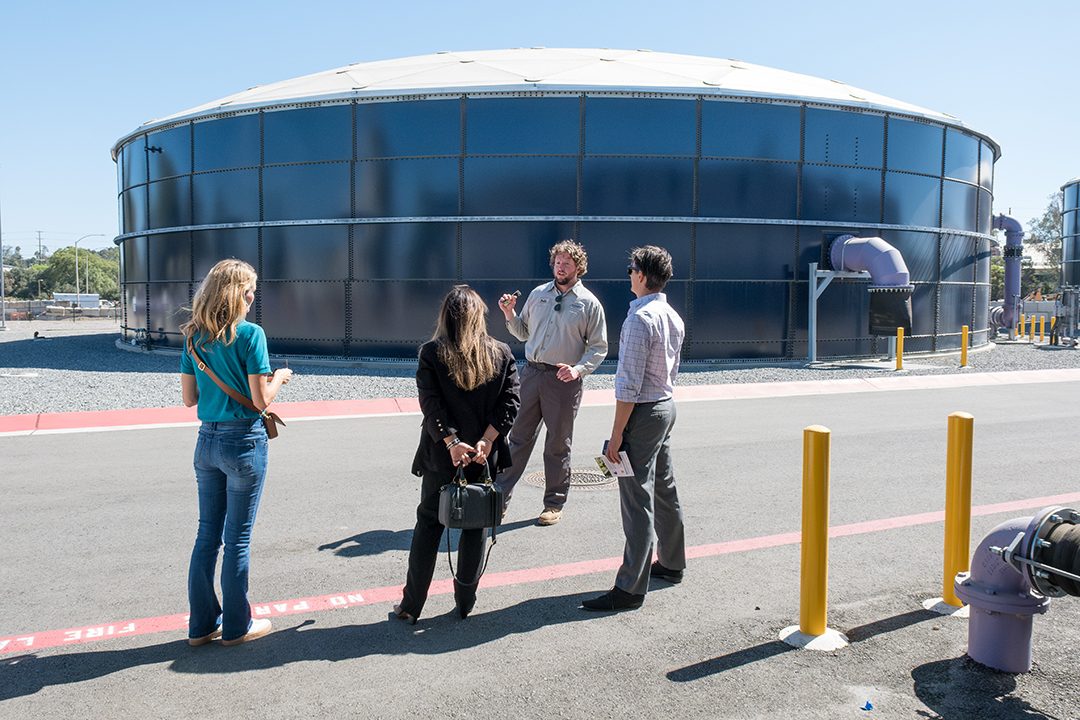
The exterior of the new AgX Membrane Filtration Reverse Osmosis Facility for Agriculture (MFRO Facility), a first-of-its-kind facility producing water for agricultural use in California. Photo: City of Escondido water reuse

The exterior of the new AgX Membrane Filtration Reverse Osmosis Facility for Agriculture (MFRO Facility), a first-of-its-kind facility producing water for agricultural use in California. Photo: City of Escondido

The AgX MFRO Facility takes water redirected from an ocean outfall, which was reaching capacity and would have cost hundreds of millions of dollars to upsize. Water is now redirected to the MFRO Facility and treated for beneficial reuse by producing water with salinity (salt) levels ideal for agriculture, such as avocado growers.

Farmers benefit from paying lower water rates. With agricultural water use shifted to this new supply, potable water the farmers previously used is now available for other users, increasing local water resiliency.

This project is a rare win-win water solution for augmenting supply while alleviating demand. In an era of water scarcity, it provides a sustainable, local supply and a cost-effective alternative to potable water.

“This is an important milestone for Escondido’s recycled water system,” said Angela Morrow, City of Escondido Director of Utilities. “The MFRO Facility will provide a reliable, affordable, and high-quality water supply to our agricultural community for generations to come while beneficially reusing wastewater and reducing our reliance on imported water.”

Escondido water reuse project funded through multiple agreements

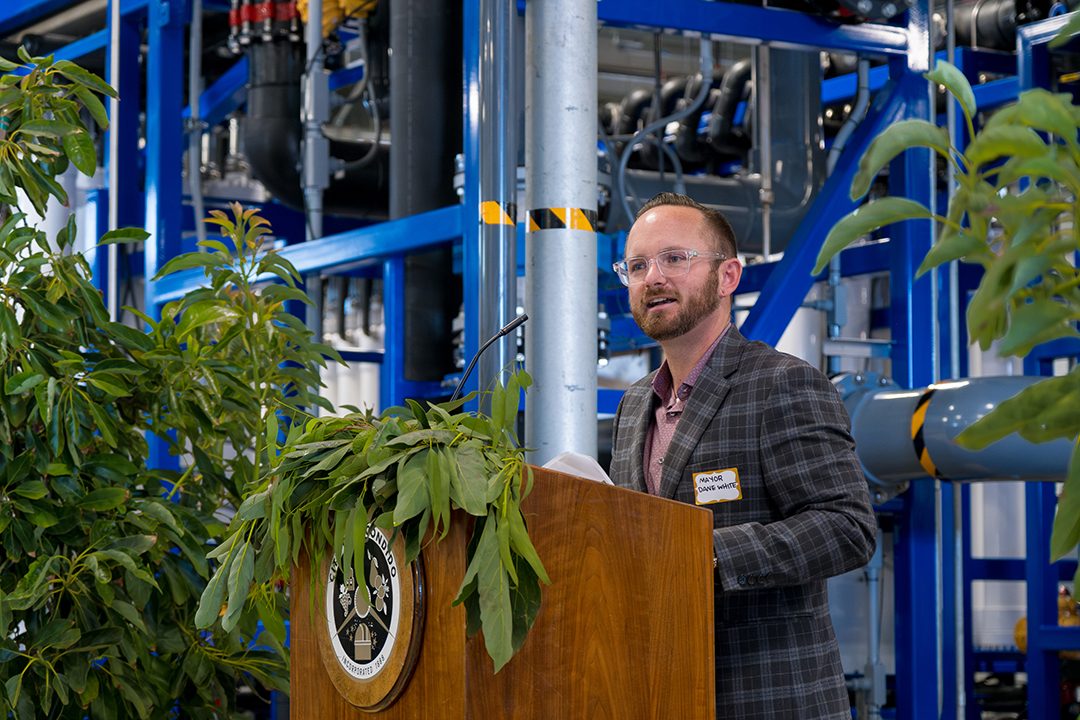
Escondido Mayor Dane White at the ribbon cutting for the new AgX Membrane Filtration Reverse Osmosis Facility for Agriculture (MFRO Facility). Photo: City of Escondido

Escondido Mayor Dane White at the ribbon cutting for the new AgX Membrane Filtration Reverse Osmosis Facility for Agriculture (MFRO Facility). Photo: City of Escondido

Funding for this project was provided in full or in part through an agreement with the State Water Resources Control Board and in part through agreements with the United States Department of the Interior, Bureau of Reclamation, and State of California, Department of Water Resources.

Headquartered in Escondido, Filanc is an award-winning general engineering and design-build contractor that solely constructs, renovates, and expands water and wastewater treatment, biosolids management, and waste-to-energy facilities throughout the Western United States.

Headquartered in Walnut Creek, California, Brown and Caldwell is a full-service environmental engineering and construction services firm with 50 offices and over 2,100 professionals across North America and the Pacific in operation for 75 years.


Two Congressmen Request Review after Times Report on Central Valley Water Heist

Two members of Congress have asked the Government Accountability Office to review how vulnerable the Bureau of Reclamation is to water theft following a Los Angeles Times report on an audacious and long-running heist from a federal canal in the Central Valley.

The facts related in the story “raise serious concerns about how widespread water theft is and what Reclamation can do to prevent water theft in the future,” Reps. Jarred Huffman (D-San Rafael) and Raul M. Grijalva (D-Ariz.) wrote in their letter requesting the review.

U.S. Government Awards $520 Million to Revitalize Aging Water Delivery Systems

Acting Deputy Secretary of the Interior Laura Daniel-Davis announced more than $520 million from President Biden’s Investing in America Agenda to revitalize aging water delivery systems across the western U.S.

California’s Lake Shasta Set to Fill Completely

Lake Shasta could reach its full capacity this spring, following a high amount of rainfall in California. The largest reservoir in California has been steadily rising since the beginning of March. It has gone up sharply since the start of the year, which saw its levels at 1,012 feet, compared to its current level on April 5 of 1,058 feet

US States to Conserve Land, Water With Solar On Canals

Three projects in California, Utah, and Oregon will soon integrate solar panels onto water canals, thanks to federal funding from the US Inflation Reduction Act (IRA), which allocated $25 million for PV installations co-located with water reclamation facilities.

Sites Reservoir Aims to Reshape California’s Water Landscape

Colusa County, California, could soon be home to the largest new reservoir in the state in 50 years. In accordance with the Bureau of Reclamation’s recommendation, Congress greenlit the allocation of $205.6 million in federal funding for the Sites Reservoir Project under the Water Infrastructure Improvements for the Nation Act (WIIN Act).

3 New California Agreements Announced to Save Colorado River Water; Billions Adding Up

The federal government announced three new conservation agreements to bolster water storage in Lake Mead and Lake Powell on Tuesday. The new agreements total about 400,000 acre-feet of water savings — more than twice the amount of Colorado River water used by Las Vegas over the past year.