Fallbrook, Calif. – Two seats are open in the November election for the Fallbrook Public Utility District board of directors. Local residents interested in serving on the FPUD board and wishing to take part in the election can now file for candidacy with the San Diego County Registrar of Voters office. The terms are for four years.
https://www.waternewsnetwork.com/wp-content/uploads/2018/05/FPUD-Logo.png200200Gayle Falkenthalhttps://www.waternewsnetwork.com/wp-content/uploads/2024/04/WNN-Horizontal-White-Blue2.pngGayle Falkenthal2018-07-12 16:57:422018-07-12 16:57:42Two Seats Open in the Nov. Election for FPUD Board of Directors
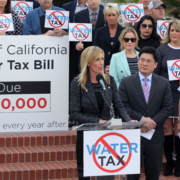
Due in part to vigorous statewide opposition by a coalition of business, civic, and water industry officials, a proposed $135 million per year tax on drinking water in California has failed to advance in the state Legislature. But opponents of the bill said their victory should be considered temporary, and the anti-water-tax coalition in San Diego County remains on alert for attempts to revive the proposal.
In June, the legislative Budget Conference Committee failed to approve a Brown Administration budget trailer bill that included the water tax, and the trailer bill was not a component of the final state budget package passed by the Legislature on June 14. The proposed drinking water tax would have raised about $135 million a year to help provide clean, safe water in disadvantaged communities, mostly in the Central and Salinas valleys, where groundwater has been contaminated by farming operations.
Tax proponents likely to renew efforts in August
Tax proponents are likely to renew their efforts to advance another water tax proposal in August, the final month of the legislative session. Several legislative vehicles could allow them that opportunity.
Regional leaders in San Diego understand the need to improve water quality in poor, rural areas of the state. However, they say that should be done without adding another tax burden to residents who live in one of the nation’s most expensive states. They have also said the tax undermines access to the very thing it aims to support – clean water – by making it more expensive.
In addition, there is a major concern with the lack of administrative infrastructure – including appropriate managerial, technical, financial, and operational expertise – within the communities and regions suffering from poor groundwater quality. Without the appropriate governance structure or administrative infrastructure in place to make lasting improvements, the proposed water tax will not provide a lasting solution.
Supervisor Kristin Gaspar, chairwoman of the San Diego County Board of Supervisors, officials from the San Diego County Water Authority and several of its member agencies, the San Diego County Taxpayers Association, the Industrial Environmental Association, and more than 30 agencies and organizations have voiced strong opposition to any effort by state legislators to impose a drinking water tax.
New legislation offers help to boost clean drinking water access
There are other ways to help boost access to clean drinking water statewide. Assembly Bill 2050 offers a more systemic, long-term approach. AB 2050 would authorize the creation of small system water authorities that will have powers to absorb, improve, and competently operate noncompliance public water systems.
Co-sponsored by Eastern Municipal Water District and the California Municipal Utilities Association, AB 2050 approaches the challenge of unsafe and undrinkable water sources within disadvantaged communities in a more methodical and well-structured manner, acknowledging the need to first improve service delivery infrastructure and governance structure of failing and noncompliant water systems as a condition precedent to any broader funding solution such as a water tax.
https://www.waternewsnetwork.com/wp-content/uploads/2018/07/TaxPrssConf.052318x018-845X450.jpg450845Gayle Falkenthalhttps://www.waternewsnetwork.com/wp-content/uploads/2024/04/WNN-Horizontal-White-Blue2.pngGayle Falkenthal2018-07-11 10:57:272018-07-11 10:57:27San Diego Coalition Remains Vigilant on Water Tax
San Diego, Calif. – Residents in San Diego can now receive $2.75 per square foot for replacing turf with sustainable landscaping features as part of a new Landscaping Transformation Program launched today across Southern California.
https://www.waternewsnetwork.com/wp-content/uploads/2018/05/logo-color-stacked-tagline-high-res.jpg534555Gayle Falkenthalhttps://www.waternewsnetwork.com/wp-content/uploads/2024/04/WNN-Horizontal-White-Blue2.pngGayle Falkenthal2018-07-10 08:24:412018-07-10 08:25:27New Landscape Transformation Program Increases Incentives in San Diego County
San Diego’s regional economy depends on cutting-edge industries such as life sciences, technology, aerospace, academia – not to mention the vibrant brewing sector. Together, those industries help drive economic prosperity countywide, and they share a basic need: reliable access to water.
It may seem obvious, but newly released numbers reveal just how vital a safe and reliable water supply is to the region’s economy.
And that’s just five industries. Total regional sales supported per day by reliable access to water amount to $482 million. That’s equivalent to 2.7 Comic-Cons every day.
A reliable water supply supports confidence by business in economic growth
Every day, the Water Authority delivers an average of 426 million gallons of water to 24 member agencies that serve 1.1 million households, more than 98,000 businesses, and 251,000 acres of farmland.
“One of the things that I think is really important about having a reliable water source is that it gives people confidence in our system,” Janice Brown, board chair of the regional EDC said during a late-June event to release the study. “And giving companies confidence in our system causes people to have more trust in economic growth.”
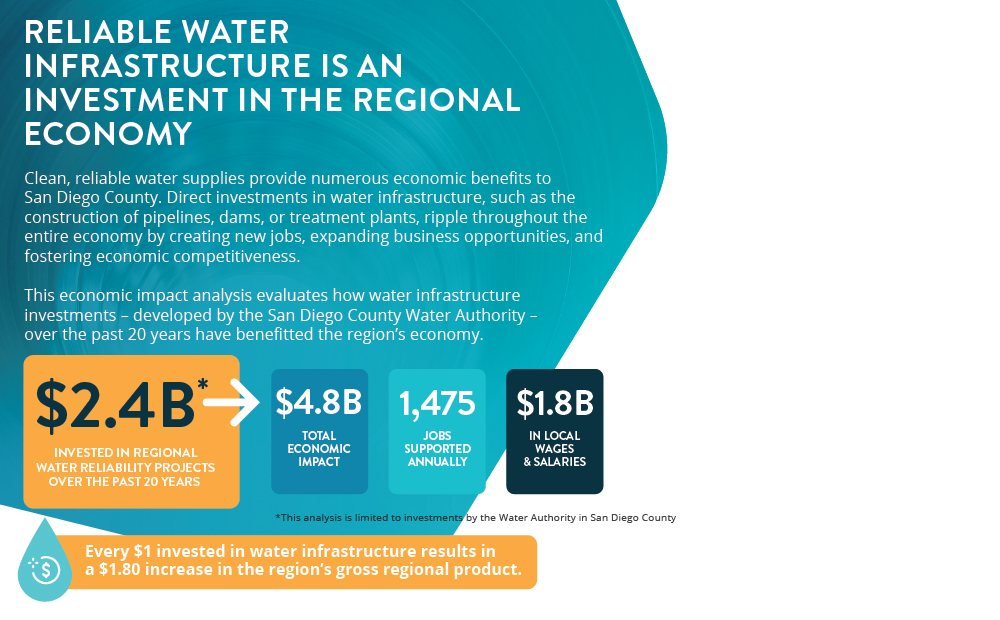
Over the past 20 years, the Water Authority has invested $2.4 billion in five major water reliability projects in the region, including new pipelines, dams and treatment plants, according to the EDC report, “The Importance of Water Reliability to San Diego’s Economy.” The total economic impact of these projects has been $4.8 billion over the past two decades.
Water reliability projects generate jobs in diverse fields
Water reliability generates jobs in a wide range of disciplines. Graphic: San Diego EDC
Regional water reliability projects, meanwhile, supported 1,475 jobs annually over the past 20 years. Just over half of these jobs have been in construction, but they also include jobs in architecture and engineering, retail, the restaurant industry, wholesale trade, real estate and other sectors.
Overall, more than 2,800 people work in the water and wastewater sector at the Water Authority and its 24 member agencies. Occupations include water resource engineers, water treatment operators, environmental scientists, hydrologists, and health and safety engineers.
Skilled water workforce development critical to the nation’s future
The Brookings report points to a need to diversify the national pool of water workers, more than half of whom have a high school diploma or less but benefit from high levels of on-the-job training that helps them develop transferable skills.
“Renewing the country’s infrastructure requires a sizable workforce, and improving water infrastructure offer enormous environmental and economic returns for residents in every community,” said Joseph Kane, a senior research associate and associate fellow at the Brookings Metropolitan Policy Program and lead author of the report.
Continued development of the nation’s water workforce will be critical as the nation renews aging infrastructure and tackles the challenge of income inequality, the Brookings report found.
In San Diego, regional water and education officials have long recognized that maintaining and enhancing the region’s robust water system will continue to require a talented, well-trained workforce.
Across the region, 58 programs create an educational pipeline for the water industry, according to the EDC report. They include programs at Cuyamaca and Palomar colleges and California State University San Marcos. The Water Authority and several member agencies also help prepare future workers through a regional program that has provided more than 150 paid internships since 2006 – many of which have led to full-time positions. More information about that internship program is at https://www.sdcwa.org/internships.
https://www.waternewsnetwork.com/wp-content/uploads/2018/07/Water-Workforce-845X450.jpg450845Gayle Falkenthalhttps://www.waternewsnetwork.com/wp-content/uploads/2024/04/WNN-Horizontal-White-Blue2.pngGayle Falkenthal2018-07-09 07:21:262018-07-09 07:21:26Water Fosters Innovation Economy in San Diego County
Wholesale water rates adopted today by the San Diego County Water Authority Board of Directors include some of the smallest increases in the past 15 years due to successful litigation against the Los Angeles-based Metropolitan Water District of Southern California and strategic use of financial reserves. They also highlight a historic shift in water costs: The Water Authority’s independent and highly reliable supplies from the 2003 Colorado River Quantification Settlement Agreement are now less expensive for the region than MWD, and that difference will grow in the years ahead.
https://www.waternewsnetwork.com/wp-content/uploads/2018/05/logo-color-stacked-tagline-high-res.jpg534555Gayle Falkenthalhttps://www.waternewsnetwork.com/wp-content/uploads/2024/04/WNN-Horizontal-White-Blue2.pngGayle Falkenthal2018-06-28 17:33:212018-06-28 17:33:21Wholesale Water Rates Kept In Check for 2019
Chula Vista, Calif. – At its June 13 meeting, the Sweetwater Authority Governing Board adopted its preliminary budget for the 2018-2019 fiscal year and accepted and filed a Five-Year Water Rate study. Over the next five years, the Authority will invest $72 million in water quality improvements, a new 36-inch transmission main pipeline, and necessary safety work to the Sweetwater and Loveland Dams.
https://www.waternewsnetwork.com/wp-content/uploads/2019/06/SWAbluelake-LR.png200200Gayle Falkenthalhttps://www.waternewsnetwork.com/wp-content/uploads/2024/04/WNN-Horizontal-White-Blue2.pngGayle Falkenthal2018-06-27 13:25:432019-06-25 12:00:32Sweetwater Authority Infrastructure Investment Secures Safe And Reliable Water For Its Customers
La Mesa, Calif. – Helix Water District’s Water Quality Report for calendar year 2017 has been published and posted to the district’s website. A Spanish version is also available. The annual Water Quality report contains important information about the source and quality of consumers’ drinking water.
https://www.waternewsnetwork.com/wp-content/uploads/2018/06/Helix-WD-Logo-Square.jpg200200Gayle Falkenthalhttps://www.waternewsnetwork.com/wp-content/uploads/2024/04/WNN-Horizontal-White-Blue2.pngGayle Falkenthal2018-06-25 09:17:172018-06-26 17:49:55Helix Water District’s Annual Water Quality Report Now Available For Viewing Online
/in News, Supply & Demand/by Gayle Falkenthalby Water News Network Mentioned: Mark Muir, Joe Terzi, Janice Brown, Ronne Froman Quoted: San Diego County Water Authority
Dozens of partners from the San Diego region’s second largest industry, tourism, joined the San Diego County Water Authority for a special event aboard the USS Midway on the first day of summer, June 21, kicking off a new education and outreach campaign called ‘Brought To You By Water.’
The Water Authority program underscores the importance of water reliability to the region’s core industries, focusing on examples including tourism, manufacturing, agriculture, and craft brewing.
Watch video of the Brought to You Be Water kickoff event.
The EDC report underscores the importance of regional investments in clean, reliable water supplies to the San Diego region. It focused on more than $2.4 billion invested by the Water Authority in five major water reliability projects over the past two decades. Those projects generated $4.8 billion in total economic impact, supporting an average of 1,475 jobs annually over two decades and creating more than $1.8 billion in local wages and salaries. The report also found that access to safe and reliable water supplies supports $482 million in total regional sales of goods and services daily. “This figure is equivalent to the economic impact of nearly three Comic-Cons a day,” said Janice Brown, EDC board chairperson.
In addition, the report shows more than 2,800 people work in the water and wastewater sectors at the Water Authority and its 24 member agencies. The water industry provides career opportunities across all levels of educational attainment, in everything from customer service to engineering.
The Water Authority’s yearlong Brought to You by Water educational program explains how San Diego’s thriving economy and quality of life are all made possible by the safe and reliable water supply provided by the Water Authority and its 24 retail member agencies.
San Diego’s $17.9 billion tourism industry took center stage at Thursday’s event on the popular USS Midway Museum, with representatives and displays from the San Diego Tourism Authority, San Diego Zoo and Safari Park, LEGOLAND California, Balboa Park, Living Coast Discovery Center, the USS Midway, and additional attractions.
Local visitor industry shows the significance of safe and reliable water supplies
San Diego County attracts 35 million visitors annually, including 17.3 million hotel nights a year, more than 100 major conventions, and 194,000 tourism jobs. “Think about the pools, think about all of the attractions, think about the great parks. Balboa Park would not be Balboa Park without the opportunity to use water,” said Joe Terzi, President and CEO of the San Diego Tourism Authority.
In addition, the Water Authority is partnering with leaders in additional key economic sectors to showcase the significance of safe and reliable supplies to those industries. The outreach and education program includes a series of videos about the region’s iconic industries, which can be viewed and shared on social media, and a targeted advertising campaign. To watch the videos, go to: b2ubyh2o.org
Manufacturing: Nearly every one of the San Diego region’s groundbreaking 4,000 manufacturing facilities relies on water for washing, fabricating, cooling and other processes, which generate $23 billion in economic activity across 300 industries from world-famous guitars to Navy ships.
Craft Brewing: San Diego is justifiably proud of its $870 million a year craft brewing industry. But no one would enjoy a single pint wouldn’t be possible without safe and reliable water.
Coffee: Beer isn’t the only beverage making an impact in San Diego. The region is also home to a burgeoning coffee industry – another sector that values water as a core ingredient.
Agriculture: San Diego County’s farms produce nearly $2 billion annually in sales. Our region’s temperate climate and reliable water supplies support 5,500 local farms on more than 250,000 cultivated acres – plus numerous farmers markets, restaurants and grocery stores stocked with our local bounty.
Brought To You By Water outreach and education program activities planned
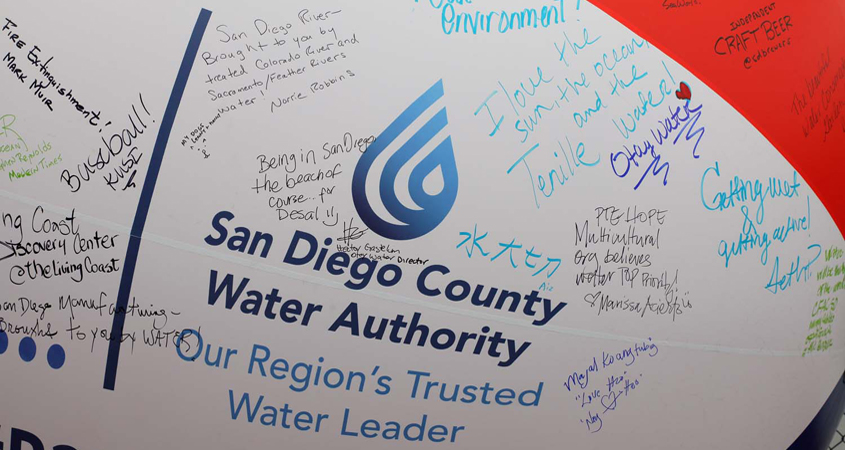
The ‘Brought to You By Water’ beach ball will travel to public events and gather more signatures this summer. Photo: Charlie Neuman for Water Authority
The “Brought To You By Water” program will be covered on the Water Authority’s newly created Water News Network, a regional online hub for water news and information at WaterNewsNetwork.com
“Over the next year, the Water Authority and its member agencies will make a special effort to highlight how our safe and reliable water supplies are critical to our economy, and quality of life,” said Mark Muir, Water Authority board chairman.
The Water Authority will participate in regional events for industry sectors, along with street fairs, farmers markets and other opportunities to talk about water with residents in the coming months. These events will feature a highlight of today’s kickoff, a giant beach ball – eight feet in diameter – branded with the Brought to You by Water logo and signed by guests at the conclusion of today’s event.
For more information about Brought to You by Water, visit B2UbyH2O.org
https://www.waternewsnetwork.com/wp-content/uploads/2018/06/B2U-Midway-Presser-845X450.jpg450845Gayle Falkenthalhttps://www.waternewsnetwork.com/wp-content/uploads/2024/04/WNN-Horizontal-White-Blue2.pngGayle Falkenthal2018-06-21 16:19:412018-06-26 17:49:55First Day of Summer ‘Brought To You’ By New Water Authority Education Campaign
Encinitas, Calif. — Olivenhain Municipal Water District’s Finance Manager, Rainy Selamat, presented the Certificate of Achievement for Excellence in Financial Reporting from the Government Finance Officers Association of the United States and Canada at the June 20 board of directors meeting. This award recognizes OMWD’s comprehensive annual financial report for the fiscal year ending June 30, 2017 and is the twenty-third consecutive year OMWD has received the award.
https://www.waternewsnetwork.com/wp-content/uploads/2018/04/Olivenhain-Logo-Square.jpg200200Gayle Falkenthalhttps://www.waternewsnetwork.com/wp-content/uploads/2024/04/WNN-Horizontal-White-Blue2.pngGayle Falkenthal2018-06-20 14:47:342018-06-28 15:00:13OMWD Acknowledged for Financial Reporting Excellence for Twenty-Third Consecutive Year
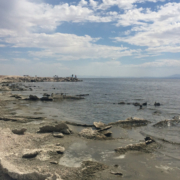
In a vote that was as important for its message as the funding it appropriates, California voters on June 5 supported Proposition 68, the $4.1 billion water bond that specifically included $200 million for Salton Sea restoration. That funding will support the ten-year phase one list of projects under the state’s Salton Sea restoration plan known as the Salton Sea Management Program (SSMP).
Coupled with $80 million for the sea from a previous bond, the $200 million moves the state closer to achieving its ten-year target of addressing 30,000 acres of exposed playa. Another water bond scheduled for the November election includes an additional $200 million for the sea to completely fund phase one of the SSMP.
Passage of Proposition 68, which voters in San Diego and Imperial County both supported, advances the SSMP at a time when there is growing concern on the state’s ability to build air quality and habitat projects to meet annual targets for playa coverage. In fact, the state has acknowledged the 2018 target of 500 acres will not be met. However, that delay is mainly due to finalizing land liability issues rather than a lack of funding. State officials working on the sea have indicated they are close to settling those issues and anticipate progress will be expedited once the necessary legal agreements are resolved. The passage of Proposition 68 means the state will be in an even better position to make up for lost time so targets can be achieved going forward.
The “yes” vote by California voters also sends an important message to the state that since additional resources have been allocated for restoration at the sea, better progress on meeting the established milestones is expected more than ever. Voters have armed the state with funding to push the SSMP forward, and it now falls upon the state to meet its responsibilities. According to the state’s SSMP ten-year planning committee meeting last week, there is a solid list of projects ready to move forward toward meeting annual targets. Those projects include ones that have been touted before, plus new projects state officials have added, at least one of which they say can be accomplished at a faster rate. Long heralded projects include the state’s Species Conservation Habitat (SCH) project. Phase one of that project, which is already funded, will address 640 acres, but with the funding from Proposition 68, additional phases of the SCH are expected to move forward. At total build-out, the SCH would address nearly 4,000 acres along the southern shore of the sea. Another project set to move forward by the year’s end is the 500-acre wetlands at Red Hill Marina on the southern shore.
According to state officials, a new 290-acre project on the southern shore will be developed as wetlands on the site of a planned geothermal project. Additional projects are planned for the northern shore under a perimeter lake proposal from Riverside County, and at least one project is under development near the communities closest to the sea.
The passage of Proposition 68 also comes as the state has begun the effort to consider longer term projects as well. Part of that effort has included a request for proposals for importing a new source of water supply to the Salton Sea. As many as 11 conceptual proposals were submitted, most of which involve importing water from Mexico, and were introduced during a recent public forum in Imperial County. Proposition 68 funding is not expected to go toward water importation projects. While the state plans to evaluate water importation proposals as a possible long-term effort, the current focus is on implementing the first ten years of the SSMP and getting projects on the ground to address air quality and habitat.
While it is likely concerns about the state’s progress will continue, thanks to California voters, the state now has the opportunity to prove the delays of the past will not continue and that there will be real headway toward addressing restoration. Additionally, state officials indicated at last week’s SSMP ten-year planning committee meeting that they intend to apply lessons learned thus far to other projects to help expedite implementation of the SSMP, understanding though, that each project is distinct as well. Now is the time for stakeholders to remain even more vigilant to make sure the pendulum swings toward greater progress.
https://www.waternewsnetwork.com/wp-content/uploads/2018/06/Salton-Sea-SDCWA845X450.jpg450845Gayle Falkenthalhttps://www.waternewsnetwork.com/wp-content/uploads/2024/04/WNN-Horizontal-White-Blue2.pngGayle Falkenthal2018-06-20 10:46:282018-06-26 17:49:56Proposition 68 Brings Critical Funding for Salton Sea and Sends Message to the State


 Those five water-dependent industry clusters – life sciences, technology, aerospace, academia and brewing – collectively support daily business sales of nearly $30 million, according to a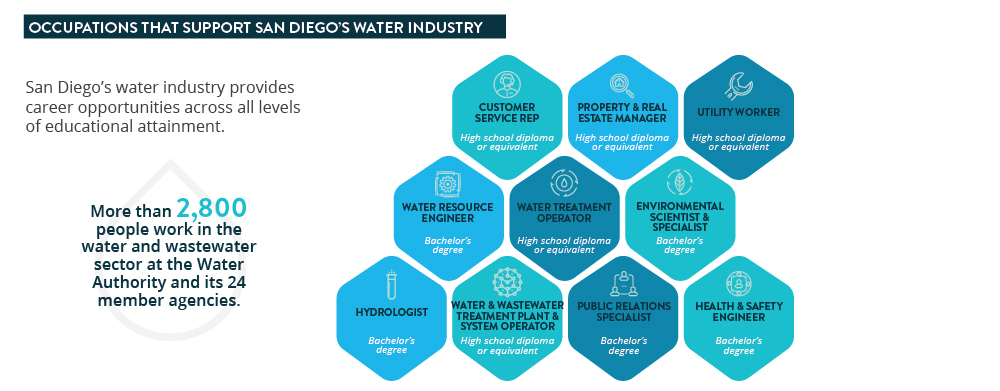
 Sweetwater Authority Logo 2019