You are now in Facilities & Operations News category.

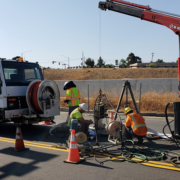
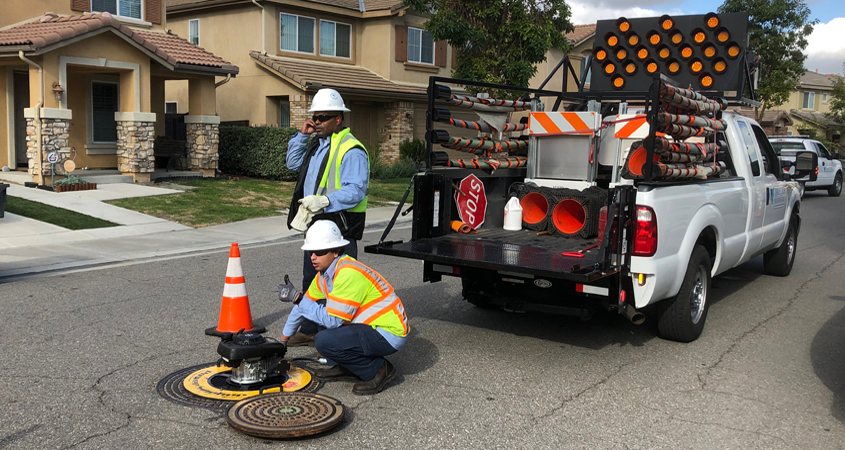
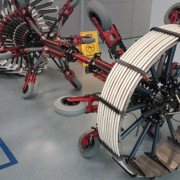
Vallecitos Water District Wastewater Collection Systems workers Raul Rodarte (left) and David Saavedra conduct smoke testing. Photo: Vallecitos Water District

Vallecitos Water District Smokes Out Wastewater System Problems

Problems in wastewater systems can’t hide behind a smokescreen at the Vallecitos Water District. The district’s Systems Collection Department routinely performs “smoke testing” of its wastewater system. This technique can easily locate flows caused by broken or incorrectly installed sewer pipes, lateral connections, or missing/broken clean-out caps.

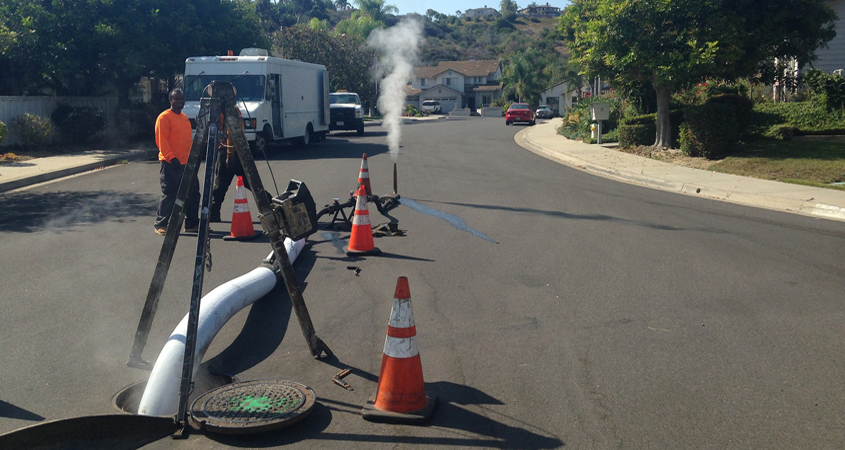
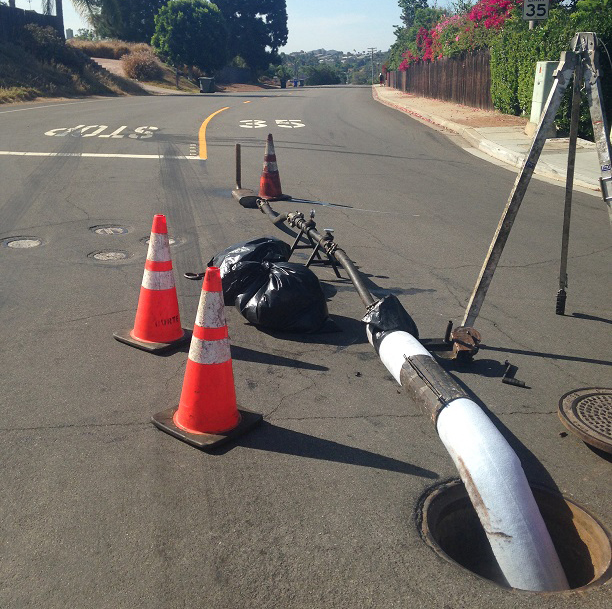
The test is performed by introducing smoke, comprised primarily of steam, through a device similar to a fog generating machine, into the wastewater systems. Staff can see if smoke comes out of the system through any leaks or breaches.

“We don’t want clean rainwater entering the sanitary sewer system, because we don’t want to treat clean water down at the treatment plant,” said Matthew Thompson, VWD wastewater collection worker. “We also don’t want to have an open system in case of an emergency, where liquids could exit the system.”

Residents are notified prior to any smoke testing in their neighborhood. The use of the smoke is an approved practice by the U.S. EPA and has no adverse health effects. The smoke used by VWD is non-toxic and dissipates quickly. During the testing process, residents can assist by monitoring the plumbing systems inside their homes to see if they have any internal problems.

Watch how the smoke testing process works in this video.

Crews inject smoke into the sewer system. It bypasses the living quarters of each residence before rising out of vents located on the roof. This is what crews are looking for, because it’s a good indicator there are no illegal hookups to the sewer. Smoke may also escape if the private sewer lateral clean-out is missing its cap.

If smoke emits from the home’s storm drain system or front yard, it could mean there is a possible illegal system connection, or an opening to the sewer that can lead to surplus water levels and subsequent sewer spills.

Field crews take care of any problems that may arise during testing. Residents are notified to disconnect illegal connections or face potential future fines. While the district does not maintain the plumbing inside homes, including the sewer lateral or the clean out, district crews will make simple, inexpensive repairs on the spot as a service to their customers. A doorhanger is left after any quick-fix is completed.

Vallecitos Water District Wastewater Collection Systems workers Dennis Richardson (standing) and David Saavedra inject smoke into the sewer system. Photo: Vallecitos Water District Smoke testing

Vallecitos Water District Wastewater Collection Systems workers Dennis Richardson (standing) and David Saavedra inject smoke into the sewer system. Photo: Vallecitos Water District

“Our ultimate goal is to make the customer happy, and that there is no interrupted service,” said Thompson. “If you see any of the wastewater crew out in the street, feel free to come talk to us and ask us what we’re doing. We’d love to share how we’re helping the system flow.”

In some cases, customers identify sewer problems themselves. District Systems Collection Department staff then determine the source of any potential problems, and how to resolve those problems.

Smoke testing isn’t new, but it might catch residents off guard. It has been used since the 1950s. For more than 10 years, smoke testing has proved to be a valuable ally in sewer maintenance. The Vallecitos Water District performs a minimum of four tests annually to keep its system operating at the optimum level.


San Diego regional water quality regulators issued a new permit for the development of permanent, stand-alone seawater intake and discharge facilities at the Carlsbad Desalination Plant. Photo: Water Authority

New Permit Fosters Sustainable Water Production at Carlsbad Desalination Plant

San Diego regional water quality regulators today issued a permit for the installation of new, technologically advanced and environmentally sensitive seawater intake and discharge facilities at the Claude “Bud” Lewis Carlsbad Desalination Plant.

The plant – and the new permit – support Gov. Gavin Newsom’s April 29 executive order for California “to think differently and act boldly by developing a comprehensive strategy to build a climate-resilient water system.”

Under the new National Pollution Discharge Elimination System (NPDES) permit, the Carlsbad plant will continue producing about 50 million gallons a day of high-quality, drought-proof drinking water for the region as Poseidon Water and the San Diego County Water Authority develop a permanent, stand-alone seawater intake and associated structures.

Environmentally sensitive facility

The new intake-discharge system is needed for long-term operations of the nation’s largest seawater desalination plant, which started commercial production in December 2015 using water withdrawn from Agua Hedionda Lagoon for once-through cooling at the Encina Power Station. So far, it has produced more than 46 billion gallons of drinking water with reverse osmosis technology.

“The Carlsbad Desalination Plant is an invaluable asset for the state and region that helps us adapt to the changing climate and sustain a $231 billion regional economy,” said Jim Madaffer, chair of the Water Authority’s Board of Directors. “It is the most environmentally sensitive and technologically advanced plant of its kind in the nation – part of our commitment to collaborative projects and integrated water solutions for San Diego and the Southwest.”

Water supply sustainability

The closure of the power station in December 2018 led to temporary intake-discharge operations that will continue while new, stand-alone desal intake-discharge facilities are built. Conversion to stand-alone operations was anticipated in the 2012 Water Purchase Agreement between Poseidon, which owns and operates the desalination plant, and the Water Authority, which purchases the water for regional use. Currently, the plant provides about 10 percent of the region’s water supply.

“We are very thankful to the Regional Board for supporting the environmental enhancements of the Carlsbad project and water supply reliability for San Diego County,” said Poseidon CEO Carlos Riva. “This plant will continue to be a vital regional resource for decades to come and an example of how environmental stewardship can go hand-in-hand with water supply sustainability.”

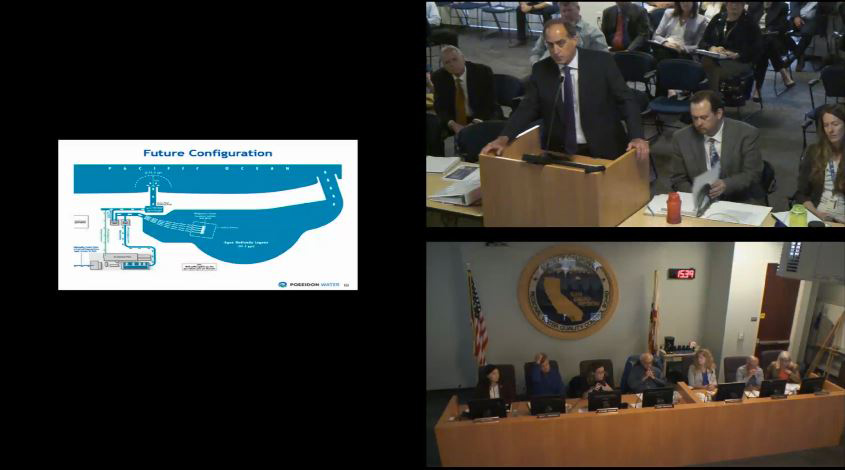
Peter MacLaggan, senior vice president of project development with Poseidon Water, describes the water quality improvement at the Carlsbad Desalination Plant during a regional water quality control board public hearing in San Diego on May 8, 2019.

Transition in three phases

With the permit in hand, the transition to the new intake and discharge facilities will be implemented in three phases:

  • Temporary Operations – NRG, which owns Encina Power Station, continues to operate the water circulation pumps while an interim intake system is constructed.
  • Interim Operations – Expected to begin in mid-2020, this phase uses new fish-friendly pumps as a replacement for the existing circulation pumps. A new, permanent screened intake system also will be designed and built in the lagoon during this phase of operation. The new intake will rely on innovative technology, including 1 mm screens that will further enhance marine life protection.
  • Permanent Operations – The new submerged, screened-intake system is expected to be connected in late 2023, achieving the best available technology to minimize impacts to marine life in full compliance with the 2015 California Ocean Plan Amendment.

Once permanent operations begin, the Carlsbad Desalination Plant will be the first to comply with the 2015 Ocean Plan Amendment, designed to advance ocean water as a reliable supplement to traditional water supplies while protecting marine life and water quality.

Environmental stewardship

Poseidon is also protecting the coastal environment by taking over responsibility for the preservation of Agua Hedionda Lagoon from NRG. As the lagoon’s steward, Poseidon Water is taking responsibility for ensuring the man-made lagoon continues to realize the life-sustaining benefits of an open connection to the Pacific Ocean through periodic maintenance dredging.

Dredging keeps sand from blocking the flow of ocean water in and out of the lagoon, maintaining its tidal circulation, which is needed to maintain a healthy marine ecosystem, support extensive recreational uses, sustainable aquaculture at Carlsbad Aquafarm, and a white seabass hatchery operated by Hubbs-SeaWorld. Dredging also helps replenish the sand on Carlsbad State Beach, which otherwise would revert to historical cobble-stone, with sand that is relocated from the lagoon to nearby shoreline.

Temporary operations are anticipated to cost about $6.5 million annually, increasing the cost of water from the plant in 2020 by about $135 per acre-foot. Permanent facilities are projected to cost between $66 million and $83 million. The Water Authority is seeking state grant funds to defray some of that cost.

The Water Authority purchases up to 56,000 acre-feet of water from the Carlsbad plant per year – enough to serve approximately 400,000 people annually. The plant is a major component of the Water Authority’s multi-decade strategy to diversify the county’s water supply portfolio and minimize vulnerability to drought or other water supply emergencies.

Alexander Schultz, Otay Water District geographic information systems technician, operates a drone in front of a district water storage tank. Photo: Otay Water District

Drones Offer Water Agencies Cost, Safety Benefits

Water agencies across San Diego County are saving time and money while improving employee safety with drones.

Industry analysts say drone use by water agencies worldwide is growing. The Helix Water District, Otay Water District and the San Diego County Water Authority have embraced the technology, using drones to inspect and monitor facilities, and to map and survey inaccessible areas.

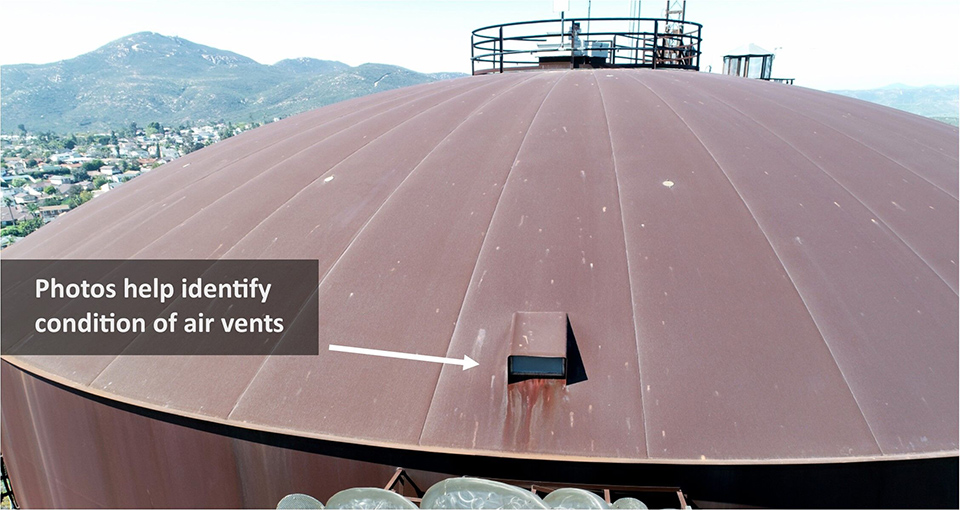
Helix used a drone in February to check rooftop air vents on a water storage tank in El Cajon, rather than send employees high in the sky to do it. The agency determined it was too risky for employees – even with safety equipment – and too costly to have staff inspect the vents outside the 120-foot-high Fletcher Hills Combined Tank.

“We continually look for ways to utilize technologies where appropriate to minimize facility down time and to keep staff safe,” said Carlos Lugo, general manager at Helix. “Drone technology is proving to be a useful and cost-efficient way to survey and keep the district’s facilities properly maintained.”

Drones provide a safe and cost-effective alternative for inspecting the condition of storage tank vents without placing employees at risk or taking the storage tank offline. Photo: Helix Water District

Drones provide a safe and cost-effective alternative for inspecting the condition of storage tank vents without placing employees at risk or taking the storage tank offline. Photo: Helix Water District

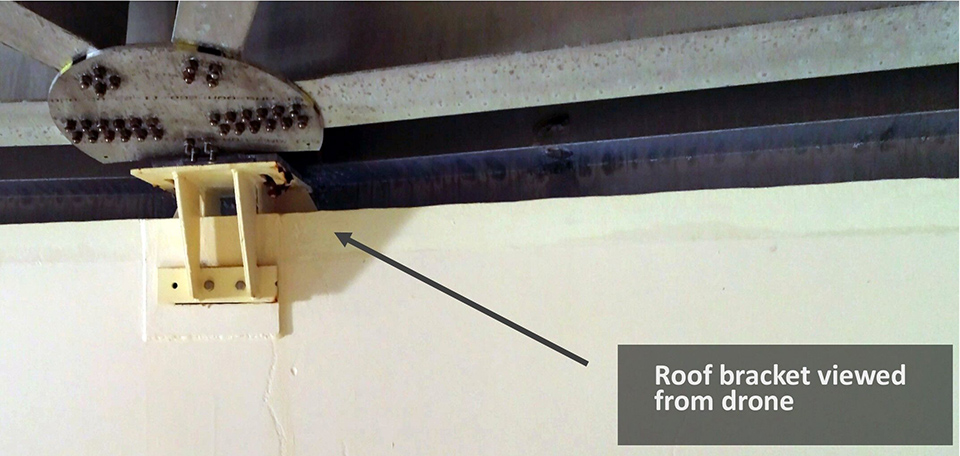
Helix uses drones to inspect interior roof supports of its water storage tanks. The supports are especially vulnerable to corrosion because they are constantly exposed to humidity and heat.

Drone image of a roof bracket inspection. Photo: Helix Water District

Drone image of a roof bracket inspection. Photo: Helix Water District

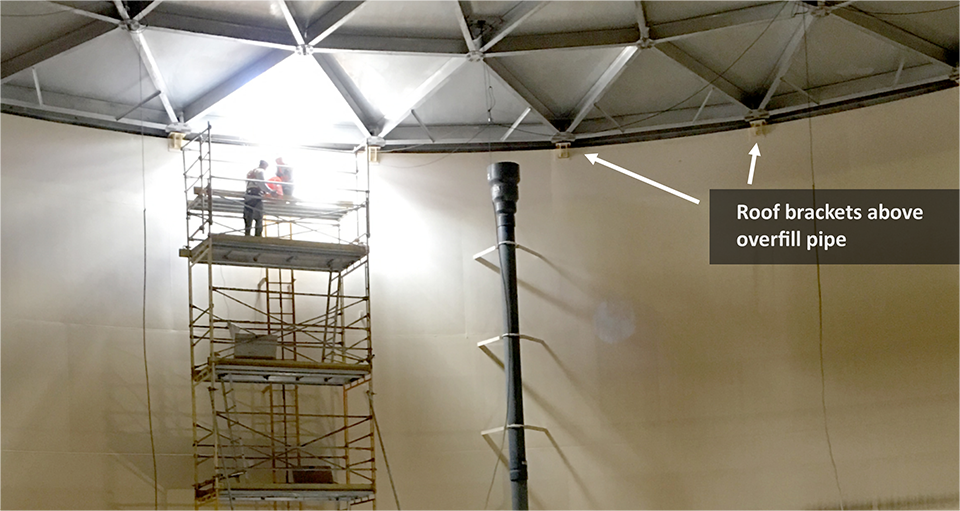
Inspecting the storage tank roof supports requires moving 30-foot-high scaffolding from one support to the next, a time-consuming and labor-intensive process. To cut down that time, Helix used a drone to get high-resolution images of the supports. The drone images showed which ones needed repair without moving the scaffolding to each support.

A drone helps reduce the need to move scaffolding to each bracket during inspections. Photo: Helix Water District

A drone helps reduce the need to move scaffolding to each bracket during inspections. Photo: Helix Water District

“Using drones for this type of inspection work is a simple, elegant and safe solution,” said Jim Tomasulo, Helix’s director of engineering. “We anticipate using drones for this and other purposes.”

Drone inspections of reservoirs, treatment plant

The Otay Water District also is finding drones useful to save money and improve employee safety.

After a two-year study and evaluation period, the district is now using two camera-equipped drones to assist with preliminary inspections of its water facilities in eastern and southern San Diego County, including 40 potable water reservoirs, four recycled water reservoirs, 20 pump stations and a recycled water treatment plant.

Drones Reduce Risk

Countywide, the Water Authority uses drones to monitor rights of way and to survey inaccessible landscapes.

When a drone was used to get images and video of steep terrain on the Second Aqueduct west of Interstate 15 and south of the San Luis Rey River, the images were 10 times higher resolution than stock aerial images. Using the drone also kept staff from being exposed to potentially dangerous conditions.

The Water Authority is also exploring using drones for future surveys and potentially at water transportation, treatment, and storage facilities, where cutting-edge technology is used to save ratepayers money.

Drones are helping the Water Authority monitor rights of way, particularly in areas of rugged terrain.

But the potential of drone use is not limited to visual photography of elevated water tanks and surveying remote areas.  Water quality monitoring is another potential application.

Water agencies can use drones with infrared cameras “to monitor water areas remotely at higher spatial resolution than ever before, at low cost and at any time,” Michal Mazur, with Drone Powered Solutions, told Waterworld.com in a recent article about the advances in drone use.

FPUD is embarking on a number of prevention, maintenance and improvement projects to safeguard and maintain its pipes and infrastructure. Photo: Fallbrook PUD

Fallbrook PUD Goes With the Maintenance Flow to Provide Reliable Service

Water pipeline blowouts like the one the day before Thanksgiving 2017 at the intersection of Stagecoach Road and Ranchwood Lane in Fallbrook provide periodic reminders about the realities of aging infrastructure.

Preventing these type of emergencies is the driving force behind planned shutdowns at water agencies such as the Fallbrook Public Utility District; investments today will avoid similar emergencies and unplanned water outages in the years ahead.

Many of FPUD’s pipes are more than 50 years old. A pipeline’s life can be 80 to 100 years, but many of the early lines that were installed were not put in at today’s standards and have shorter lives.

In fact, some of the early pipelines installed in the area were originally excavated from March Air Force Base in Riverside County and re-installed in Fallbrook, said FPUD general manager Jack Bebee. Many of these pipelines have reached the end of their useful lifespans.

That’s why FPUD is embarking on a number of prevention, maintenance and improvement projects to safeguard and maintain our pipes and infrastructure. Waiting to fix them after they break isn’t the most cost-effective and convenient way to operate.

“We’re trying to prevent a continued Band-Aid approach,” said Bebee.

Proactive approach prioritizes greatest need first

The shutdowns and retrofits are part of FPUD’s proactive approach to pipeline and valve replacement. By identifying pipes that are in the worst condition, the agency is prioritizing those needing to be replaced first, resulting in fewer pipe failures, blowouts and spills.

As part of its ongoing maintenance program, FPUD has refurbished six of its eight steel tanks over the past several years. It is also working on systematic valve replacement covering the entire community area. Valves are a critical component of water and sewer system infrastructure to limit the size of any shutdown.

Annually, the district also replaces or relines sewer manholes and sewer lines. Some of the manholes date so far back they are made of brick. Only FPUD’s sewer customers pay for sewer improvements, and only water customers pay for water improvements.

All FPUD construction work will be on weekdays between 7 a.m. and 4:30 p.m., with an exception for projects that disrupt businesses. Those projects may be scheduled overnight. FPUD customers will receive both a letter and phone call if the planned shutdown will affect their water service.

FPUD posts regular updates to its website at www.fpud.com and on its Twitter account, @Fallbrook water

Residents can also visit the FPUD Facebook page for other water-related updates.


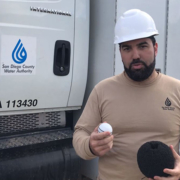
Water Resources Engineer Sami Sweis holds the Nautilus in his right hand and a foam ball in his left hand that the high-tech device is placed in before it is inserted into a water pipeline to scan for potential leaks. Photo: Water Authority

High-Tech Tools Help Detect Possible Pipeline Problems

It’s a whole new ballgame for the San Diego County Water Authority when it comes to finding leaks in major pipelines with cutting-edge technology.

One new tech tool deployed for the first time in February actually looks like a tennis ball that floats through water-filled pipelines scanning for potential trouble.

Of course, the new device is much more complex inside than a tennis ball – in fact, the Nautilus is among the most advanced tools of its kind in the world.  It not only detects defects that are invisible to the human eye, it does so without requiring pipes to be drained, which saves a significant amount of water and disruption to customers.

Innovation Leader

The Nautilus is just the latest component of the Water Authority’s cutting-edge Asset Management Program that has been adopting and developing innovative tools for more than two decades. In fact, the Water Authority has been recognized by the American Water Works Association as a leader in the water industry for its focus on asset condition assessment, risk management, proactive pipeline replacement, and use of cutting-edge technology that saves ratepayers money.

“These high-tech tools are cost-effective and fit perfectly with our proactive approach to managing our infrastructure, including 310 miles of large diameter pipelines and 1,400 pipeline structures,” said Nathan Faber, an operations and maintenance manager with the Water Authority. “Our mission is to find potential failures in the system in advance, rather than react after a failure.”

‘Listening’ for leaks

The Nautilus uses acoustic feedback to detect leaks or abnormalities in active pipelines without causing any disruption to water service or supply, Faber said. About the size of a tennis ball, the Nautilus is placed inside a larger, sterilized foam ball, to float through operating pipelines.

For the First Aqueduct scan, 26 sensors, called synchronizers, were installed on various structures on the outside of the pipeline. Those sensors relayed information to the Nautilus as it floated between checkpoints. No leaks were discovered in the tested portions of the pipeline.

Digital Resolution

A scan from the LIDAR device shows precise and highly-accurate digital measurements that pinpoint pipeline problems. Photo: Water Authority

A scan from the LIDAR device shows precise and highly-accurate digital measurements that pinpoint pipeline problems. Photo: Water Authority

Leveraging new technology to gather data and pinpoint pipeline problems saves water and money.

“Responding or reacting after failures can cost up to six times the cost of proactive repairs,” Faber said.

He pointed to a recent pipeline repair project in La Mesa, where a Light Detection and Ranging device, or LIDAR, was used inside a pipe to provide highly-accurate digital measurements.

“The LIDAR took 1,600 measurements in five seconds,” Faber said. “The high-resolution images showed stressed pipe and verified cracking issues that allowed crews to make an efficient, proactive repair.”


A $28.6 million project to rehabilitate more than four miles of large-diameter pipeline between Lake Murray and Sweetwater Reservoir was completed in June 2018. Photo: Water Authority

Water Authority Adapts to Overheated U.S. Construction Costs

Construction costs have surged across the nation over the past year as prices for materials used in construction have risen. At the same time, contractors are struggling to meet project deadlines due to a shortage of skilled workers, construction trade industry publication Constructive Dive reported on March 18.

Those higher construction costs are impacting local agencies, including the San Diego County Water Authority. Agency staff briefed the Board of Directors’ Engineering and Operations Committee in mid-March on how those market changes are driving up costs of infrastructure and maintenance projects.

“The Water Authority will monitor market trends and adjust individual project budgets as required,” said Gary Bousquet, the Water Authority’s deputy director of engineering. “Our planning process includes prioritizing projects, and evaluating the timing or need and scope of projects. We will adjust our project cost estimates to meet changing market conditions.”

Labor shortage adds to increasing costs

A labor shortage in the construction industry is one of several factors increasing costs.

“While construction hiring remained very widespread through January [2019], industry employment gains nationally slowed in February—possibly an indication that the pool of qualified workers has dried up in many markets,” Ken Simonson, chief economist with the Associated General Contractors of America, said in a new report.

The report showed that construction employment declined by 1,300 jobs in the San Diego region from January 2018 to January 2019.

“There are many large-scale construction projects underway in Southern California, while at the same time, there is a shortage of skilled and unskilled labor, which means greater competition for those workers,” said Brent Fountain, a principal engineer with the Water Authority. “In addition, increasing prices for materials are impacting the costs for both maintenance and capital projects.”

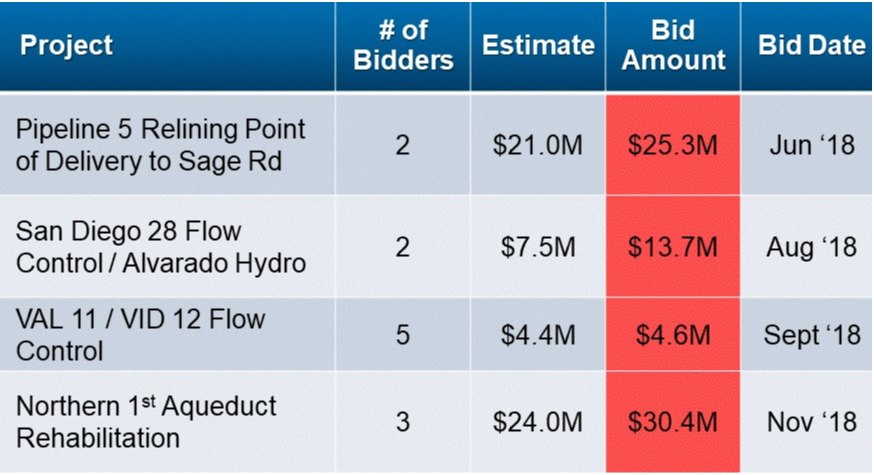
Water Authority project bids from contractors in 2018 ranged from $200,000 to $6 million over the project costs estimated by the Water Authority, according to Fountain.

Contractors bid above estimates in 2018

: In 2018, the Water Authority received 2-to-5 bids for projects, and the bids were all well-above agency estimates. Graphic: Water Authority

In 2018, the Water Authority received 2-to-5 bids for projects, and the bids were all well-above agency estimates. Graphic: Water Authority

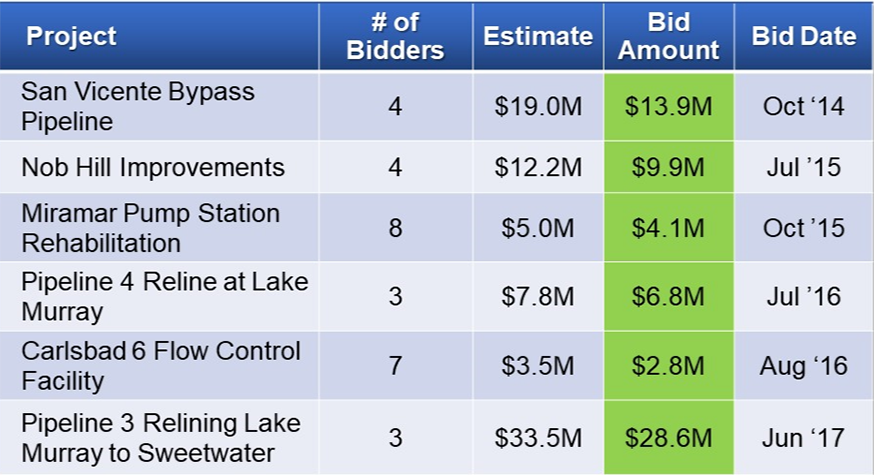
“We’ve received fewer bids at higher bid amounts from contractors for several projects in the past eight months,” he said. “The Water Authority generally had more bids and bid amounts closer to our project cost estimates, from 2014 through 2017.”

In previous years, bid amounts were typically closer to project cost estimates and sometimes the bids came in well below the estimates.

Contractors bid below estimates in prior years

From October 2014 through June 2017, the Water Authority received 3-to-7 bids for projects, and the bids were all below agency estimates. Graphic: Water Authority

From October 2014 through June 2017, the Water Authority received 3-to-7 bids for projects, and the bids were all below agency estimates. Graphic: Water Authority

Bousquet said the agency will monitor construction industry cost trends as it continues pioneering projects to serve the region.

“The Water Authority has made an array of innovative infrastructure investments over the past 25 years, including some of the largest projects in the history of the agency, to sustain the $231 billion regional economy,” said Bousquet. “We will continue to develop cost-effective projects to provide a safe and reliable wholesale water supply to San Diego residents.”

View looking north of the First Aqueduct right of way in Valley Center. Photo: Water Authority

Historic Pipeline Project Boosts Long-Term Water Reliability

San Diego County Water Authority crews successfully completed the first of three coordinated shutdowns of the First Aqueduct in early March to launch a major renovation of dozens of structures on two pipelines, including the historic Pipeline 1 that first delivered imported water to the region in 1947.

The series of shutdowns was carefully planned for nearly four years to minimize impacts on the community and retail water agencies during retrofits of Pipelines 1 and 2, which comprise the First Aqueduct.

“The First Aqueduct has been a very reliable source of imported water for more than 70 years,” said Chris Castaing, operations and maintenance manager at the Water Authority. “These critical upgrades will make sure we can operate and maintain the pipelines for another several decades to transport water to the region for future generations.”

Started during the Water Authority’s 75th anniversary year, the $30 million First Aqueduct structure and lining renovation project is among the most complicated pipeline retrofits in agency history.

During the next two years, upgrades include replacing the lining on the steel pipe sections; removing 19 associated structures; and retrofitting 41 structures – all without jeopardizing water service to the region.

Project will enhance reliability and flexibility of regional water system

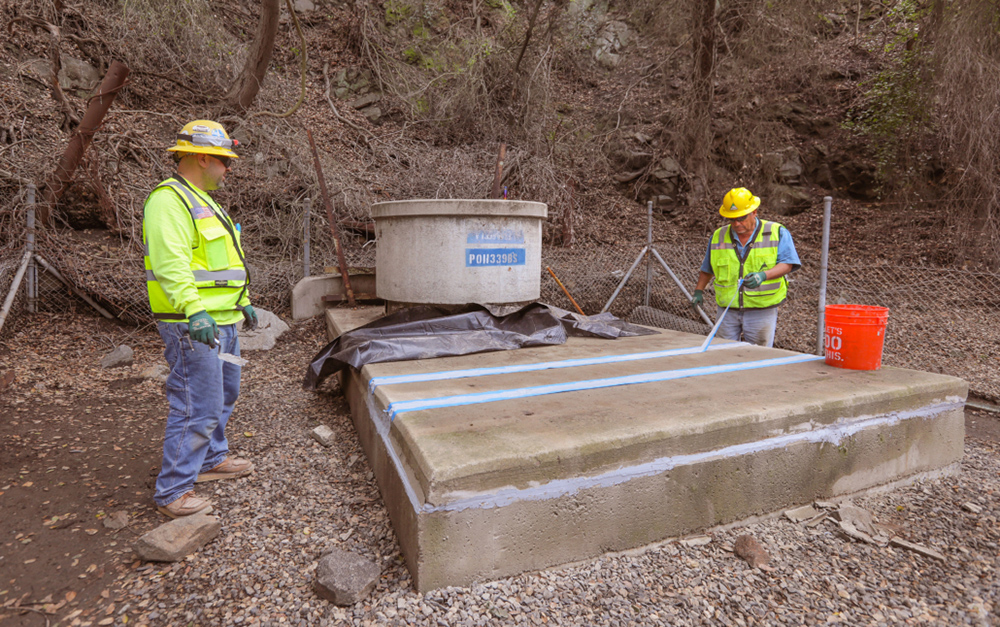
Crews complete work on and seal the top of a bifurcation structure. Photo: Water Authority

Crews complete work on and seal the top of a bifurcation structure. Photo: Water Authority

Pipeline structures that will be rehabilitated include valves, blowoffs, pump wells and access ways.

Approximately 4 miles of failing pipeline lining on the steel pipe sections will be carefully removed and replaced with new cement mortar lining. Cement mortar is the preferred material, because it protects the interior of the steel pipe from corrosion and premature failure, has a longer life, and is easier to maintain. The project also will add redundant connections to six flow control facilities between the two pipelines, greatly improving the aqueduct’s operational flexibility.

During the first shutdown between February 24 and March 5, crews isolated sections of the pipeline and took them out of service so work can be safely performed on those sections throughout the year. In late 2019, a second 10-day shutdown will allow crews to switch flows to the upgraded sections of pipe and isolate other sections for repairs.

In addition to completing the First Aqueduct structure and lining renovation project, the Water Authority also will perform assessments of 27 miles of the pipeline to determine if additional upgrades will be needed.

A wooden dam helped allow Operations and Maintenance crews to make repairs to a leaking pipeline valve. Photo: Water Authority Dewatering project

Quick Solution Keeps Pipeline Repairs on Track

When Water Authority crews began dewatering part of the region’s pipeline system for a 10-day shutdown in mid-November, they discovered a leaking valve that threatened to disrupt the time-sensitive operation.

At issue was a six-foot diameter valve in the Second Aqueduct that was designed to isolate a section of pipeline so workers could safely make repairs inside a dry section of the massive pipe. Instead, the valve was seeping water, which made it impossible to start the welding work slated for the relining project in Bonsall and Fallbrook.

The leaking valve was installed in 1980 and is at the end of its useful service life. While valve failure wasn’t an immediate threat, staff had to find a quick solution to avoid delays that could have impacted water deliveries to customers.

Each winter, the Water Authority coordinates with its 24 member agencies to schedule pipeline shutdowns when water demands are low so crews can conduct routine inspections and make repairs. Timing is always critical to ensure water agencies have adequate supplies while pipes are offline.

Strategy devised to allow successful and swift repairs

Water Authority Operations and Maintenance workers made repairs to a leaky pipeline valve. Photo: Water Authority

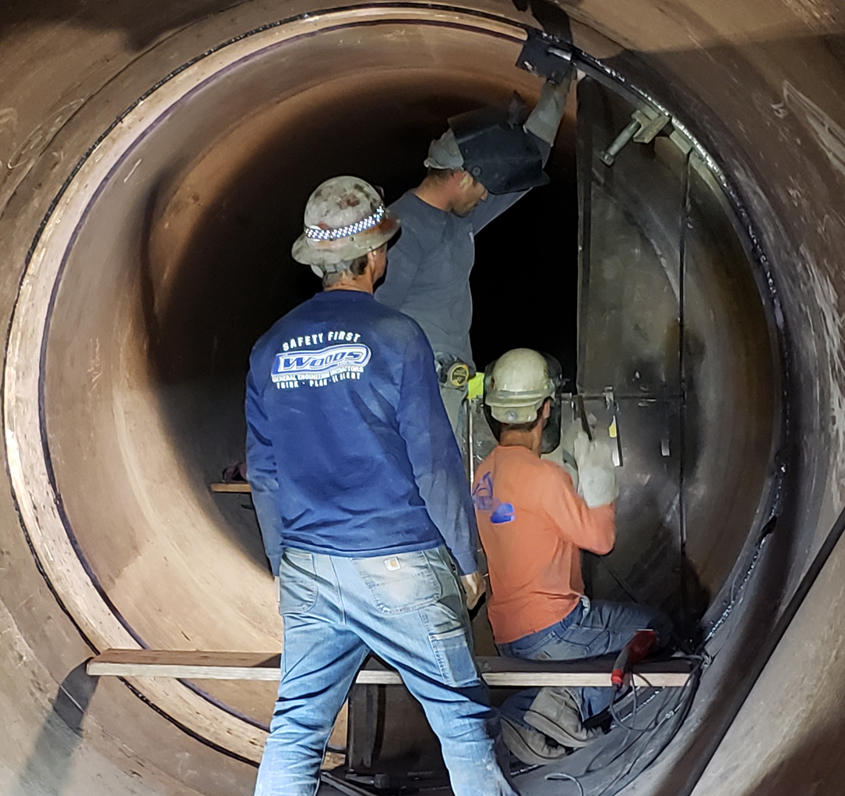
Crews begin installing an isolation bulkhead after seepage stopped by repairs. Photo: Water Authority

The leaking valve threatened to disrupt this year’s refurbishing plan, forcing the Operations and Maintenance Department to quickly assess several potential solutions, including using absorbent materials such as rice or oats to soak up excess water. The team quickly settled on a strategy to construct temporary dams inside the pipeline and divert the seepage while repairs were made.

First, crews built a dam with 200 sandbags just upstream of the leaking valve, redirecting water into another pipeline and away from the contractor’s workspace. Then, they constructed a secondary wooden dam to collect the trickle of water seeping past the sandbags.

The solution was successfully deployed in less than 48 hours, allowing the welding project to begin on time.

The $24 million Pipeline 5 Relining Project in Fallbrook is expected to conclude in summer 2019. Photo: San Diego County Water Authority

Pipeline 5 Upgrades Begin in Fallbrook

A $25.3 million Pipeline 5 relining project is under way in North County to improve the reliability of the San Diego region’s water delivery system. The project involves rehabilitating approximately 2.3 miles of one of the San Diego County Water Authority’s regional wholesale water pipelines in eight segments along a 9.5-mile stretch through the community of Fallbrook.

Construction work will be done in phases and completed in summer 2019. When finished, the Pipeline 5 Relining Project will help extend the service life of this vital piece of infrastructure for more than 75 years. Generally, relining construction rehabilitates segments of pipelines based on their age and the need for improvements.

Relining process advances in well-planned stages

Construction activities in Fallbrook began September 19 with the installation of protecting fencing, establishing an entrance to the construction area, and clearing the site of all vegetation and debris for safety. The relining itself will begin in November.

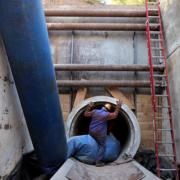
In broad terms, the relining process begins with dirt being excavated to create an access portal or work area. The construction crews will conduct most of the work underground, inside the pipe. They will access the pipe by excavating, establishing, and entering the pipeline through nine access sites, or portals. The portals will be 25-foot by 60-foot excavated pits, spaced approximately 525 to 2,500 feet apart. At each portal site, 40 feet of existing pipe is removed to permit access inside the pipe to install relining materials.

The work involves removing 20-foot sections of old concrete pipe at each portals. Then, new steel liners are inserted into the existing pipe using a specialized pipe cart. Liners are installed into the entire pipe section. Once installed, the joints of the liner pipe are welded together. Each new steel liner is coated with a cement mortar lining. Finally, portals are backfilled and — after pipeline disinfection — the pipe is ready to be put back into service.

Community kept informed about project’s progress

Much of the construction work associated with the project is in Water Authority rights-of-way. Some portals within the unincorporated San Diego County portion of the alignment will be in undeveloped areas.

As people living and working in the area begin to see the activity, project team members will be available to address questions or concerns. Contact information including 24-hour phone numbers, email contacts, and website links are posted on nine informational signs along the construction route. Construction workers on site will also have contact information to pass out on request.

For more information, residents can call the 24-hour project information line at (877) 682-9283, ext. 7009 or email . A representative from the project team will respond within one business day.

Pipeline upgrades ensure safe, reliable water supplies

The Water Authority’s large-diameter pipelines extend approximately 310 miles to convey water throughout western San Diego County. Approximately 82 miles of these pipelines were installed between the early 1960s and late 1980s with pre-stressed concrete cylinder pipes, or PCCP, made from a combination of steel and concrete. First used during World War II to help minimize the use of precious steel, this pipeline type is used extensively around the world.

Numerous failures of similar pipes nationwide prompted the Water Authority to take proactive measures to reinforce its PCCP type pipelines with steel liners in an strategic, multi-decade program starting in 1991.

In addition, in 2003 the Water Authority started using an innovative carbon fiber technology to conduct urgent pipeline repairs, helping ensure a safe and reliable water supply to the region.

When the Fallbrook project is finished, the Water Authority will have rehabilitated approximately 47 miles of PCCP — more than half of the total in the Water Authority system.

L.H. Woods working on one of its first projects for the Water Authority in 1960. Photo: Courtesy L.H. Woods

L.H. Woods & Sons Honored for 60 Years of Enhancing Region’s Aqueducts

After 60 years of work upgrading the San Diego regional aqueduct system, Vista-based L.H. Woods & Sons, Inc. was honored by the San Diego County Water Authority’s Board of Directors upon completion of the company’s final project under local ownership for the Water Authority.

The Board formally marked the successful conclusion of the $28.6 million Lake Murray to Sweetwater Reservoir pipeline relining project at its September 27 meeting. L.H. Woods reinforced 4.3 miles of large-diameter pipeline to extend its service life by decades. At the meeting, the Board adopted a resolution honoring Woods for decades of unequaled service to the region’s 3.3 million residents and its $220 billion economy.

L.H. Woods works on the 2nd Aqueduct in 1972. Photo: Courtesy L.H. Woods

L.H. Woods works on the 2nd Aqueduct in 1972. Photo: Courtesy L.H. Woods

Since Woods’ first Water Authority project in 1959 to excavate the Second Aqueduct, three generations of Woods have worked on approximately 40 projects  for the agency. Work includes construction of several pipeline segments in the 1960s, 70s and 80s; construction of the North County Distribution Pipeline in the 1990s; emergency pipeline repairs near the San Diego River in 2008; and several pipeline relining projects in recent decades.

“Nothing is more important to our region’s economy and quality of life than ensuring our pipelines continue to deliver water without interruption – and no company has played a bigger role in that effort than Woods,” said Jim Madaffer, chair of the Water Authority’s Board. “Woods brings to each project an innovative spirit and an unwavering commitment to excellence that benefits every person in our region every single day.”

L.H. Woods played key role in Water Authority relining project

L.H. Woods working on its final project within the Water Authority's relining program in 2017. Photo: Courtesy L.H. Woods

L.H. Woods working on its final project within the Water Authority’s relining program in 2017. Photo: Courtesy L.H. Woods

In September 2017, Woods started construction on the La Mesa to Sweetwater relining project. Crews conducted most of the work underground and used 17 portals to access the 66-inch and 69-inch diameter prestressed concrete cylinder pipe. Woods deployed specialized installation equipment built specifically for the Water Authority’s aqueduct system to install steel pipeline liners.

Much of the construction was in public rights-of-way in La Mesa on Baltimore Drive (south of the Laport Street-El Paso Street intersection), Nebo Drive (to University Avenue), and Spring Street. Work did not close any streets, through it temporarily reduced lanes for traffic. All construction equipment has been removed, and all streets have been restored.

L.H. Woods working on one of many projects within the Water Authority's relining program in 2000. Photo: Courtesy L.H. Woods

L.H. Woods working on one of many projects within the Water Authority’s relining program in 2000. Photo: Courtesy L.H. Woods

As a certified small business, Woods participated in the Water Authority’s Small Contractor Outreach and Opportunities Program, which is designed to maximize participation by small businesses in the agency’s procurements. In June, the company was purchased by J.F. Shea Co., Inc., one of the largest and oldest privately held construction companies in the nation. Shea’s storied history includes work on the Golden Gate Bridge, Hoover Dam and the pipeline connecting the Claude “Bud” Lewis Carlsbad Desalination Plant to the Water Authority’s regional water distribution system.

With the completion of the La Mesa to Sweetwater relining project, the Water Authority has relined 45 of the 82 miles of pre-stressed concrete cylinder pipe in its system.

An L.H. Woods crew works on emergency repairs for the Water Authority in 2008. Photo: Courtesy L.H. Woods

An L.H. Woods crew works on emergency repairs for the Water Authority in 2008. Photo: Courtesy L.H. Woods

Pre-stressed concrete cylinder pipes were commonly installed between the early 1960s and the late 1980s in water distribution systems throughout the world. This combination of concrete and steel initially appeared to provide unparalleled inner pipe strength and be highly resistant to corrosion. However, pre-stressed concrete cylinder pipes have not been as reliable as predicted, and the Water Authority is proactively relining sections of that pipe to extend their service life by at least 75 years.

The Water Authority’s relining program is an important part of its Asset Management Program, which helps avoid pipeline failures by identifying potential risks before they cause problems. To date, the Asset Management Program has saved water ratepayers more than $200 million by prioritizing repairs, avoiding unnecessary work and maximizing the service life of the region’s 310 miles of large-diameter pipelines.