Tag Archive for: Colorado River Board of California

Urban Water Management Plan-Water Authority-Primary photo-Colorado River Aqueduct

California Commits to Conservation, Collaboration in New Colorado River Framework

California’s water, tribal, and agricultural leaders today presented a comprehensive framework for a durable, basin-wide operating agreement for the Colorado River and highlighted the state’s proposal for conserving 440,000 acre-feet of river water per year.

At the annual Colorado River Water Users Association conference, California underscored the state’s leadership in conservation, collaboration, and long-term stewardship of shared water resources that inform its approach to post-2026 negotiations.

California takes a balanced approach, relying on contributions from the upper and lower basins to maintain a shared resource. California supports hydrology-based flexibility for river users, with all states contributing real water savings. Any viable framework would need to include transparent and verifiable accounting for conserved water, along with several other elements outlined in the California framework.

State leaders also noted that they are willing to set aside many of their legal positions to reach a deal, including releases from Lake Powell under the Colorado River Compact, distribution of Lower Basin shortages, and other provisions of the Law of the River, provided that there are equitable and sufficient water contributions from every state in the Basin and the country of Mexico.
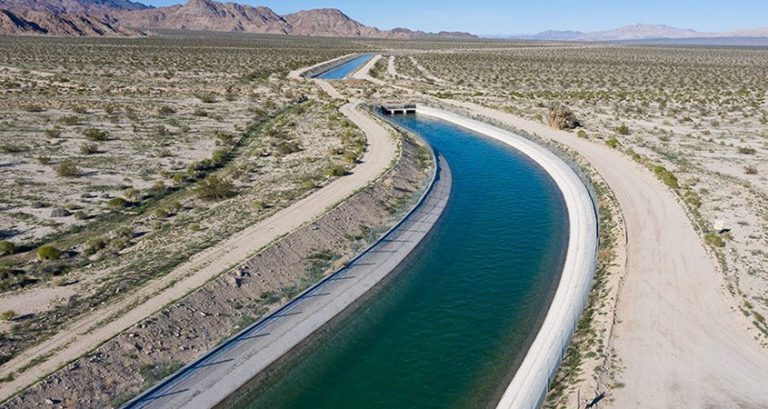
The Colorado River Basin provides essential water supplies to approximately 40 million people and 30 Tribal Nations, nearly 5.5 million acres of agricultural lands, and habitat for ecological resources across parts of several Western states (including Arizona, California, Colorado, Nevada, New Mexico, Utah and Wyoming) and Mexico.

Constructive California

“California is leading with constructive action,” said JB Hamby, chairman of the Colorado River Board of California. “We have reduced our water use to the lowest levels since the 1940s, invested billions to modernize our water systems and develop new supplies, partnered with tribes and agricultural communities, and committed to real water-use reductions that will stabilize the river. We are doing our part – and we invite every state to join us in this shared responsibility.”

Despite being home to 20 million Colorado River-reliant residents and a farming region that produces the majority of America’s winter vegetables, California’s use of Colorado River water is projected at 3.76 million acre-feet in 2025 – the lowest since 1949.

That achievement comes on top of historic reductions in water use over the past 20 years, led by collaborative conservation efforts. Urban Southern California cut imported water demand in half while adding almost 4 million residents. And farms reduced water use by more than 20% while sustaining more than $3 billion in annual output. Tribes also have made critical contributions, including nearly 40,000 acre-feet of conserved water by the Quechan Indian Tribe to directly support river system stability.

Going forward, California is prepared to reduce water use by 440,000 acre-feet per year – in addition to existing long-standing conservation efforts – as part of the Lower Basin’s proposal to conserve up to 1.5 million acre-feet per year, which would include participation by Mexico.  When conditions warrant, California is also committed to making additional reductions to address future shortages as part of a comprehensive basin-state plan.
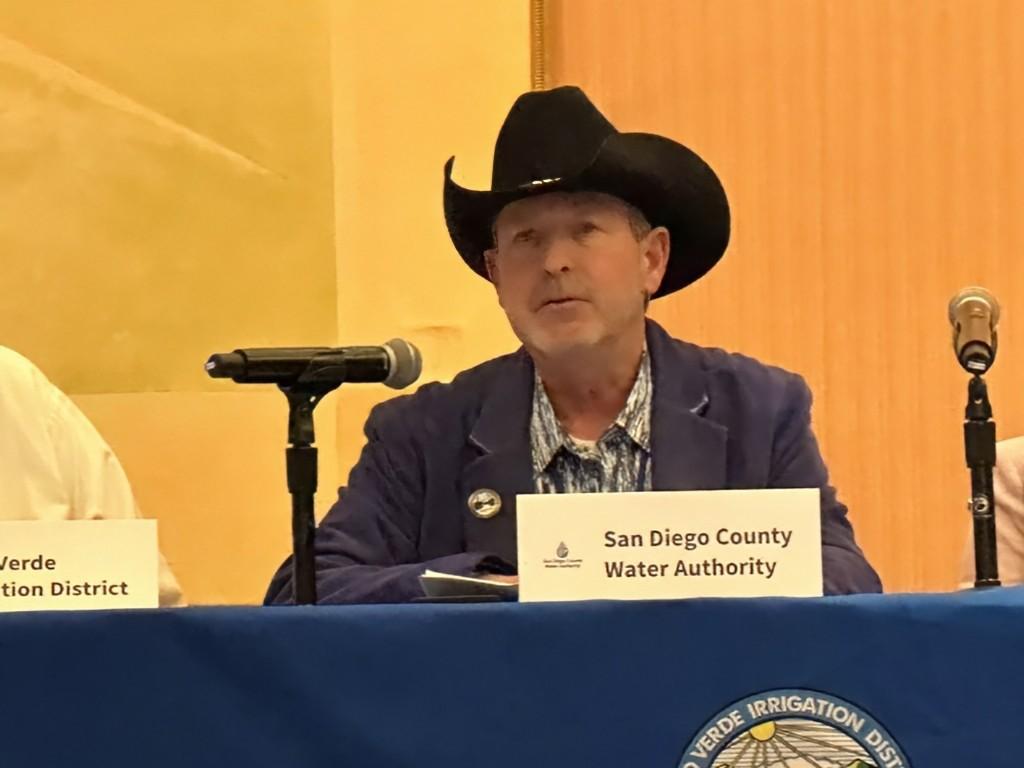
CRB Vice Chair and SDCWA Director Jim Madaffer at the 2025 CRUWA conference.

“The path to resiliency requires innovation, cooperation, and every Basin state’s commitment to conservation. The San Diego County Water Authority supports an approach that provides flexibility to adapt to changing climate conditions,” said CRB Vice Chair and SDCWA Director Jim Madaffer. “That means developing a new framework that allows for interstate water transfers to move water where it’s most needed and incentivizes the development of new supplies for augmentation.”

The state’s history of conservation illustrates what can be accomplished through collaboration, and all Colorado River water users in California are preparing to contribute to these reductions – agricultural agencies, urban agencies, and tribes.

Framework for a Post-2026 Agreement

In addition to conservation contributions, California provided a framework of principles for the post-2026 river operating guidelines to advance a shared solution for the seven Basin States, the tribes and Mexico. More specifically, California outlined the following key components for a new framework:

  • Lake Powell releases – California supports a policy of hydrology-based, flexible water releases that protects both Lake Powell and Lake Mead. Flexibility must be paired with appropriate risk-sharing across basins, avoiding disproportionate impacts to any one region.
  • Upper Initial Units (Colorado River Storage Project Act) – Releases should be made when needed to reduce water supply and power risks to both basins.
  • Shared contributions – The Lower Basin’s proposed 1.5 million acre-feet per year contribution to address the structural deficit, including an equitable share from Mexico (subject to binational negotiations), is the first enforceable offer on the table. When hydrology demands more, participation by all seven Basin States is essential.
  • Interstate exchanges – Interstate exchanges need to be part of any long-term solution to encourage interstate investments in new water supply projects that may not be economically viable for just one state or agency.
  • Operational flexibility – Continued ability to store water in Lake Mead is vital to maintain operational flexibility. California supports continuation and expansion of water storage in Lake Mead as a long-term feature of river management and to encourage conservation. We also support Upper Basin pools for conservation, allowing similar benefits.
  • Phasing of a long-term agreement – California supports a long-term operating agreement with adaptive phases. Tools like water storage in Lake Mead and Lake Powell need to extend beyond any initial period due to significant investments required to store conserved water in the reservoirs.
  • Protections and federal support: Any agreement should be supported with federal funding and any necessary federal authorities, allow agriculture and urban areas to continue to thrive, protect tribal rights, and address the environment, including the environmentally sensitive Salton Sea.

“There are no easy choices left, but California has always done what is required to protect the river,” said Jessica Neuwerth, executive director of the Colorado River Board of California. “We have proven that conservation and growth can coexist. We have shown that reductions can be real, measurable, and durable. And we have demonstrated how states, tribes, cities, and farms can work together to build a sustainable future for the Colorado River.”
California Water Agencies Extend Funding for Colorado River Board

The Colorado River Board of California (CRB), tasked with safeguarding the state’s water rights and interests in the Colorado River since its establishment in 1937, will continue its operations through July 1, 2026, under a newly proposed one-year funding extension. The amendment was approved through the consent calendar at the Tuesday, June 17, Imperial Irrigation District (IID) board meeting. It extends the existing financial agreement among the Six Agency Committee (SAC) without altering the cost-sharing structure.

Officials recognizing the Quantification Settlement Agreement 20th Anniversary (L to R): Jim Barrett, Coachella Valley Water District GM, Miguel Luna, Chair of the Legal and Claims Committee with the MWD Board, State Assemblyman David Alvarez (D-80), Water Authority GM Dan Denham, Colorado River Board of California Vice Chair and Water Authority board member Jim Madaffer, Water Authority Board Chair Mel Katz, Jamie Asbury, IID GM, MWD General Manager Adel Hagekhalil, IID GM Alex Cardenas. Photo: San Diego County Water Authority

Milestone Water Agreement Marks 20th Anniversary

San Diego County and Southern California water industry leaders commemorated the 20th anniversary of the 2003 Quantification Settlement Agreement (QSA), cited as a model of collaboration, relationship building, and voluntary conservation efforts among Southern California’s water agencies.

The QSA is a historic set of water agreements enabling California to live within its Colorado River apportionment, helping provide reliable water supplies for all users. Speakers at the commemoration event highlighted how the QSA continues to meet its goals while protecting agriculture and addressing the environment.

Learn more about the significance of the historic QSA in this video presentation.

QSA Partnership Called ‘Game Changer’

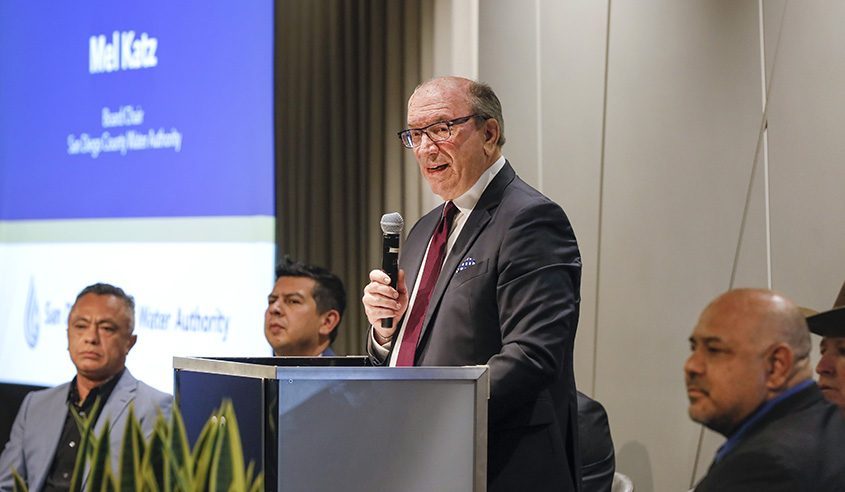
San Diego County Water Authority (Water Authority) Board Chair Mel Katz described the positive change in water management ushered in by the QSA as “a set of more than two dozen agreements that represent the dawn of a new era in water management in San Diego County and the Southwest – an era of water efficiency and supply reliability despite climate extremes.” Katz recognized the conservation efforts of the Imperial Irrigation District (IID) and Imperial Valley farmers.

San Diego County Water Authority Board Chair Mel Katz speaks at the Quantification Settlement Agreement 20th Anniversary celebration. Photo: San Diego County Water Authority water agreement

San Diego County Water Authority Board Chair Mel Katz speaks at the Quantification Settlement Agreement 20th Anniversary celebration. Photo: San Diego County Water Authority

IID Board President Alex Cardenas reported Imperial County agriculture has conserved 7.5 million acre-feet over the 20 years of the agreement, while still enabling agriculture to succeed. The Valley’s agricultural economy has grown from $1.8 billion in 2003 to $2.6 billion in 2023. according to the latest crop reports.

Water Authority General Manager Dan Denham said the Water Authority, IID, Metropolitan Water District of Southern California (MWD), and the Coachella Valley Water District continue to work together to ensure flexibility in how the river is managed and the needs of each agency are met. “We are getting to a place where we can be creative and do things differently.”

MWD General Manager Adel Hagekhalil called the QSA a great success and a great lesson. “We all came together. It was tough, but it was important.”

California Natural Resources Agency Secretary Wade Crowfoot congratulated the QSA partners on their achievement via a video message, calling it a “game changer” that remains as important today as it was 20 years ago. U.S. Senator Alex Padilla also offered his congratulations via a video message, crediting the leadership of all partners for their efforts to sustain the QSA.

Invited guests listen to water industry leaders and elected officials recognize the 20th anniversary of the Quantification Settlement Agreement. Photo: San Diego County Water Authority water agreement

Invited guests listen to water industry leaders and elected officials recognize the 20th anniversary of the Quantification Settlement Agreement. Photo: San Diego County Water Authority

San Diego Assemblyman David Alvarez told those gathered it was important to celebrate what was accomplished through the QSA. “The significance to me of the QSA is the listening that occurred,” he said, noting that the QSA brought agencies together to listen to each other as partners to create a set of mutually beneficial agreements.

Colorado River Board of California Vice Chair and Water Authority board member Jim Madaffer said the QSA provides a model of flexible river management, calling it a lesson “that we are so much better when working together than separately.”

Looking toward the challenges ahead on the river, water industry leaders noted the QSA must be a part of critical water discussions as agencies seek collaborative solutions to ensure the Colorado River can continue to be a reliable water source well into the future.

Interior Department Official with Key Role in Colorado River Talks is Stepping Down

A senior Interior Department official who has had a key role in negotiations over the shrinking Colorado River plans to step down from the job next week.

Tanya Trujillo told the department of her intention to resign as assistant secretary for water and science about six weeks ago and her last day is Monday, she told The Associated Press. Trujillo, who has served in the role since June 2021, said it made sense to leave now as the Biden administration gears up for a reelection campaign.

Opinion: Move by Two Small Water Districts Could Have Impact Across Southern California

The Fallbrook and Rainbow water districts got the green light to, in effect, move north.

That will impact ratepayers in San Diego County, and it could alter the balance of power in water decisions far beyond.

Like so many contentious developments when it comes to water, this one might not be over for a while.

Meet the Colorado River’s Newest – and Youngest – Power Player

California’s Imperial Valley is one of the few places where a 95 degree day can be described as unseasonably cool.

In the shade of a sissoo tree, with a dry breeze rustling its leaves, JB Hamby called the weather “pretty nice” for mid-June. Over his shoulder, sprinklers ticked away over a field of onions. Every few minutes, a tractor rumbled across the broiling asphalt of a nearby road.

Hamby is a water policy bigwig, especially around these parts. He helps shape policies that define how water is used by arguably the most influential water users along the Colorado River. Hamby holds two jobs – he serves on the board of directors for the Imperial Irrigation District (IID) and was recently appointed to be California’s top water negotiator.

And he’s only 27 years old.

SoCal Water Officials Hail Tri-State Agreement to Cut Colorado River Usage

Leaders of Southern California’s water wholesaler hailed a three-state agreement announced Monday aimed at dramatically reducing the amount of water pulled from the Colorado River over the next three years.

The proposed deal among California, Nevada, Arizona and the federal government would stave off what could have been far more dramatic cuts imposed by federal regulators had the states not brokered a deal by the end of the month.

IID GM Comments Lower Basin Plan for Colorado River & Lake Mead Water Conservation

Imperial Irrigation District (IID) General Manager Henry Martinez issued a statement Monday, May 22, commenting on the announcement made earlier today by the Colorado River Board of California regarding the submission of a Lower Basin Plan to Reclamation for analysis by representatives of the seven Colorado River Basin States. The Lower Basin Plan proposes to conserve 3 million acre-feet of Colorado River water through 2026, with at least 1.5 million acre-feet of that total being conserved by the end of calendar year 2024.

Record Snowpack ‘Welcome News’ for San Diego’s Colorado River Supply

The San Diego County Water Authority said a new federal report that forecasts significant increases in reservoir levels along the Colorado River is “welcome news” for San Diego’s water supply.

The report released Thursday by the U.S. Bureau of Reclamation forecasts that a near-record snowpack will raise Lake Mead at Hoover Dam by over 20 feet and Lake Powell farther north by 50 feet.

About two-thirds of San Diego County’s supplies are conserved Colorado River water.

Dan Denham, the Water Authority’s deputy general manager, said the federal report “is definitely welcome news and will buy us time to make crucial decisions.”

Above-Average Snowpack Will Raise Lake Mead, Buy Time for Collaboration

A federal report released April 20 says near-record snowpack in the Colorado River Basin could raise the elevation of Lake Mead by more than 20 feet by the end of the year, providing a critical opportunity for water agencies to improve long-term management of the river.

The U.S. Bureau of Reclamation’s report shows vastly improved hydrological conditions are also expected to raise the water level in Lake Powell by more than 50 feet. California relies heavily on lakes Powell and Mead for water, as do Arizona and Nevada.

Despite the good news this year, the ongoing trend toward a hotter and drier climate means long-term solutions remain critical. About two-thirds of San Diego County’s supplies are conserved Colorado River water.