Tag Archive for: Colorado River Basin

The Colorado River Crisis is a National Crisis

The Colorado River supports over 40 million people spread across seven southwestern states, 29 tribal nations, and Mexico. It’s responsible for the irrigation of roughly 5.5 million acres of land marked for agricultural use. Local and regional headlines show the river is in crisis. The nation mostly isn’t listening.

Precipitation-Snowpack Survey-Sierra Nevada-DWR

Precipitation Below Average in California

Precipitation is below average in California for the current water year. Despite recent storms that increased the statewide Sierra Nevada snowpack to 70% of average to date, the state is experiencing its second consecutive below average year for rain and snow. The water year starts on October 1 and ends September 30.

The Department of Water Resources Feb. 3 conducted the second manual snow survey of the season at Phillips Station. The manual survey recorded 63 inches of snow depth and a snow water equivalent, or SWE, of 17 inches, which is 93% of average for that location, according to the DWR. The SWE measures the amount of water contained in the snowpack and is a key component of DWR’s water supply forecast.

“The recent blast of winter weather was a welcome sight, but it was not enough to offset this winter’s dry start,” said DWR Director Karla Nemeth. “While there is still a chance we will see additional storms in the coming weeks, the Department and other state agencies are preparing for the potential for a second consecutive year of dry conditions.”
 La Niña-Sierra Nevada-snowpack-climate-snow survey

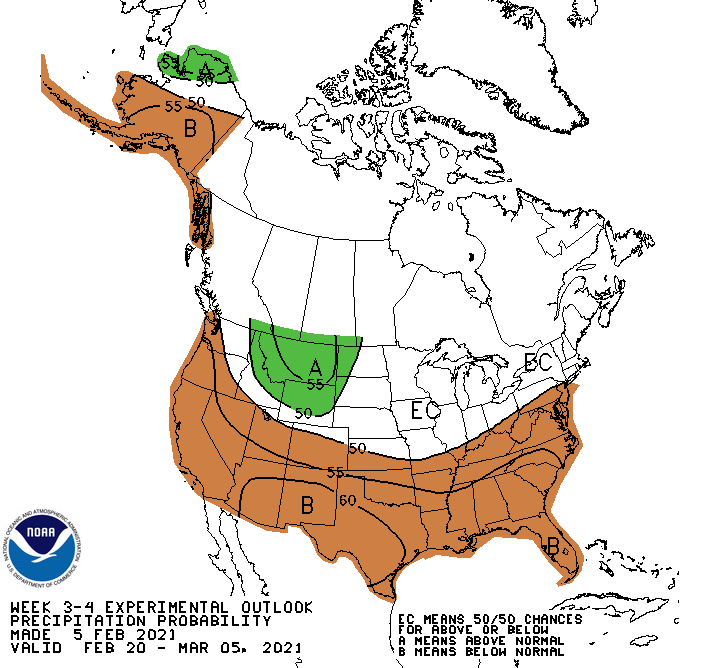
Below normal precipitation is favored throughout most of the southern tier of the United States in late February to early March, according to the National Weather Service Climate Prediction Center. La Niña conditions remain over the Pacific Ocean.

Precipitation below normal

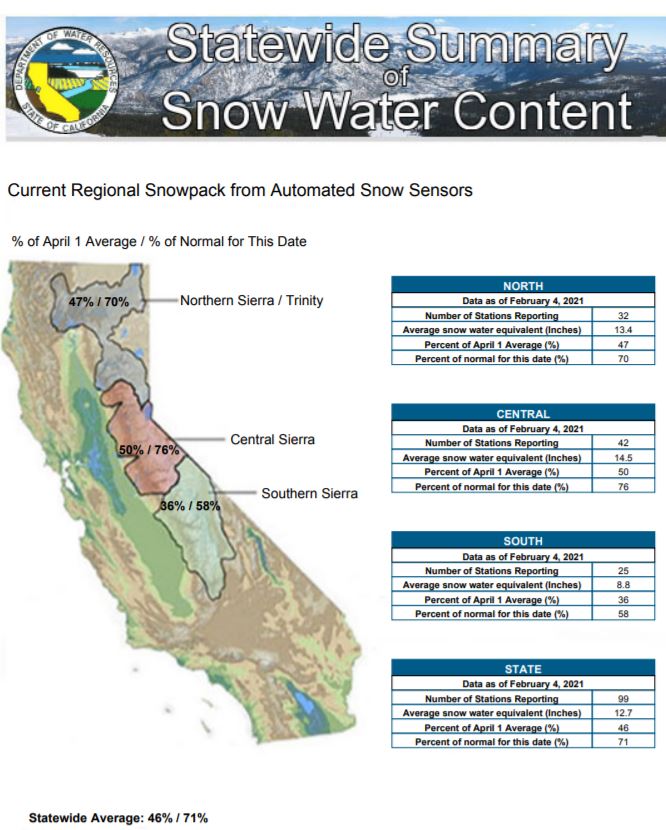
Statewide snow survey measurements reflect those dry conditions. Measurements from DWR’s electronic snow survey stations indicate that statewide the snowpack’s SWE is 12.5 inches, or 70% of the February 3 average, and 45% of the April 1 average. April 1 is typically when California’s snowpack is the deepest and has the highest SWE.

“The recent atmospheric storms have brought rain and snow to the northern Sierra Nevada, but conditions are still well below normal,” said Goldy Herbon, San Diego County Water Authority senior resources specialist.

Following last year’s below average water year, northern California is now experiencing its second straight water year of below average precipitation.

Colorado River Basin

Another source of the state’s water supply, the Colorado River Basin, isn’t faring much better. The water year 2021 precipitation at the end of January for the Colorado River Basin is 66% of normal, according to the U.S. Bureau of Reclamation.

Precipitation totals to date are behind historical averages for two of the main sources of San Diego County’s supply, with two months to go in the winter season but, a couple of atmospheric rivers can change that quickly.

“The San Diego region will have a plentiful and reliable source of water due to actions taken by the Water Authority and its 24 member agencies to diversify the water supply,” said Herbon. “Continuing efforts to expand supply sources, including desalination, water reuse, and recycling, will ensure that the water needs are met for the region’s 3.3 million people and its $245 billion economy.”

Fall 2020 was extremely dry, especially in the Sierra Nevada, and follows last year’s below-average snow and precipitation, according to the DWR. With only a couple months remaining in California’s traditional wet season, DWR officials say Californians should look at ways to reduce water use at home.
snowpack-reservoirs-Snow survey

Statewide Sierra Nevada snowpack is 71% of average for February 4, 2021. Graphic: California Department of Water Resources

Opinion: Drain Lake Powell, Not Colorado Farms

Experts agree the amount of water in the Colorado River basin has declined because of drought and climate change, and that population growth is fueling demand for water higher and higher. One result is the level of Lake Powell in Arizona, behind Glen Canyon Dam, has steadily declined and is now at 43% of capacity.

Colorado River Getting Saltier Sparks Calls for Federal Help

Water suppliers along the drought-stricken Colorado River hope to tackle another tricky issue after the U.S. Bureau of Reclamation installs a new leader: salty water.

The river provides water for 40 million people from Colorado to California, and helps irrigate 5.5 million acres of farm and ranchland in the U.S. But all that water also comes with 9 million tons of salt that flow through the system as it heads to Mexico, both due to natural occurrence and runoff, mostly from agriculture. Salt can hurt crop production, corrode drinking water pipes, and cause other damage.

Upper Colorado River Drought Plan Triggered for First Time

Increasingly bleak forecasts for the Colorado River have for the first time put into action elements of the 2019 upper basin drought contingency plan.

The 24-month study released in January by the Bureau of Reclamation, which projects two years of operations at the river’s biggest reservoirs, showed Lake Powell possibly dipping below an elevation of 3,525 feet above sea level in 2022. That elevation was designated as a critical threshold in the agreement to preserve the ability to produce hydropower at Glen Canyon Dam.

Opinion: Lasting Colorado River Solutions Come from Main Street, Not Wall Street

Sensational headlines, like those speculating that Wall Street will make billions off the Colorado River or that West Slope farmers should pack it in now, certainly attracts readers. Unfortunately, these articles wholly fail to convey the reality of the water challenges facing the Colorado River Basin.

As representatives of irrigated agriculture and conservation organizations, we deal with these issues every day. Often times, we do so through working partnerships with each other. Increasingly, we find these relationships are necessary to ensure that farms and ranches thrive and that rivers continue to support fish, wildlife, and recreation.

A “Forever” Drought Takes Shape in the West

The Southwest U.S. is mired in an ever-worsening drought, one that has left deer starving in Hawaii, turned parts of the Rio Grande into a wading pool, and set a record in Colorado for the most days of “exceptional drought.”

Climate Change is Hitting the Colorado River ‘Incredibly Fast and Incredibly Hard’

Beside a river that winds through a mountain valley, the charred trunks of pine trees lie toppled on the blackened ground, covered in a thin layer of fresh snow.

Weeks after flames ripped through this alpine forest, a smoky odor still lingers in the air.

The fire, called the East Troublesome, burned later into the fall than what once was normal. It cut across Rocky Mountain National Park, racing up and over the Continental Divide.

Wall Street Eyes Billions in the Colorado’s Water

There is a myth about water in the Western United States, which is that there is not enough of it. But those who deal closely with water will tell you this is false. There is plenty. It is just in the wrong places.

Climate’s Toll on the Colorado River: ‘We Can Weather Maybe a Couple of Years’

Beside a river that winds through a mountain valley, the charred trunks of pine trees lie toppled on the blackened ground, covered in a thin layer of fresh snow. Weeks after flames ripped through this alpine forest, a smoky odor still lingers in the air.

The fire, called the East Troublesome, burned later into the fall than what once was normal. It cut across Rocky Mountain National Park, racing up and over the Continental Divide. It raged in the headwaters of the Colorado River, reducing thick forests to ashes and scorching the ground along the river’s banks.