The largest international dam on the Texas/Mexico border has acquired unsafe sinkholes in need of costly repairs for decades, the U.S. International Boundary and Water Commission head told Border Report.
https://www.waternewsnetwork.com/wp-content/uploads/2024/04/WNN-Horizontal-White-Blue2.png00Chelsea Camposhttps://www.waternewsnetwork.com/wp-content/uploads/2024/04/WNN-Horizontal-White-Blue2.pngChelsea Campos2023-12-07 08:30:022023-12-07 08:30:02Sinkholes in Amistad Dam Threaten International Border Water Reservoir
An atmospheric river brought heavy rain, flooding and unseasonably warm temperatures to the Pacific Northwest, closing rail links, schools and roads as it shattered daily rainfall and temperature records in Washington state.
https://www.waternewsnetwork.com/wp-content/uploads/2024/04/WNN-Horizontal-White-Blue2.png00Chelsea Camposhttps://www.waternewsnetwork.com/wp-content/uploads/2024/04/WNN-Horizontal-White-Blue2.pngChelsea Campos2023-12-07 08:26:312023-12-07 08:26:31Atmospheric River Brings Heavy Rain, Flooding to Pacific Northwest
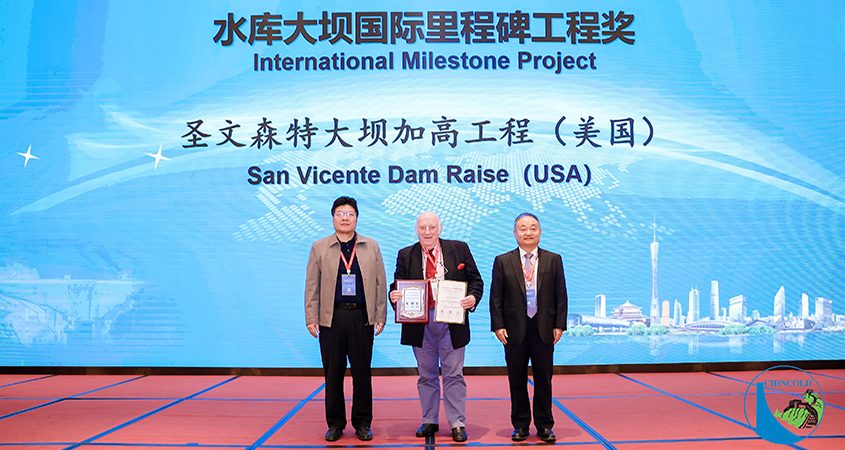
The International Commission on Large Dams presented the San Diego County Water Authority this week with a prestigious international engineering award for its innovative construction technology used to raise the historic San Vicente Dam. The project helps ensure regional water security for generations to come.
Commission leaders made the presentation to the Water Authority at its annual conference in Guangzhou, China. It cited a special type of construction called roller compacted concrete, or RCC. Applying this method to the San Vincente Dam project simplified construction, saving both time and money. The completed dam structure is capable of withstanding a 7.5 magnitude earthquake.
Dr. Malcolm Dunstan of MAD & Associates accepts the San Vicente Dam Raise award from International Commission on Large Dams officials. Photo: International Commission on Large Dams
“This award is a reminder that the San Diego region has a long history of strategic investments to
protect our most important natural resource,” said Water Authority Board Chair Mel Katz. “The
San Vicente Dam Raise was a landmark project and one that inspires us as we seek solutions to
current and future challenges.”
The Water Authority sent a video message to the conference. View it below.
San Vicente Dam Project Increases Water Storage Capacity
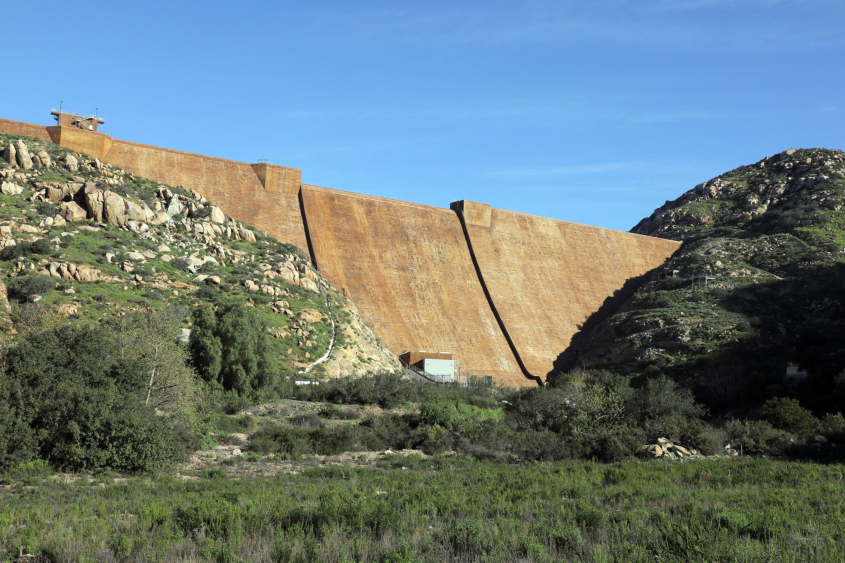
Completed in 2014, the dam raise project increased the height of San Vicente Dam by 117 feet, the equivalent of adding a 12-story building atop the original structure. It more than doubled the capacity of the San Vicente Reservoir by adding 152,000-acre feet of water storage capacity, enough to serve more than 450,000 households for a year.
San Vicente Dam has been owned and operated by the City of San Diego since it was built in 1943. Capacity in the enlarged reservoir is shared by the city and the Water Authority, which also share the cost of operating the reservoir.
“Raising the San Vicente Dam was a massive feat of engineering and it’s recognized as the world’s tallest dam extension using roller compacted concrete,” said Water Authority Engineering Director Neena Kuzmich. “More importantly, it was the final major element of the Water Authority’s $1.5 billion Emergency Storage Project, a system of reservoirs, pipelines and pumping stations designed to secure a six-month supply of drinking water for the San Diego region in case a natural disaster such as an earthquake or a prolonged drought interrupts imported water deliveries.”
State-Of-The-Art Method Shortens Construction Time
The San Vicente Dam Raise, completed in 2014, added more than 157,000 acre-feet of regional water storage capacity – the largest increase in San Diego County history. Photo: San Diego County Water Authority
Work to prepare the original dam and foundation for the expansion began in 2009. Using RCC for the expansion was a key design element. Unlike conventional wet concrete, which is poured, RCC uses less cement and water to create a cookie dough or clay-like texture. Equally as strong as wet concrete, RCC is placed in layers one on top of the other and compacted. The placement process resembles road construction.
This state-of-the art application method significantly shortens construction time while meeting
all technical requirements. Expansion was completed in 2014. The San Vicente Reservoir is located just outside of Lakeside and now stands 337 feet tall.
https://www.waternewsnetwork.com/wp-content/uploads/2023/12/SV-Award-0-845X450.jpg449845Gayle Falkenthalhttps://www.waternewsnetwork.com/wp-content/uploads/2024/04/WNN-Horizontal-White-Blue2.pngGayle Falkenthal2023-12-06 10:36:502023-12-06 10:36:50San Vicente Dam Raise Wins Global Award
A new law expanding California’s atmospheric river research program goes into effect next year. It connects flood and reservoir control operations with new technologies and strategies that can help operators accurately predict the arrival of these storms.
https://www.waternewsnetwork.com/wp-content/uploads/2024/04/WNN-Horizontal-White-Blue2.png00Chelsea Camposhttps://www.waternewsnetwork.com/wp-content/uploads/2024/04/WNN-Horizontal-White-Blue2.pngChelsea Campos2023-12-06 09:26:452023-12-06 09:26:45As Atmospheric Rivers Become More Frequent, California Expands Research to Prepare
Over the next two decades, Los Angeles County will collect billions more gallons in water from local sources, especially storm and reclaimed water, shifting from its reliance on other region’s water supplies as the effects of climate change make such efforts less reliable and more expensive.
https://www.waternewsnetwork.com/wp-content/uploads/2024/04/WNN-Horizontal-White-Blue2.png00Chelsea Camposhttps://www.waternewsnetwork.com/wp-content/uploads/2024/04/WNN-Horizontal-White-Blue2.pngChelsea Campos2023-12-06 08:59:092023-12-06 08:59:09L.A. County Aims to Collect Billions More Gallons of Local Water by 2045
The Imperial Irrigation District in California, which uses more Colorado River water than any other farm district or city in the West, has agreed to conserve 100,000 acre-feet in 2023 in exchange for payments from the federal government. It’s less than half the amount of water the district originally proposed saving last spring.
https://www.waternewsnetwork.com/wp-content/uploads/2024/04/WNN-Horizontal-White-Blue2.png00Chelsea Camposhttps://www.waternewsnetwork.com/wp-content/uploads/2024/04/WNN-Horizontal-White-Blue2.pngChelsea Campos2023-12-06 08:54:542023-12-06 08:54:54The Colorado River’s Biggest User Will Conserve Some Water in Exchange for Federal Dollars
According to the US Drought Monitor, 28.8% of the lower 48 states are in drought. At one point in 2022, almost half of the country was in a drought condition. The lack of precipitation plays havoc on the groundwater supply which is the basic water supply for most Americans.
https://www.waternewsnetwork.com/wp-content/uploads/2024/04/WNN-Horizontal-White-Blue2.png00Chelsea Camposhttps://www.waternewsnetwork.com/wp-content/uploads/2024/04/WNN-Horizontal-White-Blue2.pngChelsea Campos2023-12-06 08:30:562023-12-06 08:30:56Atmospheric River Threatening West Coast With Floods, Heavy Rain
Southern California has agreed to conserve enough water in Lake Mead to support upwards of 300,000 single family homes for a year under an agreement struck with the federal government.
https://www.waternewsnetwork.com/wp-content/uploads/2024/04/WNN-Horizontal-White-Blue2.png00Chelsea Camposhttps://www.waternewsnetwork.com/wp-content/uploads/2024/04/WNN-Horizontal-White-Blue2.pngChelsea Campos2023-12-05 08:11:072023-12-05 08:11:07CA Farmers Agree to Conserve 100,000 Acre-feet of Lake Mead Water in Exchange for Compensation