Tag Archive for: Metropolitan Water District

Southwest Water Leaders Sign MOU to Explore Framework for Interstate Exchanges

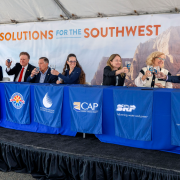
Today, the Bureau of Reclamation and agencies in California, Nevada and Arizona signed a Memorandum of Understanding (MOU) at the Claude “Bud” Lewis Carlsbad Desalination Plant to jointly explore new water supply solutions for the Colorado River Basin.

The MOU aims to improve long-term water management in the Colorado River Basin by advancing discussions to develop a framework that could allow for interstate water exchanges. The goal is to discuss a pathway that would allow agencies to partner across state borders on desalination, recycled water and other water supply projects that would benefit multiple states.

The MOU was signed by the Bureau of Reclamation, San Diego County Water Authority, Metropolitan Water District of Southern California, Southern Nevada Water Authority, the Arizona Department of Water Resources, Central Arizona Project and Salt River Project.

Interstate exchanges can be an important next step in successfully managing limited Colorado River supplies in the future by allowing shared financing of new supply projects that, through operational flexibility, could provide water to participating agencies when they need it most – taking advantage of variations in local hydrology across the Basin and other factors. Future water exchanges would use existing infrastructure and avoid costly new infrastructure without changing or reallocating existing rights or obligating parties to projects.

Long-term drought has reduced Colorado River system water storage to about 36% of capacity, and the combination of the lowest snowpack on record and record-breaking heat has further intensified drought conditions. These compounding factors create elevated risks to essential water and power infrastructure that supply water to more than 43 million people, underscoring the need for near-term actions to balance supply and demand.

What the signatories said:

“Next-generation strategies in the face of climate volatility must include interstate partnerships that deliver water where it’s needed most.  We appreciate the collaboration with the Bureau of Reclamation and all the other agencies involved. New ideas are challenging to implement, but it’s in everyone’s best interest to make this work.” – Dan Denham, General Manager, San Diego County Water Authority

“Across the Colorado River Basin, water users are developing new supply projects to reduce reliance on the river. But some of the larger projects require significant investment. The MOU signed today demonstrates our commitment to discussing how to develop flexible partnerships across borders to pool funding, advance projects, and allow water to be shared when and where it is needed most.” – Shivaji Deshmukh, General Manager, Metropolitan Water District of Southern California

“As Colorado River conditions grow more challenging, regional partnerships like this are an essential tool to help ensure sustainable water supplies. This agreement allows us to explore forward-thinking, strategic investments that will strengthen water resilience in Southern Nevada and across the Lower Basin.” – John Entsminger, General Manager, Southern Nevada Water Authority

“This is an important step in addressing the goal of augmenting the water supplies of the Colorado River by creating a mechanism to deliver those supplies through an exchange using existing infrastructure. It represents the kind of innovation that Arizona and its Lower Basin partners believe is needed from all the Colorado River states to help stabilize the system in the long term.” – Tom Buschatzke, Director, Arizona Department of Water Resources

“This MOU is important because we are agreeing to discuss innovative ways to help each other and secure our future water supplies. When you have good partners, you can find collaborative opportunities that benefit all.” – Brenda Burman, General Manager, Central Arizona Project

“This agreement demonstrates the Lower Basin states’ commitment to work together to explore ways to supplement our water supplies as we continue to experience Colorado River shortages. SRP supports collaborative and strategic options and projects to develop and deliver resilient and reliable water for all of Central Arizona.” –  Leslie Meyers, Salt River Project Associate General Manager and Chief Water Resources Executive
Water Authority, MWD End Lengthy Legal Dispute

Signaling a new era of collaboration, the San Diego County Water Authority and the Metropolitan Water District of Southern California today announced the settlement of a 15-year legal dispute over rates and the price term of an exchange agreement between the agencies.

At a news conference in San Diego, leaders from two of the state’s largest water agencies hailed the conclusion of all pending litigation, highlighting their commitment to fostering greater teamwork on a range of issues that affect nearly 19 million Southern California residents. The settlement dismisses all pending appeals, maintaining earlier judicial decisions on various matters. It includes provisions to reduce the potential for future litigation, improve certainty in budgeting, and increase flexibility in efficiently managing water supplies.

“For far too long, this legal battle sat at the center of Metropolitan’s relationship with the Water Authority,” Metropolitan board Chair Adán Ortega, Jr. said. “That era of conflict has finally come to an end and we can forge ahead, building a relationship based instead on cooperation and shared goals that will benefit the entire region. The agreement is acknowledgement of a regional approach to water supply management with mechanisms to efficiently squeeze every drop of water to assure future prosperity and our quality of life while protecting the sources of water we all depend upon.”

The agreement also opens a pathway for San Diego to provide water to other water agencies in Metropolitan’s service area.

“Ratepayers and water users across Southern California are the winners in this settlement. It provides a new revenue opportunity for San Diego, a new water supply opportunity for other communities, and greater budget certainty for the entire region,” said Water Authority board Chair Nick Serrano. “Only by working together could we produce these results. I greatly appreciate our colleagues at Metropolitan for their willingness to move past years of disagreement and chart a brighter future.”

Serrano made ending the litigation a cornerstone of his term that started in October 2024. He thanked prior Water Authority board leaders, including Chair Emeritus Mel Katz, for years spent laying the groundwork with Metropolitan’s Board Chair Ortega.

Ortega shared his gratitude.

“I greatly appreciate the partnership of board Chair Serrano and former Chair Katz, who serves on Metropolitan’s board, as well as the work of my Metropolitan board colleagues Vice Chair Nancy Sutley, Director Desi Alvarez and the members of Metropolitan’s ad hoc committee on the San Diego litigation, as we set the groundwork of trust that made this agreement possible.”

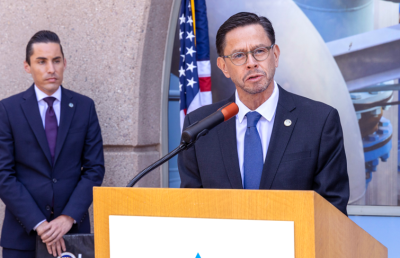
Metropolitan Water District Board Chair Adán Ortega, Jr. speaks at the press conference announcing an end to litigation.

The litigation centered on the price the Water Authority pays to Metropolitan for an exchange of water. The Water Authority has acquired conserved Colorado River water from two sources: the Water Authority purchases water from the Imperial Irrigation District, and Metropolitan assigned to the Water Authority water conserved by the lining of the All-American and Coachella canals.

This conserved Colorado River water totals up to 277,700 acre-feet a year (an acre-foot is about 326,000 gallons, enough to serve roughly three Southern California families for a year). The conserved Colorado River water is provided to Metropolitan at the Colorado River and, in exchange, Metropolitan delivers the same quantity of its water to San Diego. The Water Authority repeatedly challenged the price Metropolitan charged for this exchange starting in 2010, with both sides winning important legal judgments over more than a decade.

Under the settlement, the Water Authority will pay a fixed price to Metropolitan for delivery of the exchange water, adjusted annually for inflation. The price will no longer be tied to Metropolitan’s rates, which was a source of dispute and litigation. In addition, the Water Authority will be able to offer those deliveries to other Metropolitan member agencies or to sell the conserved Colorado River water to Metropolitan.

“This agreement will allow San Diego to take advantage of our past investments in diverse water supplies to benefit regional ratepayers while addressing water reliability challenges more broadly,” Water Authority General Manager Dan Denham said. “We look forward to building on the foundation of collaboration laid today.”

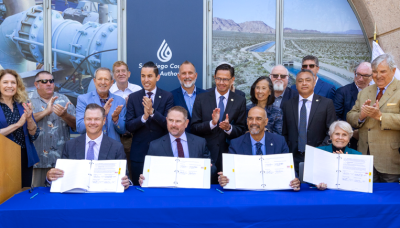
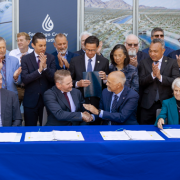
Board members and leaders from the San Diego County Water Authority and the Metropolitan Water District celebrate the end of 15 years of litigation.

“And from Metropolitan’s perspective, the agreement provides increased revenue certainty, potential access to additional water, and the confidence that years of litigation are behind us,” Metropolitan General Manager Deven Upadhyay said. “Today truly marks a new beginning. Through dialogue, negotiation and mutual understanding, we have found a common path forward. And we are all far better off for it.”

The settlement agreement was drafted and refined over the past year by Ortega, Upadhyay, General Counsel Marcia Scully and Metropolitan’s in-house litigation team, who worked with the Water Authority team of Serrano, Katz, Denham and General Counsel David Edwards.

Settlement Agreement Highlights

• Pending appeals are dismissed, all previous final judicial decisions remain in place and parties retain already decided attorneys’ fees and costs awarded.

• Water Authority to pay Metropolitan an agreed upon fixed price for the delivery of exchange water, instead of the past price that was based on Metropolitan’s rates. The fixed price will start at $671 per acre-foot in 2026, and increase annually based on a specified consumer price index escalator.

• Water Authority to pay Metropolitan a fixed payment for 227,000 acre-feet of exchange water a year, rather than making payments based on volume of water exchanged. If more than 227,000 acre-feet of water is exchanged, then the Water Authority will pay the unit price based on volumetric deliveries.

• Provides Water Authority potential new revenue. The Water Authority can first offer to Metropolitan member agencies the right to receive exchange water, and then can offer to Metropolitan the right to purchase conserved water.

• Metropolitan and Water Authority will meet every five years to discuss ongoing implementation of the Exchange Agreement.

Met Imported Water Subcomm: From Crisis to Collaboration: The Past and Future of Colorado River Management Copy

The Colorado River’s water future was a major topic on the agenda at the inaugural meeting of the Metropolitan’s Subcommittee on Imported Water, where Bill Hasencamp, Manager of Colorado River Resources, delivered an update on the ongoing post-2026 guidelines negotiations. These discussions will set the course for managing the Colorado River’s dwindling resources at a time when water reliability is more critical than ever.

Where San Diego’s Water Comes From, Explained

Water in California, while always a hot topic, entered the national spotlight at the start of 2025. Where the San Diego region’s water comes from, how it’s provided and who’s in charge of what are big questions that water professionals address every day.

What are the biggest sources of water for San Diego County?

In 2024, about 60% of the region’s water supplies were from the Colorado River, about one-third were from local sources and the rest was from Northern California through the State Water Project. The State Water Project is operated by the State of California and is separate from the Central Valley Project operated by the federal government.

Regardless of the source, all the water delivered to homes and businesses across the region meets strict state and federal quality standards.

How has our region’s water supply changed over the years?

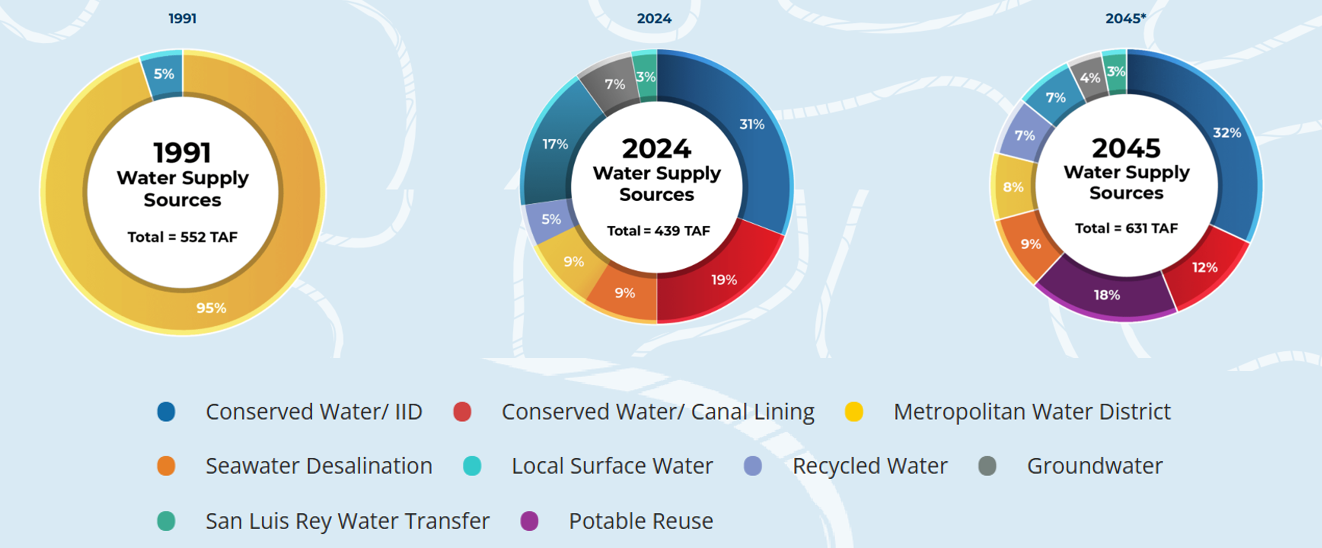
In 1991, San Diego County got 95% of its water from the Metropolitan Water District (MWD) in Los Angeles, leaving the region’s water supply outside of San Diego’s control. A lack of local resources left the region susceptible to supply cutbacks from its major single major source. In 1991, MWD imposed an supply reduction of 31%, prompting the San Diego region’s civic and business leaders to demand greater investments and increased control over the county’s water future. In the following three decades, the Water Authority invested  roughly $3 billion in regional water reliability projects. That included cementing the largest water conservation-and-transfer deal in U.S. history to secure conserved water from the Imperial Valley, partnering with a private company to build the nation’s largest seawater desalination plant and super-sizing San Vicente Reservoir by raising the height of the World War II-era dam. Now San Diego has a locally controlled and diversified water supply to make sure the taps always turn on.

SDCWA’s water portfolio over the years.

Why doesn’t San Diego County use much groundwater?

Before 1947, the San Diego region relied heavily on local surface water runoff in normal and wet years, and on groundwater pumped from local aquifers during dry years when stream flows shriveled. As the economy and population grew exponentially, local resources became insufficient to meet the region’s water supply needs, and the region increasingly turned to imported water supplies. Today, groundwater is a small but important resource, especially in places like the South Bay where the aquifers are relatively large. Overall, it accounts for about 5 percent of the region’s water supply portfolio.

What is being done to create additional water supply here in the region?

Coordinating with 22 member agencies to develop long-term, local water reliability is a key component of the Water Authority’s mission. In fact, a growing number of local water sources across the San Diego region are managed by local retail agencies — and they are critical to ensuring long-term supply reliability. Local projects reduce demand on imported supplies and provide local agencies with more control.

In San Diego County, agencies are investing in seawater desalination, water recycling and water purification to create the water reliability our region needs to thrive.

What does the future of water look like for San Diego County?

Even in very dry years like 2025, regional investments mean there’s sufficient water to sustain our economy and quality of life.  In fact, the region has done such a good job securing water, that it’s talking with other agencies across the Southwest about selling some of locally controlled water to combat rate increases in the county and support the larger regional economy.

For more information about San Diego’s water sources, click here.

Water Rights Agreement Will Save $20 Million, Help Protect Colorado River

The San Diego County Water Authority announced a new multi-agency agreement this week that will save local water customers $20 million while protecting Colorado River supplies.

California Water Agency Considers Spending $141 Million on Delta Tunnel Project

The powerful board of Southern California’s largest urban water supplier will soon vote on whether to continue funding a large share of preliminary planning work for the state’s proposed water tunnel in the Sacramento-San Joaquin River Delta.

The 38-member board of the Metropolitan Water District of Southern California is set to consider approving $141.6 million for planning and preconstruction costs at its Dec. 10 meeting.

California Water Agency Extends Manager’s Leave of Absence While Investigation Continues

The board of the Metropolitan Water District of Southern California voted to allow more time to complete an investigation into accusations against General Manager Adel Hagekhalil, who was placed on leave more than four months ago in response to harassment allegations by the agency’s chief financial officer.

The board’s decision will extend Hagekhalil’s leave of absence until an investigator has finished interviews and submitted a report on the findings.

Column: Something is Rotten in SoCal’s Metropolitan Water District

There are few government agencies more central to daily life in Los Angeles than the Metropolitan Water District of Southern California, which spends billions of dollars each year ensuring that 19 million people have enough to drink, in part by importing hundreds of billions of gallons from the Colorado River and Northern California.

There are also few agencies more prone to bitter power struggles.

Thanks to Cleanup of Groundwater and New Systems, San Fernando Celebrates its ‘Water Independence’

The City of San Fernando celebrated a water milestone on Thursday, Sept. 5.

State Sen. Caroline Menjivar and Metropolitan Water District Board Chair Adan Ortega joined San Fernando’s mayor and City Council members to “turn off the valve” and mark the city’s “return to water independence.”

Embattled Manager of California Water Agency Defends Record, Says Complaints are Unfounded

More than two months after he was placed on leave by the board of California’s largest urban water supplier, embattled General Manager Adel Hagekhalil defended his performance and insisted the accusations against him are unfounded.

The board of the Metropolitan Water District of Southern California met in closed session Tuesday to discuss the status of investigations into multiple complaints and voted to extend Hagekhalil’s leave of absence until Oct. 23 as the investigation continues. The leave had been scheduled to end in September.