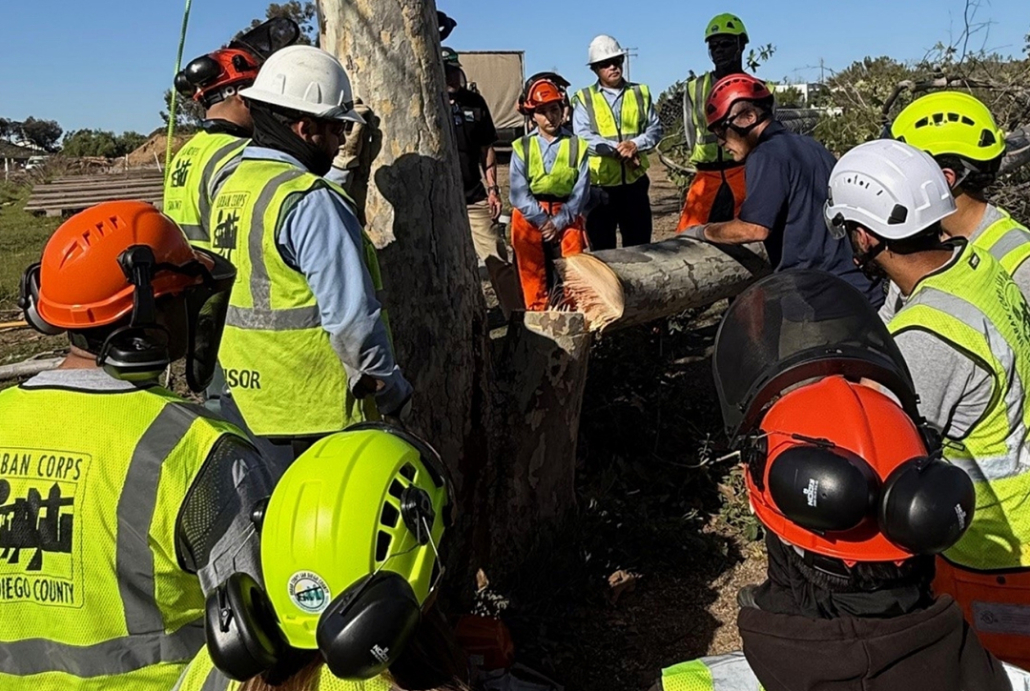
 Urban Corps San Diego team members get a briefing before beginning habitat restoration work. Photo: Sweetwater Authority
Sweetwater Authority Habitat Restoration Effort Delivers Impressive Results
What began as an emergency hazardous tree removal project to protect water treatment facilities by the Sweetwater Authority became an effective community partnership. By working with Urban Corps San Diego, supported by neighboring residents and regulatory agencies, Sweetwater Authority transformed a portion of a fire-prone canyon adjacent to the Robert A. Perdue Water Treatment Plant into a safer, fire-resilient native habitat.
Need For Fire Hazard Mitigation Addressed With Two-Year Plan
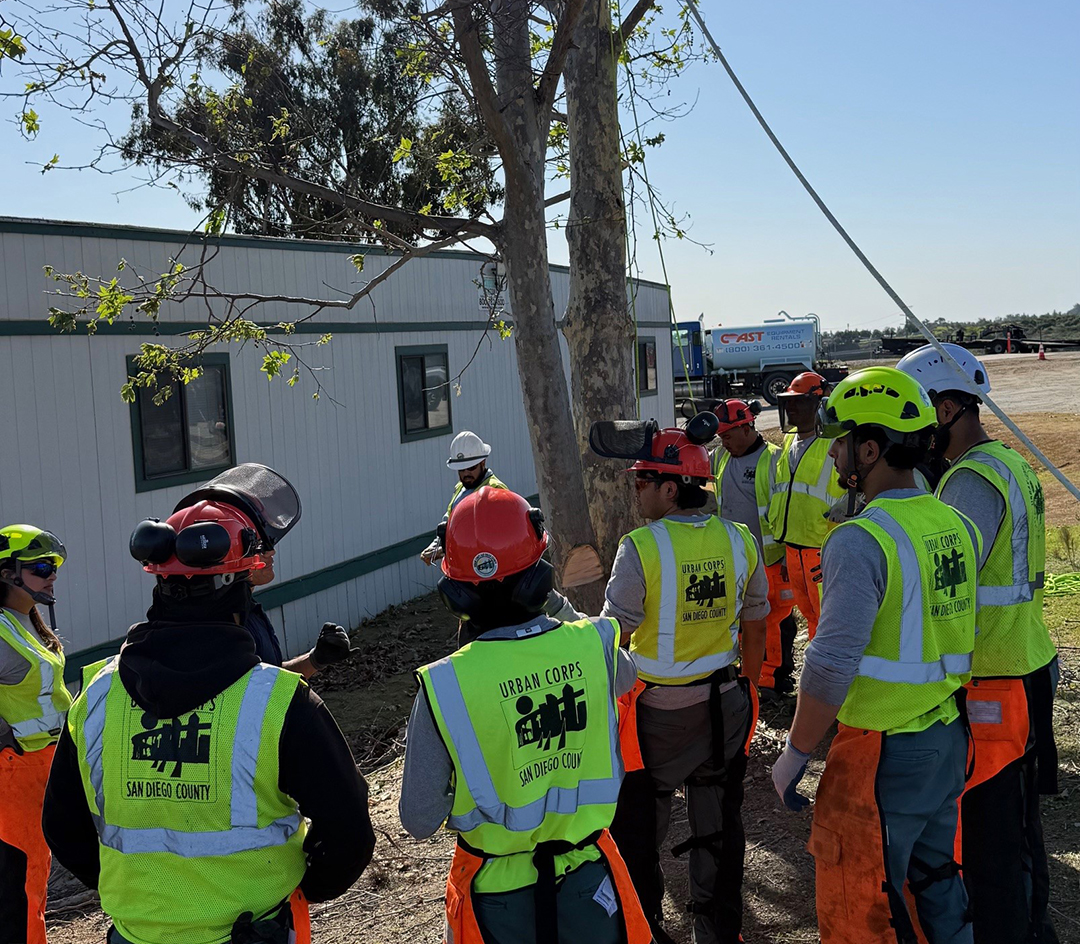
Non-native tree removal was a focus of the Sweetwater Authority’s habitat restoration project. Photo: Sweetwater Authority
The Perdue Plant is situated at the western edge of the urban–wildland interface, within a designated Very High Fire Hazard Zone. The facility faces ongoing wildfire threats from the adjacent open space and urban canyon immediately west of the treatment plant.
Eight different fires burned in the canyon below in five years, including one that came close to buildings. It became evident that the hazardous eucalyptus trees adjacent to the treatment plant needed to be removed. Sweetwater Authority took proactive steps to protect water infrastructure and the surrounding neighborhoods, approving a two-year plan in 2024.
The project evolved through the development of partnerships among the Sweetwater Authority, nonprofits, conservation partners, and the community working side by side to protect people and wildlife with positive results. Sweetwater Authority decided to restore that same area with fire-resilient native habitat to protect the slope from erosion issues and to create habitat for sensitive species.
State and federal wildlife agencies including the California Department of Fish & Wildlife (CDFW) and the U.S. Geological Survey (USGS) provided scientific guidance, emphasizing the importance of restoring the cactus scrub habitat for sensitive species like the coastal cactus wren and the California gnatcatcher.
San Miguel Fire & Rescue supported the need to reduce fuel loads in this difficult terrain. Sweetwater Authority’s neighbors in Spring Valley, led by the Spring Canyon HOA, worked to ensure safe access, good communication, and community awareness.
Sweetwater Authority Teams Partner With Urban Corps San Diego
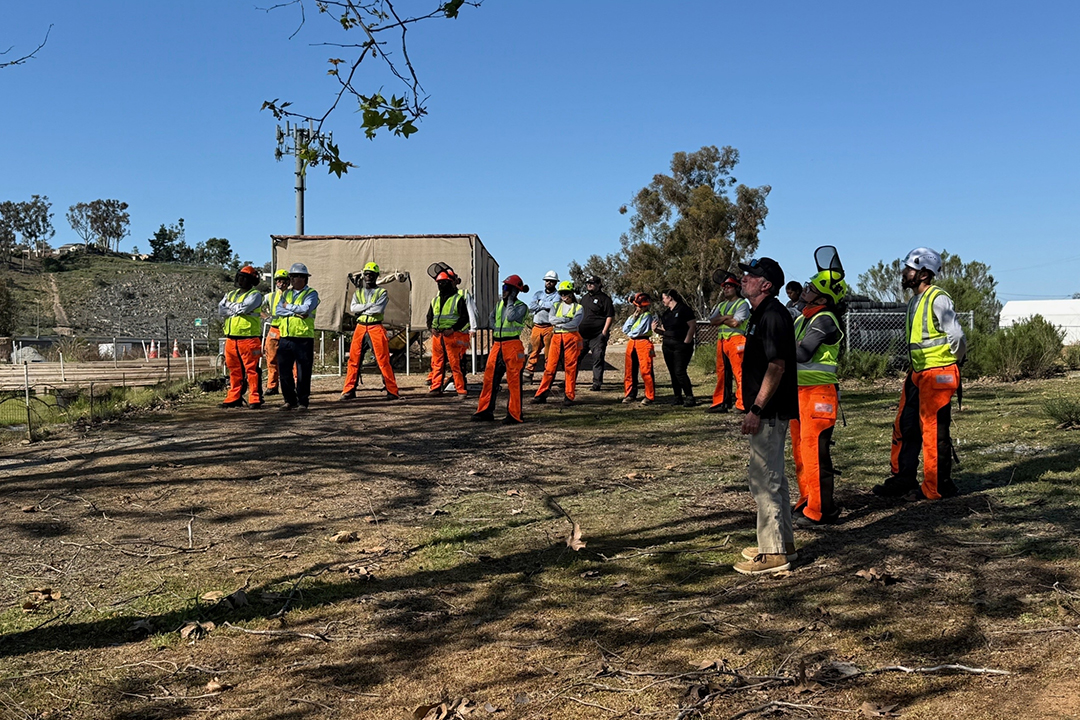
Urban Corps San Diego teams, led by development manager Zhenxi Zhong, contributed labor to habitat restoration and site management. Photo: Sweetwater Authority
The Authority effort led by project manager Israel Marquez included both its Habitat Maintenance team and Watershed Caretaker team. “Both played essential roles in every phase of the work,” said Marquez.
The Urban Corps of San Diego County, led by development manager Zhenxi Zhong, applied for a Forestry Corps Grant and contributed its labor to habitat restoration and site management. Hazardous non-native invasive trees were removed, slopes stabilized, and fire-resilient native habitat restored.
“Today, the landscape is recovering and becoming a model for wildfire resilience, habitat restoration, and community collaboration,” said Marquez.
The Habitat Restoration team, led by Cesar Alcaraz and Julia Varnergardner, worked side by side with Urban Corps crews, guiding them in collecting and planting cactus cuttings, removing debris, installing erosion-control measures, and stabilizing soils on the steep slope.
In collaboration with the Urban Corps Construction Team, the Watershed Caretaker Team led by Adam Dingley and Richard Cortez handled the heavy lifting of site preparation, field coordination, and tree material reuse. Their work was essential to the project’s success.
Cortez personally contributed a full day of chainsaw safety and arborist training with Urban Corps members, highlighting the Authority’s commitment to workforce development.
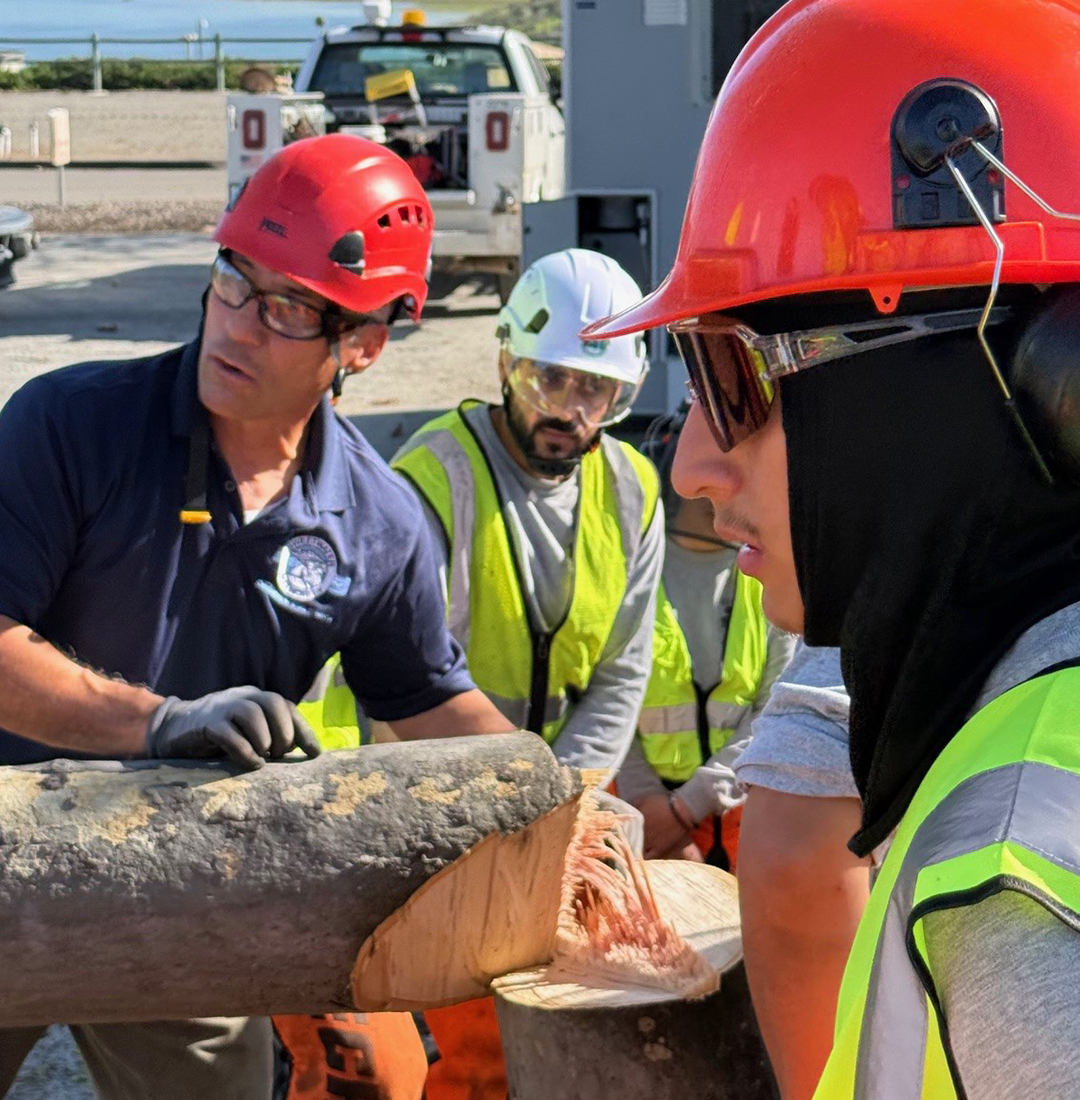
Sweetwater Authority project manager Richard Cortez (far left) with the Watershed Caretakers team and Urban Corps San Diego crew members. Photo: Sweetwater Authority
Mitigation Efforts Magnified By Flourishing Habitat
Over the past two years, the project has yielded impressive and visible results. The first year focused on removing dozens of dead and dying trees, stabilizing slopes, and beginning the transition to fire-resilient native habitat.
The results were immediate. When the Quarry Fire swept through the area on October 31, 2024, the newly created defensible space and early restoration work helped reduce the potential for the wildfire to spread to the Perdue Plant, protecting the facility and nearby homes.
In the second year, hazardous tree removal was completed. Authority staff and Urban Corps crews returned to the slope to expand restoration efforts by planting native succulent scrub habitat, which is dominated by cacti and adapted to the region’s fire cycles.
Tree branches were chipped and reused as mulch at Authority tank sites and other properties to control weeds and reduce erosion. Selected tree trunks were also repurposed at the Sweetwater Reservoir Recreation Area to help mark roads and trails and reduce trespassing into sensitive habitats.
The native habitat is now flourishing. With the eucalyptus canopy removed and the soil receiving more sunlight and moisture, the slope is healing itself. Native coastal sage scrub species, including some rare plants like California Adolphia and many native annual herbs, are returning to the site. The recovering ecosystem is becoming more resilient, more diverse, and more supportive of native wildlife.
USGS and the wildlife agencies emphasized the importance of expanding succulent scrub habitat to support breeding, foraging, and long-term population stability of threatened bird species, including the coastal cactus wren and the California gnatcatcher, a federally threatened species. Both benefit from the return of coastal sage scrub habitat.
As the slope continues to recover, these species will find new opportunities for nesting, feeding, and moving across the landscape in one of their last remaining strongholds in southern San Diego County.
Restoration and monitoring will continue through 2026, with follow-up maintenance by Sweetwater Authority staff as part of its watershed and habitat protection program.
What was once a hazardous, fire-prone area covered with dead and dying eucalyptus and debris is becoming a healthier, safer, and more resilient habitat that protects critical drinking water infrastructure, supports sensitive wildlife, and strengthens the connection between Sweetwater Authority and the community it serves.