You are now in News Supply & Demand category.

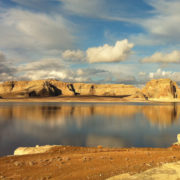
Lake Mead and Lake Powell – which provide storage for the Lower Basin states of Nevada, Arizona and California – are about 51 percent full. Photo: SDCWA Drought Talks

Bureau Executive Makes Case for Renewing Drought Talks in Colorado Basin

El Centro, Calif. – U.S. Bureau of Reclamation Commissioner Brenda W. Burman delivered a sobering message about the risks facing the Colorado River system and the need for action considering long-term drought conditions during an Imperial Irrigation District Board meeting on May 22.

In her first presentation to the IID Board of Directors since her confirmation as commissioner in November, Burman said it’s time to restart the stalled basin-wide drought contingency planning talks to address the threat of shortage on the river. Her discussion was filled with stark predictions for the river system should drought conditions continue, along with hopeful notes that worst-case shortage scenarios could be averted through conservation efforts.

Terry Fulp, the bureau’s regional director of the Lower Colorado River Basin, joined Burman at the IID meeting. Fulp said Lake Mead and Lake Powell – which provide storage for the Lower Basin states of Nevada, Arizona and California – are about 51 percent full.

Both lakes were near capacity in 1999, then dropped by half in just five years. That sudden loss of storage led to the development of the interim guidelines for managing a shortage on the river in 2007. In the years since, Fulp said, the river system has met demands despite the ongoing drought.

However, a shortage declaration may be triggered in the next two years because Lake Mead is barely over 1075 feet above sea level, the point at which a shortage could be declared. Fulp said Lake Mead would likely already be below the 1075-foot mark if not for conservation efforts across the Colorado River Basin.

Call to action on the river

Burman said she recognizes that drought contingency discussions have “fallen off,” but she said they need to start again with the goal of expanding conservation efforts throughout the river system. She said actions taken now will benefit water users today and serve the needs of the river system decades into the future, just as water users today benefit from the actions of the pioneers who built the system under the Boulder Canyon Act of 1928

“There absolutely needs to be action on the Colorado River,” she said. “The risk is too great.”

Under questioning from IID board members, Burman said “there is room” in drought contingency discussions to include additional storage for IID in Lake Mead (which IID has advocated for), and there could be flexibility in how that storage water is created.

When pressed on the Salton Sea, Burman said a memorandum of understanding between the state and federal governments remains in effect to address issues at the sea. She added that the federal government remains committed to the MOU even though the state is leading ongoing Salton Sea restoration efforts.

Burman said time will tell if drought contingency talks restart and whether agencies can reach agreement on the critical issues related to conservation and storage. To the extent that there is additional water conservation in the Imperial Valley, that likely would reduce flows to the Salton Sea – and that in turn would raise important questions about how reduced inflows would be mitigated to minimize impacts on sea levels.
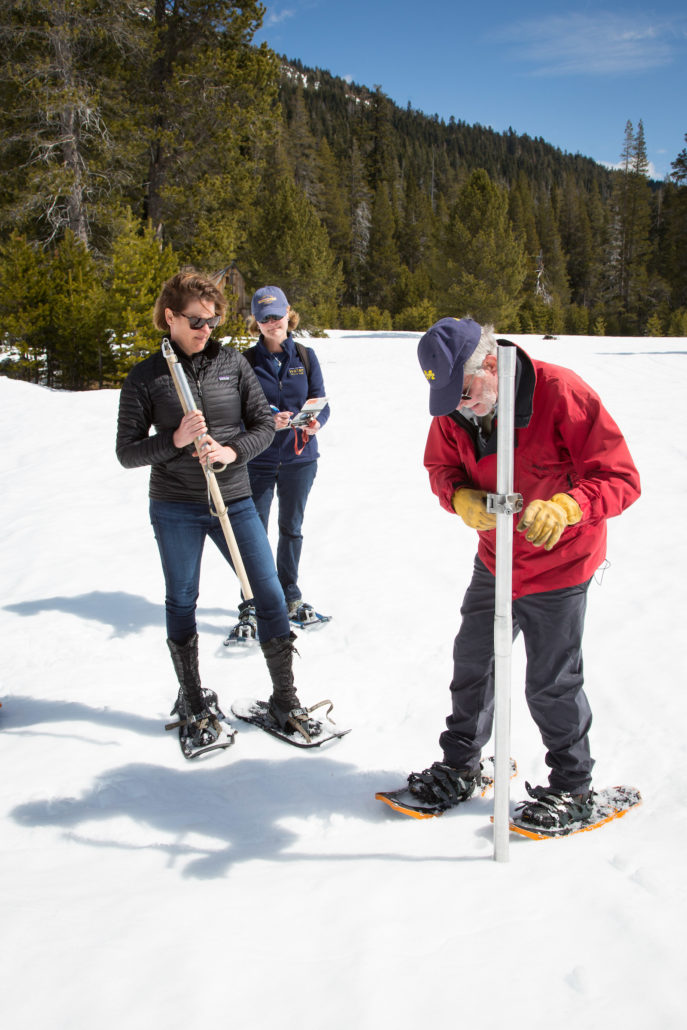
Karla Nemeth, Director of the California Department of Water Resources, left, Cindy Messer, Chief Deputy Director (DWR), center, assists Frank Gehrke, Chief of the California Cooperative Snow Surveys Program, with the fourth snow survey of 2018 at Phillips Station in the Sierra Nevada Mountains. The survey site is approximately 90 miles east of Sacramento off Highway 50 in El Dorado County. Photo: Dale Kolke / California Department of Water Resources

San Diego County Water Supplies Sufficient Despite Low Snowpack

San Diego County has secured sufficient water supplies for 2018 and beyond despite below-average, low snowpack in the Sierra Nevada at the start of April when the snowpack typically peaks.

The April 2 survey by the California Cooperative Snow Surveys Program showed water content in the snowpack statewide increased from 23 percent of average on March 1 to 54 percent of the historical average at the start of April. The early-April snow survey is deemed the most important for forecasting supplies from the State Water Project, which provides about 15 percent of the San Diego region’s water supplies.

“That’s a big improvement over last month, and there are still storms moving through the Sierra,” Alexi Schnell, a water resources specialist for the Water Authority, told the agency’s Board on April 12.

Water Use Drops Nearly 50 Percent

In San Diego County, ratepayers have invested heavily in drought-resilient supplies from water recycling, seawater desalination and conservation-and-transfer agreements for high-priority supplies from the Colorado River.

At the same time, the region’s per capita potable water use dropped by 47 percent between fiscal years 1990 and 2017 due to numerous conservation programs coupled with a strong commitment by residents and businesses countywide to “Live WaterSmart.”

In addition to the State Water Project, the San Diego region’s water supplies come from local sources such as the Claude “Bud” Lewis Carlsbad Desalination Plant and the Colorado River, which accounts for roughly three quarters of local supplies. Late March conditions in the Upper Colorado River Basin were better than the Sierra at 72 percent of normal snowpack – though the basin remains in a long-term drought.

Karla Nemeth, Director of the California Department of Water Resources, left, Cindy Messer, Chief Deputy Director (DWR), center, assists Frank Gehrke, Chief of the California Cooperative Snow Surveys Program, with the fourth snow survey of 2018 at Phillips Station in the Sierra Nevada Mountains. The survey site is approximately 90 miles east of Sacramento off Highway 50 in El Dorado County. Photo: Dale Kolke / California Department of Water Resources low snowpack

Karla Nemeth, Director of the California Department of Water Resources, left, Cindy Messer, Chief Deputy Director (DWR), center, assists Frank Gehrke, Chief of the California Cooperative Snow Surveys Program, with the fourth snow survey of 2018 at Phillips Station in the Sierra Nevada Mountains. The survey site is approximately 90 miles east of Sacramento off Highway 50 in El Dorado County. Photo:
Dale Kolke / California Department of Water Resources

Water Year Marked by Hot, Dry Conditions

On the home front, Lindbergh Field and the Ramona Airport have reported only 33 percent and 40 percent of normal rainfall respectively since the start of the water year in October.

In addition, the local hot streak persisted through late-winter, with average daily maximum temperatures at Lindbergh Field remaining above normal into early April. Over the past four years, only two months have been cooler than normal.


Region’s Farms Get Help Boosting Water Efficiency

Agriculture is a rich part of San Diego County’s heritage and foundational piece of the region’s economy, but it’s not easy to make a go of farming here given the hilly terrain, uneven soils and limited natural water supplies.

That’s where the San Diego County Water Authority comes in. The wholesale water agency has funded more than 2,300 free irrigation system evaluations for farmers since 1991 by partnering with the Fallbrook-based Mission Resource Conservation District. Those efforts can save farmers hundreds or even thousands of dollars each year, while stretching the region’s most valuable natural resource and improving crop performance.

And this year, the Water Authority is taking its agricultural assistance program to a new level by leveraging more than $1.5 million from a variety of sources to help improve irrigation efficiency at local farms with an enhanced package of services. By sharing costs with farmers, those funds will be stretched through 2021 to offer additional site evaluations and testing, soil mapping, water conservation planning, soil moisture sensors and technical assistance.

“I don’t think a lot of people really realize how important agriculture is to our economy,” says Michele Shumate, a water resources specialist at the Water Authority. “By improving water efficiency, we’re also supporting a large economy.”

Many Partners Enhance Efficiency Efforts

These dual benefits explain why the Water Authority helped to secure funding for expanded agricultural water efficiency efforts over the next three years. In addition to the Water Authority, the program partners are USDA Natural Resource Conservation Service, Mission Resource Conservation District, San Diego County Farm Bureau, and 10 Water Authority member agencies – Carlsbad, Escondido, Fallbrook, Oceanside, Rainbow, Rincon del Diablo, San Dieguito, Vallecitos, Valley Center and Yuima.

“The purpose of the funding is to address three related natural resource issues – water quantity, water quality and soil health,” said Shumate. “Making the most of our water supplies, reducing runoff and enhancing crop productivity benefit farmers and the region at large.”

San Diego County is home to approximately 5,700 farms – more than any other county in the nation – and they benefit from the region’s nearly perfect weather. But they also must contend with intermittent rain, hilly terrain and bedrock that can sit just a few feet below the surface – all of which makes irrigation efficiency both challenging and critical.

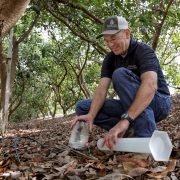
Irrigation evaluations typically begin with a conversation about current practices – when farmers irrigate, for how long and how many zones are in the irrigation system. Lance Andersen, who performs farm water-use evaluations as agricultural program director for the conservation district, then measures flow rates at sprinklers and water pressure at the risers. He produces a written report with recommendations for improving irrigation efficiency and offers a follow-up evaluation.

Simple Changes Can Yield Big Results

Easy fixes typically include adjusting water pressure throughout irrigation systems and replacing faulty pressure regulators. Regulating pressure on hilly terrain can be tricky, and Andersen often finds that water pressure in flat areas is too high, which results in overwatering. Ensuring that all emitters are of the same size and type is another easy adjustment for farmers.

It can be more challenging to adjust irrigation rates to account for soil type and depth. “Everybody kind of knows that we don’t have deep soil, but they don’t irrigate that way,” Andersen says.