You are now in Agency News News category.

High School Photo Contest Winners Recognized at Water Board Meeting

Chula Vista, Calif. – Local high school students will be honored for their winning photos at the Sweetwater Authority Governing Board meeting on May 9. More than 40 students from the Authority’s service area entered the annual water photo contest, which included a short essay about why water is an essential resource.

Sweetwater Authority Kicks Off Its Five-Year Capital Improvement Plan

Chula Vista, Calif. – On May 2, the Sweetwater Authority’s Governing Board kicked off the start of the agency’s first project of its five-year capital improvement plan with a commemorative pipe-signing at its Board meeting.

Olivenhain Municipal Water District Logo landscape design workshops

Connect With Nature Through Elfin Forest Recreational Reserve’s Thirteenth Annual Amateur Photography Contest

Encinitas, Calif. – Olivenhain Municipal Water District and the Escondido Creek Conservancy invite amateur photographers of all ages to Elfin Forest Recreational Reserve for the thirteeth annual amateur photography contest, which launched on Saturday, April 21, and will conclude on Monday, September 3.


Olivenhain Municipal Water District Logo landscape design workshops

OMWD’s 4S Ranch Water Reclamation Facility Recognized As California’s Top Safety Plant for 2017

Encinitas, Calif. – OMWD’s 4S Ranch Water Reclamation Facility received the “Small Safety Plant of the Year” award from the California Water Environment Association during the statewide awards ceremony on April 20. In addition, as the highest rated California facility in the Safety Category, the Water Environment Federation also presented OMWD with its coveted George W. Burke Award.

San Diego County Water Authority Logo Stacked Tagline

Regional Photo Contest Highlights The Value of Water Across the San Diego Region

San Diego, Calif. – Sharing images that highlight the importance of safe and reliable water supplies in San Diego County will win valuable prizes for dozens of participants during a social media contest that spans Water Awareness Month in May.

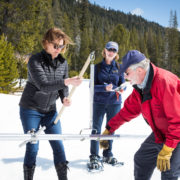
Karla Nemeth, Director of the California Department of Water Resources, left, Cindy Messer, Chief Deputy Director (DWR), center, assists Frank Gehrke, Chief of the California Cooperative Snow Surveys Program, with the fourth snow survey of 2018 at Phillips Station in the Sierra Nevada Mountains. The survey site is approximately 90 miles east of Sacramento off Highway 50 in El Dorado County. Photo: Dale Kolke / California Department of Water Resources

San Diego County Water Supplies Sufficient Despite Low Snowpack

San Diego County has secured sufficient water supplies for 2018 and beyond despite below-average, low snowpack in the Sierra Nevada at the start of April when the snowpack typically peaks.

The April 2 survey by the California Cooperative Snow Surveys Program showed water content in the snowpack statewide increased from 23 percent of average on March 1 to 54 percent of the historical average at the start of April. The early-April snow survey is deemed the most important for forecasting supplies from the State Water Project, which provides about 15 percent of the San Diego region’s water supplies.

“That’s a big improvement over last month, and there are still storms moving through the Sierra,” Alexi Schnell, a water resources specialist for the Water Authority, told the agency’s Board on April 12.

Water Use Drops Nearly 50 Percent

In San Diego County, ratepayers have invested heavily in drought-resilient supplies from water recycling, seawater desalination and conservation-and-transfer agreements for high-priority supplies from the Colorado River.

At the same time, the region’s per capita potable water use dropped by 47 percent between fiscal years 1990 and 2017 due to numerous conservation programs coupled with a strong commitment by residents and businesses countywide to “Live WaterSmart.”

In addition to the State Water Project, the San Diego region’s water supplies come from local sources such as the Claude “Bud” Lewis Carlsbad Desalination Plant and the Colorado River, which accounts for roughly three quarters of local supplies. Late March conditions in the Upper Colorado River Basin were better than the Sierra at 72 percent of normal snowpack – though the basin remains in a long-term drought.
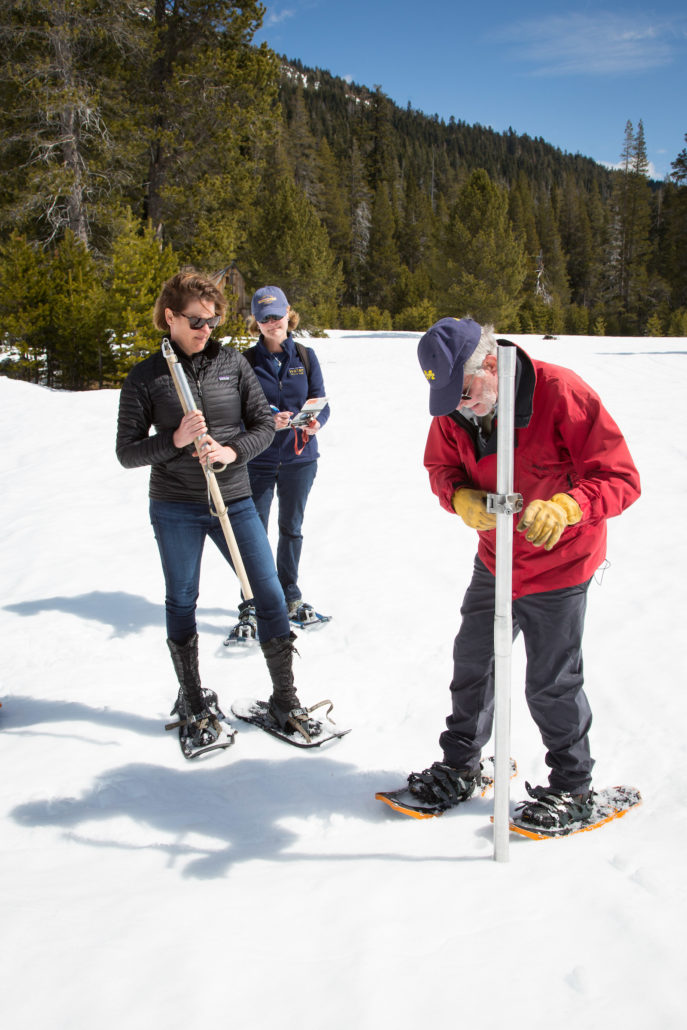
Karla Nemeth, Director of the California Department of Water Resources, left, Cindy Messer, Chief Deputy Director (DWR), center, assists Frank Gehrke, Chief of the California Cooperative Snow Surveys Program, with the fourth snow survey of 2018 at Phillips Station in the Sierra Nevada Mountains. The survey site is approximately 90 miles east of Sacramento off Highway 50 in El Dorado County. Photo: Dale Kolke / California Department of Water Resources low snowpack

Karla Nemeth, Director of the California Department of Water Resources, left, Cindy Messer, Chief Deputy Director (DWR), center, assists Frank Gehrke, Chief of the California Cooperative Snow Surveys Program, with the fourth snow survey of 2018 at Phillips Station in the Sierra Nevada Mountains. The survey site is approximately 90 miles east of Sacramento off Highway 50 in El Dorado County. Photo:
Dale Kolke / California Department of Water Resources

Water Year Marked by Hot, Dry Conditions

On the home front, Lindbergh Field and the Ramona Airport have reported only 33 percent and 40 percent of normal rainfall respectively since the start of the water year in October.

In addition, the local hot streak persisted through late-winter, with average daily maximum temperatures at Lindbergh Field remaining above normal into early April. Over the past four years, only two months have been cooler than normal.

 

Vallecitos District Logo

Vallecitos Water District Receive Re-Accreditation as ‘District of Distinction’

San Marcos, Calif. – On April 4, the Vallecitos Water District was honored for achieving re-accreditation as a “District of Distinction” by the Special District Leadership Foundation (SDLF). The accreditation is designed as a way for districts to highlight their prudent fiscal practices along with other areas important to effectively operate and govern a special district. California SDLF public affairs field coordinator Chris Palmer was on hand to recognize Vallecitos for completing the essential governance requirements. This is the second time Vallecitos has received this biannual accreditation.

San Diego County Water Authority Logo Stacked Tagline

Water Authority Helps Launch National Leak-Detection Competition

Agency aims to boost efficiency of large-scale water pipelines

San Diego, Calif. – As part of its pioneering approach to pipeline asset management, the San Diego County Water Authority is co-sponsoring a nationwide contest to advance leak- and corrosion-detection technologies for large-diameter pipelines. Leaks and corrosion are major problems across the country, resulting in billions of gallons of water wasted annually – enough to fill more than three million Olympic-sized swimming pools – along with disruptions in water service and costly repairs. The competition runs through May 8 and includes a $75,000 purse provided by the U.S. Bureau of Reclamation, the nation’s largest water provider and the operator of more than 20,000 miles of buried water pipelines.

San Diego County Water Authority Logo Stacked Tagline

Water Authority Board Endorses State Bond to Fund Natural Resource Upgrades

Proposition 68 would benefit Salton Sea restoration and other vital projects

San Diego, Calif. – The San Diego County Water Authority’s Board of Directors voted to endorse Proposition 68, a state bond measure that would fund projects important to the San Diego region and allocate more than $1 billion for water-related initiatives statewide. If passed by California voters on June 5, the bond would provide $200 million to Salton Sea restoration activities and $12 million for the San Diego River Conservancy as part of a $4 billion package to address natural resource issues across California.


California State Capitol Building Dome

Voters Overwhelmingly Oppose Proposed Water Tax

California voters overwhelmingly oppose state legislation that would create a new tax on drinking water, according to a recent poll of likely 2018 voters around the state.

In all, 73 percent said they opposed Senate legislation that would impose a tax on residential customers across the state in order to fund safe drinking water for disadvantaged communities living in areas with groundwater contamination. Over half said they “strongly opposed” the measure, while just 8 percent said they “strongly supported” it.

When asked their preference, three out of four voters preferred using existing state funds for providing safe drinking water to low-income communities in need, rather than establishing a new tax on drinking water. Just one in five voters chose a new tax on drinking water. Five percent said they didn’t know.

The results cross party and demographic lines, and preferences held firm even as respondents learned more about the tax proposal and its aims to provide safe drinking water to low-income communities.

“Clearly, voters want elected officials in Sacramento to use existing resources such as the state’s general fund, available federal funds, voter-approved water bonds and agricultural assessments intended for this purpose to fund the objective of this policy,” according to Tulchin Research, which conducted the poll of 1,000 likely voters in late January. The poll was commissioned by the Association of California Water Agencies and has a 3.1 percent margin of error.

The legislation in question, Senate Bill 623 by Sen. Bill Monning of Carmel, proposes taxing fertilizer, dairy products and water customers around the state to address groundwater pollution largely related to farming.

The bill is opposed by water agencies, including the San Diego County Water Authority, as well as their industry organizations such as the Association of California Water Agencies and California Municipal Utilities Association.

Opponents of the bill say the bill violates the California principle of “polluter pays” by putting the onus of cleanup on urban ratepayers. They say a greater portion of the funding for drinking water pollution cleanup should come from the agricultural and dairy industries, whose assessments make up just 15 percent of the anticipated revenue. Poll respondents agreed overwhelmingly that ratepaying customers should not be stuck with the bill.