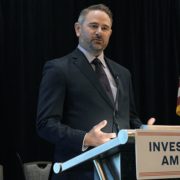
A familiar face was featured on the cover of the October edition of Municipal Water Leader magazine: Water Authority General Manager Dan Denham. In a wide-ranging interview with former Metropolitan Water District General Manager Jeff Kightlinger, Denham discussed his background, the relationships between the Water Authority and other agencies, major challenges facing the water sector and more.
Below are some of the highlights from this extensive conversation. To read the entire interview, which starts on Page 6, click here.
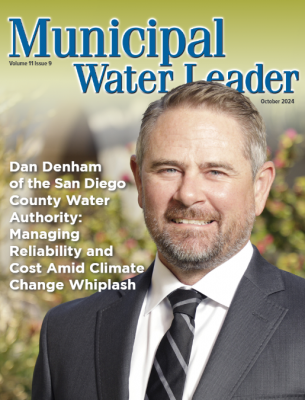
Cover of the October edition of “Municipal Water Leaders” profiling SDCWA General Manager Dan Denham.
What are the biggest challenges facing SDCWA right now?
Climate change whiplash. We’ve had an unprecedented 2 consecutive wet years in Southern California, and while that was wonderful, it also created financial havoc, because water sales and revenues plummeted far below projections. Like most water agencies, we have high fixed expenses, but our revenues remain highly variable. This year, that combination of factors created unprecedented fiscal challenges.
The era of major construction is finished for us, but over the past 20 years, we built water supply projects to prepare for a dry future. I’m positive that droughts will be back, and the public will expect us to be ready for that, since it paid for those investments. In fact, the state is now saying that State Water Project (SWP) supplies could crash over the next 20 years.
So, it’s a matter of trying to right-size the water supply for our current demands while remaining prepared for the future and getting some costs off our books to make water more affordable for our rate payers.
Less than 10 years ago, we were all extremely concerned with reliability, drought cutbacks, and mandatory rationing. Between your transfers and your desal plant, you’ve brought an incredibly high degree of reliability to the region. The challenge today seems to be managing the fiscal concerns in a world of dropping demand and rising costs.
I gave a presentation recently at the Council of Water Utilities in San Diego County. One of the open questions that I threw out to the group was exactly what you just described. In planning for dry years, SDCWA never wanted to see a curtailment of water, whether because of a state mandate or through our wholesaler, Metropolitan, so we built and spent accordingly. The cost of all of that is now catching up with us. The open questions to the group were, Is 100 percent reliability still what this region wants and needs? What kind of insurance policy do you want? Do you want a lower deductible? What is your comfort level as a region? I don’t have the answer to those questions. I don’t know whether our policymakers and decisionmakers have thought those through yet. But that’s a discussion we need to have.
There’s been interest within the Colorado River basin and in Southern California in taking parts of the portfolio, whether that’s the desalinated water or conserved water from the Imperial Valley and transferring some use to another agency or even another region. Shipping off your 100 percent reliable supplies exposes you to some extra risk while at the same time providing a financial benefit. Again, for this generation and the future, we have to settle the question about the level of water supply reliability we want and can afford.
What is your vision for the future?
This industry, this space, is really challenging, but it’s still fun. I really enjoy being part of it, helping lay out the future of water in the West. I’m excited about the prospects for San Diego. When you’re willing to think differently and change the way that you’ve been doing things for the past 20 or 30 years, that’s exciting. I’m glad to be part of it. I hope I still have many years ahead in this space. If this is the springboard for it, I’m all in.