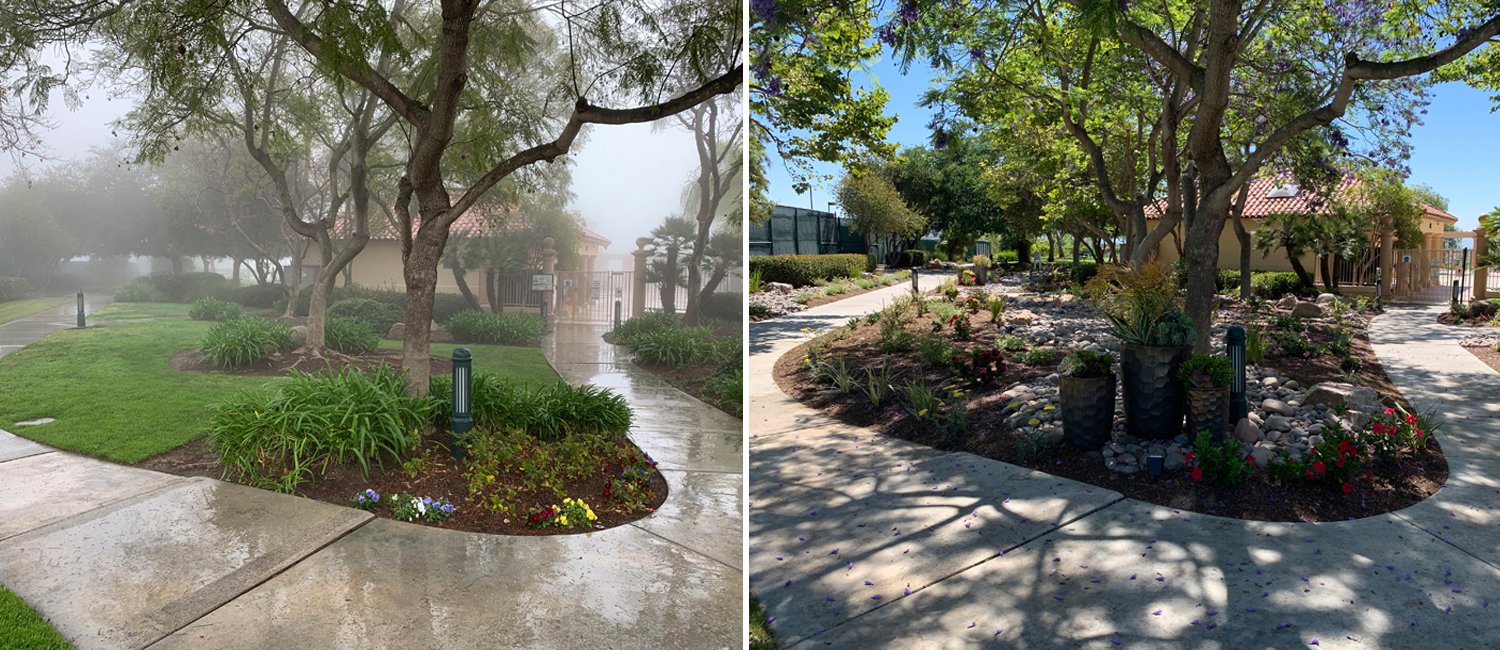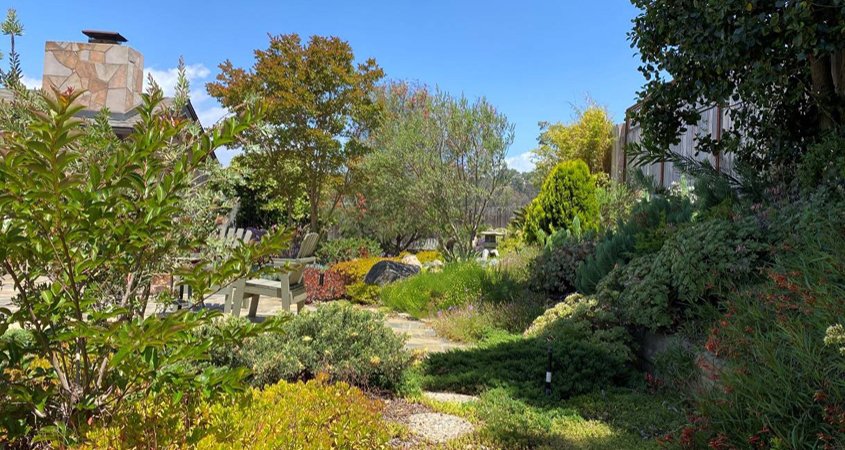
Olivenhain Municipal Water District’s Board of Directors honored Rick Whitney as the 2024 WaterSmart Landscape design contest winner.
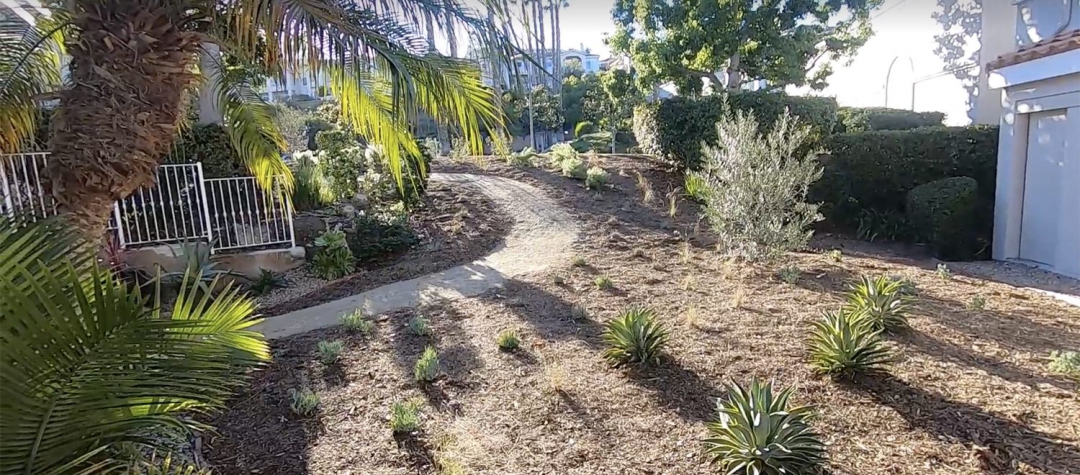
The winning design includes a seating area to let visitors sit and enjoy the space. Photo: Olivenhain Municipal Water District
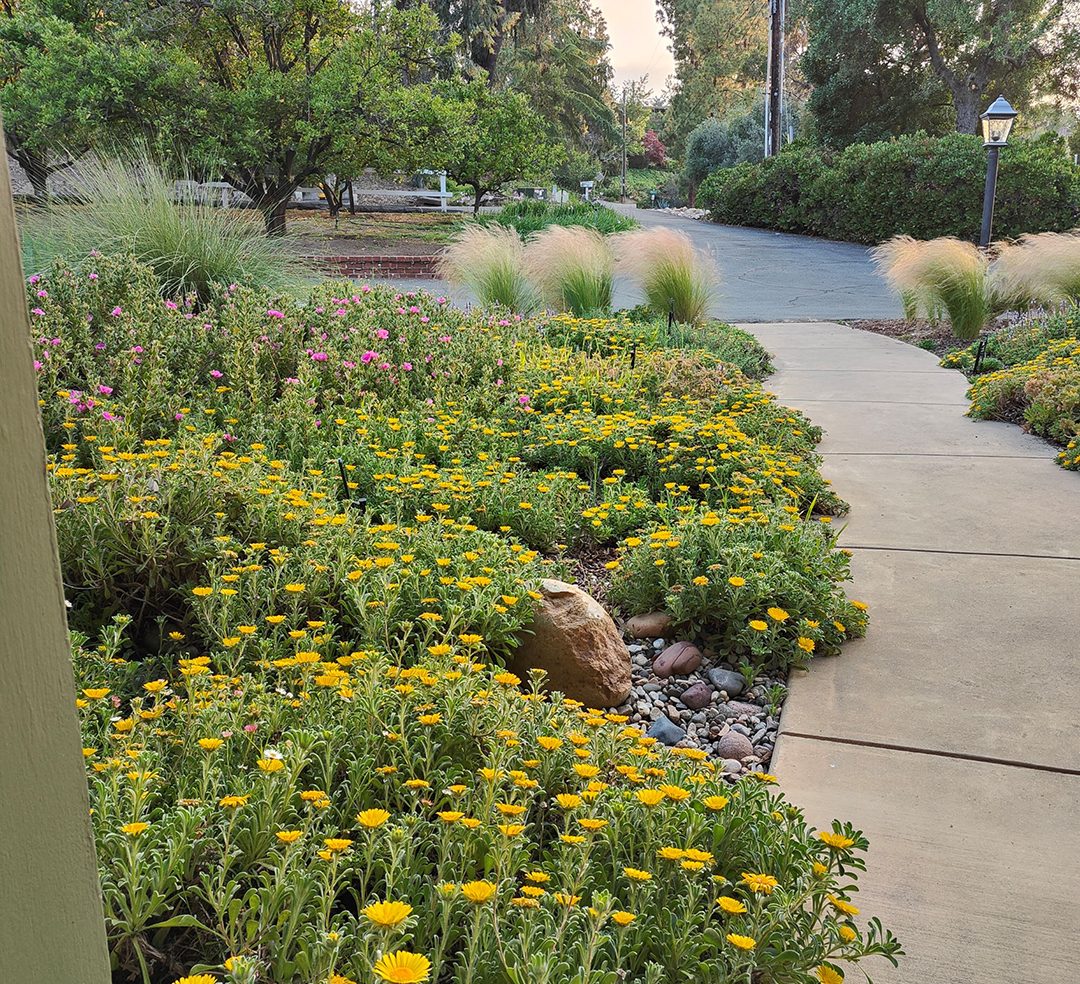
Water agencies throughout the county participate in an annual contest to encourage landscape transformations that reduce outdoor water use, are attractive, and often require less maintenance than turf-heavy landscapes. Each agency selects a winner within its service area that exhibits climate-appropriate plant selection, water-efficient irrigation, and appealing design.
Rainwater Capture Reduces Runoff
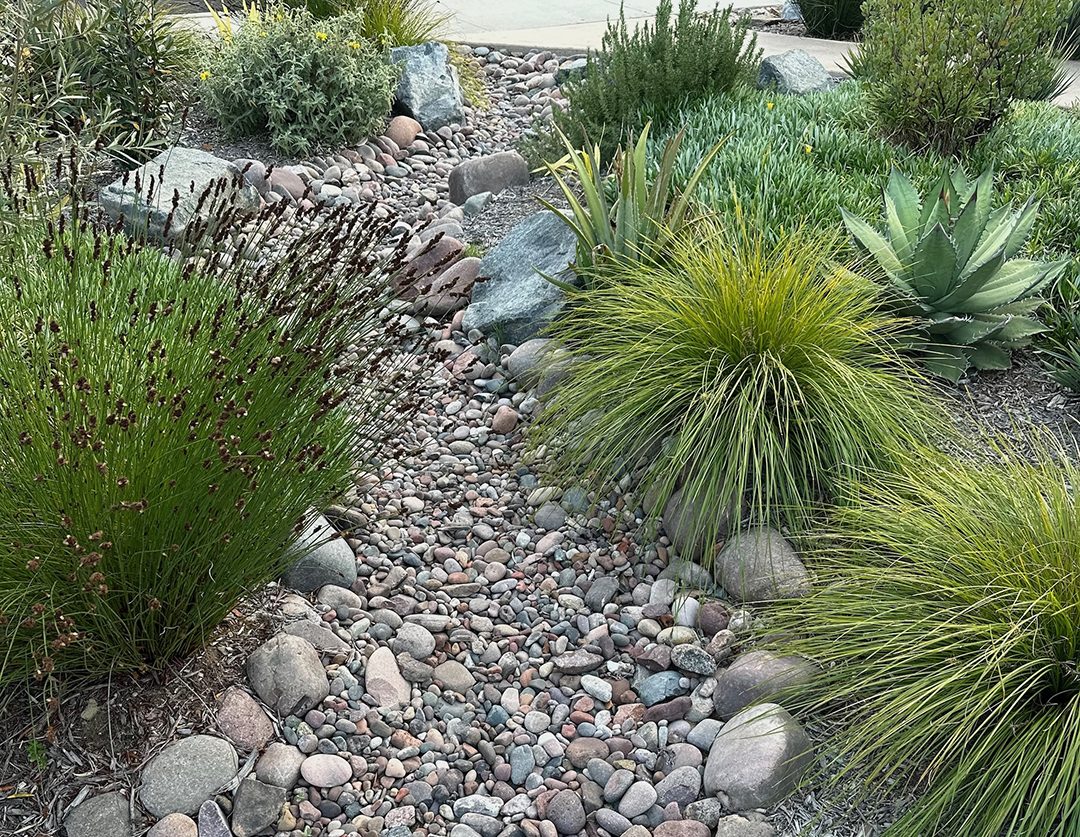
Dry riverbeds are attractive as well as functional, capturing rainwater runoff. Photo: Olivenhain Municipal Water District
“Using water efficiently outdoors will always be important in Southern California, and replacing a lawn with a water-wise landscape can significantly reduce water bills,” said OMWD Vice President Matthew Hahn. “Mr. Whitney’s California-friendly alternative to grass provides an attractive example of a sustainable, water-wise landscape.”
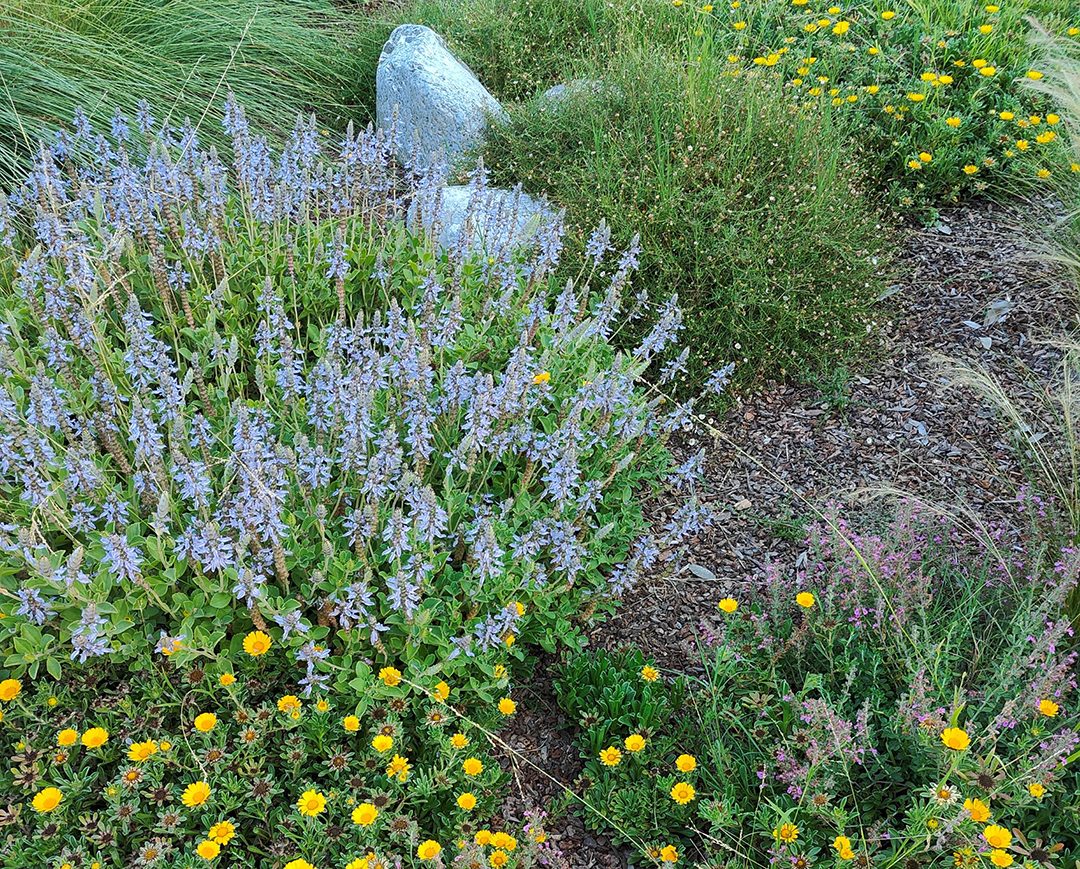
Mr. Whitney’s water-efficient landscape uses rainwater capture in its design. Rainwater from the roof collects in a rock riverbed, keeping it on the property and reducing runoff that can carry pollutants to waterways and beaches. An in-line drip system irrigates all other areas of the landscape.
Beautiful New Yard Yields Water Savings
A closer look at the dry riverbed and plant selection. Photo: Olivenhain Municipal Water District
“We decided to install a water-conserving landscape because of the severe drought California has experienced over the last decade,” said Mr. Whitney. “We are glad we did, as our water usage is down now, and our front yard looks beautiful.”
The San Diego County Water Authority offers free WaterSmart landscaping classes with several choices designed to give you the skills and knowledge to create a landscape that saves water and will thrive in our region.
Local landscape design professionals teach workshops using a do-it-yourself approach. They cover landscape design and maintenance, soil identification and health, turf types and removal tips, plant selection, rainwater catchment, irrigation retrofits, and project installation.
With climate change creating new challenges for managing safe and reliable water supplies, trees are increasingly recognized and relied on for their importance in helping mitigate weather extremes and contributing to water conservation efforts.
Trees are among the most valuable investments in San Diego County’s landscape – including your own waterwise landscaping. No other landscape plant plays a more significant role in fighting climate change and managing a healthy watershed.
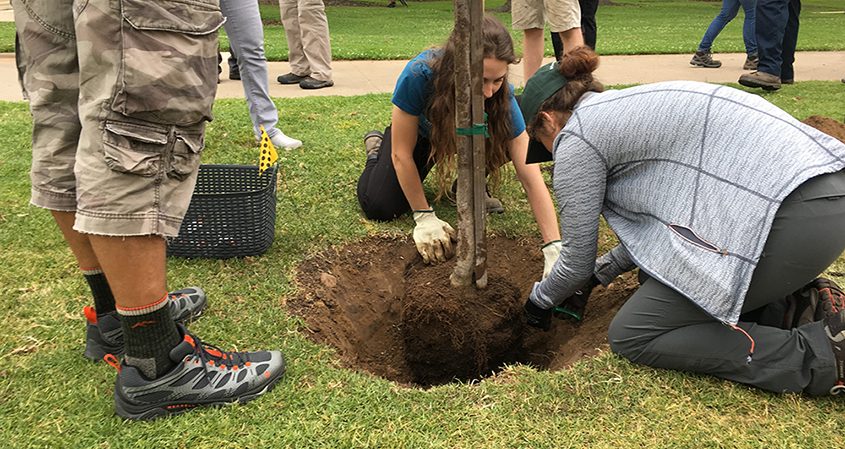
National Arbor Day on Friday, April 26, presents an opportunity to call attention to the benefits of planting trees. Several Arbor Day promotions and ongoing programs in San Diego County offer support for planting trees, including rebates and volunteer events that let you contribute to the effort to provide more trees.
New Tree Rebate Program Launched By Metropolitan Water District
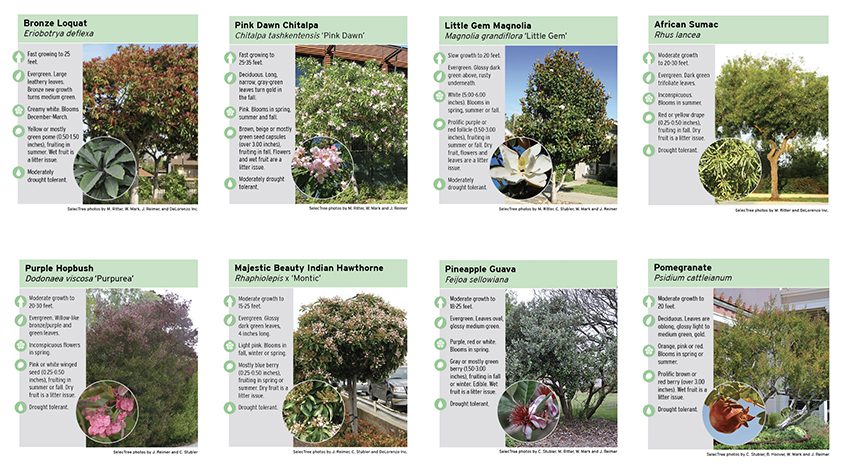
Carefully selected trees are the most valuable addition to your sustainable landscaping. Photo: Helix Water District
Metropolitan’s new “tree-bate” provides incentives for up to five trees in residents’ and businesses’ turf replacement projects. The district partnered with TreePeople and local water agencies to identify and recommend trees with lower water use that are appropriate for Southern California’s climate.
San Diego Gas & Electric offers a tree planting guide through its rebate program. Photo: SDGE
The San Diego Gas & Electric’s (SDGE) Community Tree Rebate Program for Residential Customers allows qualifying residential customers throughout the region to plant trees that provide environmental, health, and economic benefits.
Qualifying customers can receive a $25 rebate for planting or potting a one-gallon tree, a $35 rebate for a five-gallon tree, and a $50 rebate for a 15-gallon tree. Customers can apply for up to five rebates annually. Customers do not need a yard to qualify. Trees can be planted in large containers on outdoor balconies or patio areas.
City of San Diego Arbor Day Event
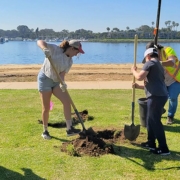
Volunteers are needed for an Arbor Day event to help plant trees at Memorial Community Park. Photo: City of San Diego
On Arbor Day, the City of San Diego’s Urban Forestry Program hopes to plant 100 new trees at Memorial Community Park in Logan Heights. It needs volunteers to help with planting, prepping soil, spreading mulch, and cleanup. Learn more and sign up using this link.
Throughout the year, City of San Diego residents can request a new street tree through Free Tree SD. This program allows residents and the City to work together by increasing San Diego’s tree canopy cover. Residents need to identify a space in the public right-of-way and agree to water the tree for three years. City arborists will evaluate the space and determine an appropriate tree selection. Fill out the Free Tree SD application form on the City’s website to get started.
City of Escondido Celebrates Arbor Day 2024
The City of Escondido needs volunteers to help plant 120 trees for Arbor Day on Saturday, April 27, from 8:30 a.m. to 11:30 a.m. Meet at the House of Prayer Lutheran Church, 795 N. Rose Street. Trees will be planted from Oleander Place to Fern Street between Lincoln Avenue and Mission Avenue. Volunteers of all ages are welcome and are asked to wear comfortable clothing for getting dirty, close-toe shoes, and a hat. Sunscreen is highly recommended. Register on the City website.
City of Vista Residential Tree Giveaway Program
The City of Vista now offers a new Residential Tree Giveaway Program. This initiative is available to Vista residents who own property or have permission from the property owner to plant a tree on the premises. The program is first-come, first-served, and available as long as the funds last. Increasing the local tree canopy on private properties enhances wildlife habitat, mitigates the effects of climate change, and supports the City’s Climate Action Plan goals.
Applications are available now. Since this is a pilot program, it is only available as long as funds last. It was funded through a $50,000 year-end fund balance request, approved by the City Council at the end of 2023. The application form is on the City of Vista website.
County of San Diego Tree Planting Program
The County of San Diego surpassed its goal of planting 10,000 trees in 2023 by adding 11,010 trees, including 5,744 new trees planted at County parks and facilities, 1,637 trees planted through non-government organizational partnerships, and 3,629 trees planted by incorporated cities. The Board of Supervisors has budgeted funds to plant 4,000 trees through spring 2024.
The County has a tree plotter to help staff track tree inventory and plantings regionwide. Residents can participate by reporting trees they plant on their own. Visit the County’s Tree Plotter web page to get started.
The Role of Trees In Preventing Climate Change
Healthy trees fight climate change and cool our cities, provide habitat, and improve the health of our neighborhoods. Photo: Kampus Production / Pexels
The hydrological cycle heavily relies on trees to absorb water in the atmosphere. Trees act as water reservoirs, taking in water from the soil and releasing it through their leaves, a process known as transpiration. The added moisture in the air leads to rainfall and the continuation of the water cycle.
Tree root systems filter and remove pollutants and slow down water absorption into the soil. This process helps to prevent erosion and reduce the risk of over-saturation and flooding.
Trees provide cooling to increasingly hot neighborhoods and cities, and they are among the most efficient tools for removing harmful carbon dioxide that fuels global warming.
San Diego forestry and landscaping professionals work with the San Diego County Water Authority and its 23 member agencies to help protect our region’s trees while conserving water. Find more resources at the Kate Sessions Trees website.
https://www.waternewsnetwork.com/wp-content/uploads/2024/04/tree-planting-02-845X450.jpg451845Gayle Falkenthalhttps://www.waternewsnetwork.com/wp-content/uploads/2024/04/WNN-Horizontal-White-Blue2.pngGayle Falkenthal2024-04-23 18:09:152024-04-23 18:09:15Celebrate Arbor Day: Discover How San Diego’s Tree Planting Programs Combat Climate Change and Save Water
A Lake San Marcos homeowners association successfully upgraded its community landscape to achieve water savings and cost savings with assistance from a joint program offered through a partnership between the San Diego County Water Authority and the County of San Diego.
The original Fairways HOA landscaping included large areas of unused grass. Photo: Vallecitos Water District
The Landscape Optimization Service (LOS) offered through the Waterscape Rebate Program is a technical assistance program for large-scale landscaping projects in the unincorporated areas of San Diego County. The program helps applicants with large landscapes, such as HOAs, parks, and commercial properties, to navigate the requirements, overcome any barriers, and maximize their rebate eligibility.
Members of the Fairways Homeowners Association (HOA) in Lake San Marcos within the Vallecitos Water District recently took advantage of this program to facilitate a water-saving landscape makeover project. Upgrades replaced large grass areas with attractive low-water-use plants inside the property. Drip irrigation was upgraded, and swales act as a water retention feature.
Learn more about the Fairways HOA transformation in this new video.
Saving Costs, Saving The Environment
Fairways HOA president Terry Brown said her community was introduced to the program about 18 months ago.
“We removed 23,000 square feet, and then we got three dollars for each square foot that we removed, plus we got 40 cents for the drip irrigation system. We’re going to receive one dollar per square foot for at least 10,000 square feet of California native plants. So, we did all of that. And we’re pleased with everything that has happened,” said Brown.
New landscaping includes low-water use plants, decorative dry riverbeds, and low-water use plants along small areas of grass for walkers and pet owners. Photo: Vallecitos Water District
While rebates defrayed the initial costs, the real savings will be realized in the years ahead on one of the HOA’s major expenses. “Within ten years, we’ll save $40,000 on water,” said Brown.
Maggie Knol, chairperson of the Landscape Committee, is also a Master Gardener. She understood the need to balance the needs of everyone in the community while planning their landscape makeover.
“We saw certain areas that weren’t really being used where we could definitely have some waterscape landscaping,” said Knol. Now, irrigation water is better managed and used only where needed.
“We have no water in the gutters. That makes us feel better about what we’re doing for our environment,” said Knol. “I would encourage any subdivision or any area to go ahead with it. It’s a wonderful program.
Still Room for Thoughtful Use of Grass
Grass can still be a useful part of a low-water-use landscape. Photo: Vallecitos Water District
Makeovers don’t require eliminating all grass. Instead, grass is retained where it is most useful and practical. For the Fairways HOA board members, this meant accommodating the many residents who like to walk their dogs in the neighborhood and wanted to retain some grassy spaces for them to enjoy with their pets.
“We have tried to be sensitive to the dog owners in the neighborhood because we have a lot of dogs,” said Knol. “When we mapped this out, we left certain areas that could be definitely used as little rest spots for the dogs and the owners as they walk around. They all realize that the water crisis is going to continue and not get better.”
“This project is an ideal example of balancing community needs to create a thoughtful landscape design that saves water but allows room for retaining grass areas when there’s a practical purpose for them,” said Vallecitos Water District Conservation Supervisor Chris Robbins.
The completed Fairways HOA landscape makeover in Lake San Marcos retains some turf mixed with low-water use plants for substantial water savings. Photo: Vallecitos Water District
As part of the program, LOS staff analyzes estimated water and cost savings, which helps decision-makers justify the investment with an understanding of how quickly the project will pay for itself. The program also offers discounted designs to participants.
The enhanced incentives include rebates for turf replacement, smart controller stations, rain barrels, and cisterns. In addition to offering technical assistance to upgrade larger landscapes on multifamily and commercial properties, a cost-share is available for agricultural growers to make water-saving upgrades.
More information on the Landscape Optimization Service can be found here, or contact your member water agency for details. The program is actively recruiting new participants.
https://www.waternewsnetwork.com/wp-content/uploads/2024/03/Fairways-HOA-Before-After-845X450.jpg450845Gayle Falkenthalhttps://www.waternewsnetwork.com/wp-content/uploads/2024/04/WNN-Horizontal-White-Blue2.pngGayle Falkenthal2024-03-21 10:50:392024-03-21 10:50:39Fairways HOA Achieves Savings Through Landscape Optimization
Water leaks don’t happen just in the home. This year, the Environmental Protection Agency’s (EPA) annual Fix-A-Leak Week 2024 program focuses on the importance of repairing leaks and saving water in the workplace and commercial buildings such as hospitals, schools, hotels, retail stores, and community centers.
Fix-A-Leak Week was created in 2009 by the Environmental Protection Agency’s (EPA) WaterSense program. It serves as a reminder every March to check indoor and outdoor plumbing systems for leaks.
In 2024, Fix-A-Leak Week takes place March 18 – 24. It is supported by the San Diego County Water Authority and many of its 23 member agencies and by other regional WaterSense partners throughout North America.
Leaks can account for six percent of average water use and be the greatest source of water waste within a facility. Leaks and continuously running water may not always be visible, but they can add up quickly and become a major cost in water and energy bills.
Be alert for leaks at work. Here are some ways to help find and fix leaks in your workplace:
Workplace water leaks can add up quickly and become a significant cost in water and energy bills. Photo: Pixabay/CC
If you see a leak in the restroom, kitchen, or outdoors, report it to your maintenance staff.
During Fix-A-Leak Week, challenge employees and tenants to find leaks and report water waste.
Post signs in restrooms, kitchens, and other high-water-use areas to encourage everyone to look for leaks and report problems. Include information on who to contact.
Listen and look for unexpected indoor and outdoor water use, such as running water, unanticipated discharge to floor drains, or wet spots and puddling water on floors or grounds.
Don’t wait for a high water bill to find the problem. Read water meters during off-peak hours, when water use is lower. If the meter continues to show high use, there may be a leak. Submeters and temporary flow meters can also monitor specific areas or pieces of equipment to detect problems quickly.
Water leaks add up fast, so water use needs to be periodically verified to make sure the fixture is still performing correctly. Get a handle on your facility’s water use to identify and fix leaks before they become a big problem and expense.
Regional water agencies help customers save water, save money
The Vallecitos Water District added a new video for 2024 to its award-winning series, helping customers find and fix leaks to save water and money.
In an effort to help customers save water and money, Sweetwater Authority (Authority) is offering a rebate of up to $100 for customers who find and fix leaks at their homes or businesses. Though available year-round, the Authority is highlighting this special offer in celebration of the national Fix-A-Leak Week.
In addition to its special rebate on leak repairs, the Authority offers customers a $75 rebate to replace or install a new pressure-reducing valve at homes. These valves help to address high pressure that can cause increased wear on fittings, making them more prone to leaks. A rebate of up to $100 is also available for qualifying leak detectors and flow monitors, which can alert customers to potential leaks on a smartphone app. Information on all the Sweetwater Authority’s water-efficiency rebates is at www.sweetwater.org/rebates.
Check your water meter before and after a two-hour period when no water is being used. If the meter changes, you may have a leak. Visit otaywater.gov/how-to-read-your-meter to learn how to track your water use.
Place a few drops of food coloring in the toilet tank and wait 10 minutes without flushing. If color appears in the bowl, you have a leak.
Examine faucet gaskets and pipe fittings for any water on the outside of the pipe to check for surface leaks.
Check WaterSmartSD.org for tips and more information about Fix-A-Leak Week.
https://www.waternewsnetwork.com/wp-content/uploads/2024/03/fix-a-leak-week-2024.jpg450845Gayle Falkenthalhttps://www.waternewsnetwork.com/wp-content/uploads/2024/04/WNN-Horizontal-White-Blue2.pngGayle Falkenthal2024-03-16 21:14:572024-03-16 21:14:57Fix-A-Leak Week 2024 Brings WaterSense To Work
One of the most valuable tools for managing water retention and avoiding stormwater runoff while improving your landscaping soil harnesses the power of worms – earthworks, to be specific.
Vermiculture and vermicomposting are eco-friendly tools using earthworms to transform organic waste into nutrient-rich compost. This process benefits gardeners and the environment.
In the San Diego region, spring’s mild weather is an ideal time to start vermicomposting. Moderate temperatures facilitate optimal worm activity and compost processing. During the hotter summer months, compost bins must be kept in cooler, shaded areas to prevent overheating and ensure worm survival.
Vallecitos Water District 2023 Landscape Contest winner Dean Williams of Carlsbad is a big believer in vermiculture and vermicomposting. In this video, he shows how easy it is to learn how to put worms to work in your landscaping.
Understanding Vermiculture and Vermicomposting
Vermiculture refers to the cultivation of earthworms. The normal activity of earthworms breaks down organic waste. The result is vermicompost, also known as worm castings, a highly nutritious form of compost.
Vermicomposting is the practice of using earthworms to convert organic wastes into high-quality compost and worm castings. This method is an efficient, odorless, and space-saving way to recycle kitchen scraps, keeping them out of landfills where they contribute to greenhouse gas emissions and climate change.
How Using Worms Works
Adding common kitchen food waste to your vermicomposting system keeps it out of our landfills where it produces greenhouse gases. Photo: Sarah Chai/Pexels
As the video shows, setting up a vermicomposting bin is simple and can be done indoors or outdoors. The bin is stocked with material such as shredded newspaper, cardboard, or coconut coir and stocked with earthworms. When organic waste is added, such as food scraps, weeds, or plant trimmings, the worms digest this material and convert it into compost.
Recommended types of worms for vermicomposting are red wigglers (Eisenia fetida) and red earthworms (Lumbricus rubellus). Both thrive in compost bins and are efficient at processing waste.
Vermicomposting’s Environmental Benefits
Nutrient-rich compost produced by vermiculture helps soil retain rainwater in your garden, preventing it from picking up pollutants and washing them into storm drains. Photo: Pixabay/CC
Vermicomposting helps protect the watershed and preserves soil in several ways.
Safe, Nutrient-Rich Soil Amendment: Vermicompost improves soil structure and enhances nutrient availability. It can reduce the need for chemical fertilizers.
Water Conservation: By improving soil structure and water retention, vermicompost helps conserve water.
Stormwater Runoff: Healthy, vermicompost-amended soils absorb water more efficiently. It lessens the amount of runoff washing pollutants into watersheds.
Waste Reduction: Vermicomposting diverts organic waste from landfills, helping avoid the production and release of greenhouse gases.
As vermicompost increases the ground’s capacity to absorb rainwater, it lessens the burden on stormwater management systems. With less water flowing into stormwater drainage systems, vermiculture helps diminish flood risks.
Vermiculture and vermicomposting offer a holistic approach to environmental stewardship for San Diego residents. It’s an easy, practical way for individuals to help preserve resources, enhance soil health, and support sustainable gardening. Vermiculture and vermicomposting offer simple tools to confront the challenges of climate change, including risks to our region’s long-term water supply.
With climatologists predicting the potential for above-average precipitation in the months ahead due to the El Niño weather phenomenon, it’s an ideal time to take advantage of the County of San Diego’s upcoming rainwater harvesting workshops and rain barrel rebates.
The County’s Waterscape Rebate Program will host free rainwater harvesting workshops in Fall and Winter 2023. Workshops help residents learn how to capture rainwater to supplement their irrigation needs, save money on water bills, and protect our region’s environment by preventing pollutants from spilling into regional watersheds.
The County of San Diego holds free rain barrel rebate workshops at different locations. Use the QR Code for the latest schedule. Photo: County of San Diego
The next scheduled workshop is Wednesday, November 8, at 1 p.m. at Tractor Supply, 27444 Valley Center Road. Future workshops will be listed on the County of San Diego Waterscape Rebate Program website.
At the end of the workshop, residents who live in unincorporated areas of San Diego County may be eligible to receive a free rain barrel. Participants in incorporated areas can check their rebate eligibility on the San Diego County website’s interactive map.
During San Diego County’s limited periods of rainfall, any rainwater captured from your roof and property saves money. It also helps the region maintain its water supplies.
Directing downspouts into water-collecting features in your landscaping makes use of rainfall. Photo: County of San Diego
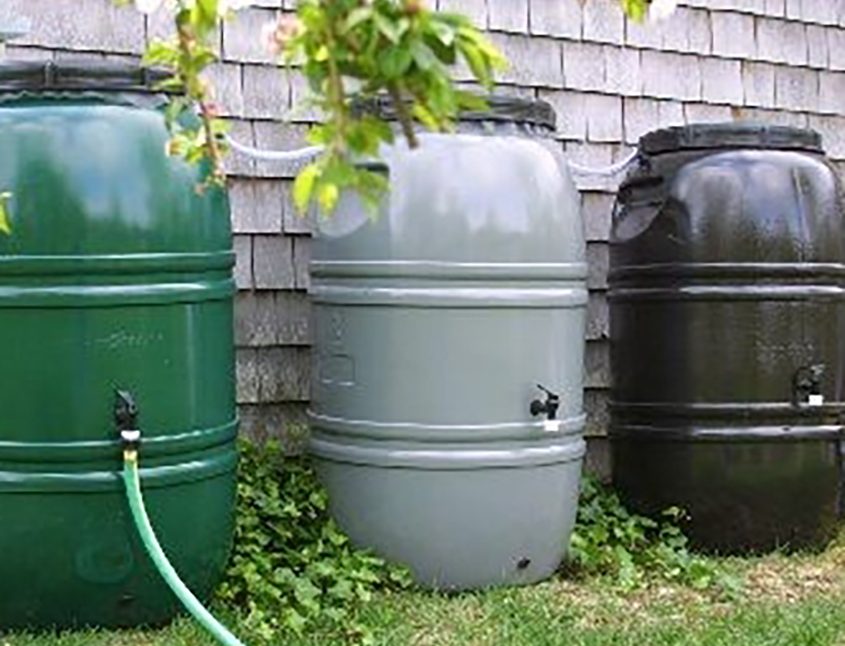
Workshops introduce residents to several beautiful, efficient ways to save rainwater. In addition to rain barrels, directing downspouts to fill containers lets you choose how to use the rainwater you capture. The overflow should empty onto your yard or a landscape feature to infiltrate the excess flow into the soil. Rain chains can assist with this.
Protecting water quality in watersheds
The Countyl of San Diego is committed to protecting the water quality in county creeks, streams, and coastal areas. Runoff from irrigation, storms, and even faulty septic systems can bring pollutants to county waterways and threaten public health.
When businesses and households make changes to reduce water use and use rainwater in their landscapes, it helps preserve healthy, safe waterways and more reliable water supplies.
How rain barrel rebates work
After buying rain-saving containers or other items eligible for rebates, and have installed them, residents can apply for rebates. Current rain barrel rebates are $35 and are limited to two per household for most San Diego County residents. Multiple projects are eligible. Details at: Socal WaterSmart.
Rain barrels conserve water for WaterSmart landscape maintenance
Making use of rain barrels is good for the environment and good for your household budget. Photo: National Audubon Society
Whether or not El Niño results in increased rainfall, even light rain can provide enough water for later use. A roof with a 2,000-square-foot surface area can capture 300 gallons from only a quarter inch of rain.
Stored water can be released gradually into landscaping between winter rainstorms, building up the soil sponge and ensuring that native plants get adequate water during the winter months when they need it most. If additional water is needed in the summer, captured and stored water during the winter could be used as supplemental irrigation.
The San Diego County Water Authority offers free WaterSmart classes, with both virtual and in-person options, taught by local landscape design professionals. Classes help participants understand landscape design and maintenance, soil identification and health, turf types and removal tips, plant selection, rainwater catchment, irrigation retrofits and project installation, whether completed as a DIY project or with contractor assistance.
Participants get the knowledge and skills they need to transform their yards into spaces that are water-efficient, sustainable, and beautiful year-round. The workshops are typically offered in spring and in fall clusters, with fall classes scheduled for September through November.
Five topics are available to choose from, including:
Plan Ahead: Understanding Soil and Site Assessments
Design: Shape Your Space
Plants: Inspiring Choices for our Region
Water & Irrigation: Utilizing a Precious Resource
Installation and Maintenance: Protecting Your Investment
Residents will learn how to plan and design a landscape that is not only water-efficient, but also looks vibrant and attracts pollinators. Photo: San Dieguito Water District
Local professionals can help you create a customized plan
Participants who attend all five workshops and meet other program criteria can sign up to receive an in-home visit by a landscape professional who will help them create customized landscape transformation plans, through the Designer at Your Door service. For more information, visit sdcwa.org/your-water/conservation/classes.
“The workshops are designed to help residents create and maintain their own beautiful and water-efficient outdoor spaces,” said Debby Dunn, a water resources specialist for the Water Authority. “Most of our residential water use is outdoors in our landscapes. This is why learning how to create water-efficient spaces is a great way for San Diegans to continue doing their part to use water efficiently.”
Short videos offer an educational and entertaining experience
For people who prefer to learn at their own pace, the Water Authority offers short, entertaining and educational on-demand videos, with topics that mirror the workshops. To watch the videos go to sdcwa.org/your-water/conservation/classes and click on the videos link.
Low-water plants, improved irrigation technologies, and WaterSmart classes not only save water, but also reduce energy use, protect our natural resources, and create beautiful outdoor living spaces.
(Editor’s note: The “Thanks for Planting Me!” summer campaign offers gratitude to the hundreds of thousands of San Diegans who have transformed their landscapes using low-water and native plants as part of a larger effort to use water more efficiently.)
Large trees were the driving force that led Encinitas homeowners to remove grass and create a vibrant, low-water use landscape. The waterwise transformation won the San Dieguito Water District 2023 Landscape Makeover Contest.
Rick and Melanie Cullen had a yard with grass with large shade trees. But the roots of their three large Liquidambar trees were damaging the driveway and the grass, which motivated the couple to remake their landscape.
Overgrown landscape trees helped inspire a change to a waterwise landscape design. Photo: San Dieguito Water District
“San Dieguito Water District is proud to recognize customers like the Cullens, who create beautiful and resilient landscapes while making efficient use of their water,” said Isam Hireish, general manager of San Dieguito Water District.
Mountain visits inspire landcape makeover
The makeover design incorporates a dry riverbed. Photo: San Dieguito Water District
The Cullens wanted to plant a drought-tolerant, water-wise yard that would be easy to maintain, beautiful, and hold up to their frequent travel schedule.
“My inspiration was to create a water wise, drought-tolerant front yard that also provides us a beautiful yard as if we were in the mountains,” said Melanie Cullen. It started with taking existing small landscape rocks and repurposing them into a natural dry streambed feature.
Colorful plant palette pollinators love
Plants in beautiful colors that attract pollinators highlight the plant palette. Photo: San Dieguito Water District
Plants were selected that would thrive in the coastal San Diego County environment. The invasive Liquidambar trees were replaced by Blue Ice Cypress, Forest Pansy Red Bud, and dwarf Deodar Cedar trees. Colorful drought-tolerant flowering shrubs and perennials including Coastal Woolybush, salvias, echinaceas, Texas primrose, heronsbill, columbine, Grevillea ‘Mt. Tamboritha’ and ‘Sour Grapes’ Penstemon provide habitat for pollinators.
Fragrant ground cover
Grasses including Pennisetum ‘Fireworks’ and Acorus ‘Variegated Sweetflag’ add to the plant palette. Creeping Thyme and trailing Rosemary are used as colorful, fragrant ground cover.
A highlight: one dozen Azaleas create a woodland flower look. Cullen says they bloom when other plants aren’t flowering.
“One might think they are water hogs, but they get the same water as everything else and bloom quite a bit throughout the year,” said Cullen. “It was a matter of choosing the right type of Azalea (Red Bird and Alaska White).”
Drip irrigation system saves water
A circular drip irrigation system requires watering plants only once every one-to-weeks for 20 minutes. Photo: San Dieguito Water District
The Cullens used a drip irrigation system that encircles each plant individually to direct water to the specific plant. They already had a smart irrigation controller which is still in use. A remote moisture sensor was added allowing the homeowners to monitor the ground moisture at the plants and then adjust watering for the yard.
Three to four inches of bark mulch helps retain irrigation, which has worked “extremely well.”
Tapping rain
Melanie Cullen says the irrigation was turned off completely from January through May due to generous rainfall. “Presently, we only need to water once every one to two weeks for 20 minutes,” she said.
“I join our Board of Directors in recognizing the leadership of the Cullens and commend them for taking proactive steps to improve our community’s resilience to a changing climate,” said Isam Hireish, General Manager of San Dieguito Water District. “I encourage all customers to utilize water more efficiently and take advantage of the various water-saving incentives we offer.”
In the months since the landscape makeover, the Cullens report all their original goals were met. “We love sitting in our front now and watching the many hummingbirds that also love our yard,” said Melanie Cullen.
(Editor’s note: The San Dieguito Water District is one of the San Diego County Water Authority’s 24 member agencies that deliver water across the metropolitan San Diego region.)
https://www.waternewsnetwork.com/wp-content/uploads/2023/08/San-Dieguito-2023-May-1-yr-later-39772-845X450.jpg450845Gayle Falkenthalhttps://www.waternewsnetwork.com/wp-content/uploads/2024/04/WNN-Horizontal-White-Blue2.pngGayle Falkenthal2023-08-10 14:38:532023-08-10 14:46:44Mountains Inspire Winners of San Dieguito Water District 2023 Landscape Contest
Three resourceful homeowners took advantage of free resources, including design and plant selection advice, to create beautiful drought-tolerant landscapes. Their projects were named winners of the 2023 Vallecitos Water District Landscape Makeover Contest.
Video features the three winning projects
Dean Williams: Drab To Delightful
Carlsbad homeowner Dean Williams and his wife didn’t like their existing landscaping.
“It wasn’t a garden, it was a yard,” recalls Williams.
In 2020, Williams found resources on the Vallecitos Water District website for saving water by redesigning your landscaping. The results won first place in the 2023 landscape makeover contest.
Dean Williams’ home after completing his landscape makeover. Photo: Vallecitos Water District
“There are so many resources. The first step was to take some landscape classes offered through the San Diego County Water Authority, find out the process and what I needed to do,” said Williams.
After removing existing turf using the sheet mulching method to create healthy soil, he planned a colorful plant palette to replace his grass.
Dean Williams’ home before his winning landscape makeover. Photo: Vallecitos Water District
“One of the big things I wanted to change was to go from a drab landscape to having some variety by using different textures on the plants, different flowers, different colors, and complementing colors,” said Williams, who used purple and yellow as the primary landscape colors. “I tried to have an interesting landscape pleasing to the eye.”
The colorful redesign saves water and costs. Photo: Vallecitos Water District
Williams said the benefit of installing drip irrigation and a smart controller was significant water and cost savings.
“We’ve noticed over that our water use and bills have gone slowly down,” he said.
Lessons learned
Williams said the “do it yourself” project offered many lessons learned, including watering too often.
“Drought-tolerant plants don’t do well in wet soil,” said Williams.
Williams encourages other homeowners to tap into all the available resources through the Vallecitos Water District, Water Authority, City of Carlsbad, and others for advice and possible rebates to offset their investment.
“It just pays in more ways than one to change your landscape. “I want to thank Vallecitos Water District for selecting us so we can showcase our landscape transformation,” said Williams.
Dean Williams took advantage of free resources offered by the Vallecitos Water District and San Diego County Water Authority. Photo: Vallecitos Water District
Donald De Tar: DIY project earns second place
Donald De Tar’s home after completing his landscape makeover. Photo: Vallecitos Water District
Donald De Tar learned about the annual Landscape Makeover Contest through the Palomar Cactus and Succulent Society. “So, we decided on a lark to enter,” said De Tar.
His Woodlawn Park area home in San Marcos is dedicated to succulents, cactus, and drought-tolerant plants.
De Tar says it not only saves water but it also saves time spent mowing, fertilizing, and trimming grass. It’s also a lot of fun.
Donald De Tar’s home before his landscape makeover. Photo: Vallecitos Water District
De Tar is proud of the budget-friendly approach to his landscaping.
“I did it on a very inexpensive budget,” said De Tar. “It doesn’t have to be super expensive, especially if you join an organization like the Palomar Cactus and Succulent Society. It can be almost free, especially if you’re doing the work yourself.”
De Tar learned about rebate programs through the Vallecitos Water District, and he successfully applied for rebates to offset costs. “Over time, we did the whole yard, and the backyards and side yards have been transformed.”
I’m very appreciative of the Vallecitos contest,” said De Tar. “I like the fact that Vallecitos is involved in the community and promotes these kinds of contests.”
Mily Le Wins Third Place
The results of Mily Le’s landscape makeover, which won second place. Photo: Vallecitos Water District
Third place went to longtime San Marcos homeowner Mily Le. She learned about the annual landscape contest through the Vallecitos Water District’s customer newsletter, “Between The Pipes.”
Le visited the lawn replacement program website and learned how to remove her regional grass safely and effectively. She got her design laid out and purchased plants from her local nursery.
The Mily Le home before her landscape makeover. Photo: Vallecitos Water District
As a result, Le says she saves about 30% of her water consumption after replacing her lawn. She says she learned from a neighbor’s experience about researching the eventual size of plants before planting them.
“(My neighbor) did not look it up,” she said. “She had to demolish the front yard, so I took that lesson.”
Le suggests lots of advance planning with your layout. “I’m glad I did it. I think it’s a successful project,” said Le.
(Editor’s note: The Vallecitos Water District is one of the San Diego County Water Authority’s 24 member agencies that deliver water across the metropolitan San Diego region.)
https://www.waternewsnetwork.com/wp-content/uploads/2023/08/VWD-2023-Landscape-Williams-2-845X450-1.png450845Gayle Falkenthalhttps://www.waternewsnetwork.com/wp-content/uploads/2024/04/WNN-Horizontal-White-Blue2.pngGayle Falkenthal2023-08-07 16:48:322023-08-07 18:05:34Vallecitos Water District 2023 Landscape Makeover Winners Find Inspiration
Vista Homeowner Diane Krupnak redesigned her front yard to save water and won the 2023 Vista Irrigation District WaterSmart Landscape Contest.
The annual contest recognizes outstanding waterwise residential landscapes based on the criteria of overall attractiveness, appropriate plant selection, design, appropriate maintenance, and efficient irrigation methods.
Workshops provide homeowner know-how
Concerned by the severity of the last drought, Krupnak removed the water-thirsty grass from her front yard to reduce water use. She began her project by enrolling in the free WaterSmart Landscape Makeover series of workshops for homeowners offered by the San Diego County Water Authority and its member agencies.
The workshops gave Krupnak the knowledge to move forward with her makeover, including soil assessment, creating a landscape plot plan, and drip irrigation basics, and mulching.
Colorful plant palette replaces grass
Diane Krupnake wanted a landscape that would complement the Mediterranean aesthetic of her home. Photo: Vista Irrigation District
Krupnak started by researching the plants she wanted to add to her yard. She focused on the plants’ characteristics and water needs to make sure they would be compatible in her landscape.
She also wanted a landscape to complement the Mediterranean aesthetic of her home. Krupnak selected a base color palate in greens and whites highlighted with pops of color. Once the plan came together, she hired landscape professionals to install the new landscape and hardscape.
The green hues in her landscape design come from shaggy Cousin Itt Acacias, Wheeler’s Dwarf Pittosporum, dwarf daylilies, and Italian Oregano. Each plant provides contrasting textures and structure creating visual interest. A fruitless Olea Swan Hill olive tree stands as the focal point of her yard.
White tones include flowering Scaevola White plants adjacent to Krupnak’s new permeable walkways accentuating the earth tones of the pavers.
The base colors in the winning landscape design are accented with bright reds from plants like Caliente Deep Red Geraniums and Tecoma Stans Bells of Fire Esperanza, as well as yellow foliage from Sunset Gold Coleonema pulchellum.
Beautiful results reduce water use, saving money and time
The landscape makeover replaced grass with new low-water-use plants and a patio area. Photo: Vista Irrigation District
“I chose a landscape of moderate to low water use plants that complement the Mediterranean influence of my home,” said Krupnak. “I save money on my water bills and no longer pay to have my yard mowed.”
The hardscape included in Krupnak’s design plan provides functional living space. The patio replaces a flat lawn area near the home’s entranceway and transforms it into an inviting place to sit and admire the rest of her new landscape.
Free WaterSmart landscape workshops – online or in-person
“Free regional WaterSmart landscape workshops are available online and in person to assist homeowners in upgrading their home’s landscape to reduce water bills,” said Brent Reyes, VID management analyst. “Additionally, turf removal rebates can help with the cost.”
Participating San Diego County Water Authority member agencies include the Vista Irrigation District, Helix Water District, Olivenhain Municipal Water District, Otay Water District, Padre Dam Municipal Water District, San Dieguito Water District, Sweetwater Authority, Vallecitos Water District, Rincon Del Diablo Water District, and the cities of Escondido and Oceanside. Customers of California American Water also can access the workshops.
For more information about the contest and to see more examples of waterwise landscaping, visit www.landscapecontest.com. Visit the district’s website to learn more about free landscape workshops and incentive programs.
Vista Irrigation District is a public agency governed by an elected five-member board. The district provides water service to roughly 134,000 people in the city of Vista and portions of San Marcos, Escondido, Oceanside, and unincorporated areas of San Diego County.
(Editor’s note: The Vista Irrigation District is one of the San Diego County Water Authority’s 24 member agencies that deliver water across the San Diego County region.)
https://www.waternewsnetwork.com/wp-content/uploads/2023/07/VID-Landscape-2023-3a-AFTER-Krupnak-full-house-lit-845X450.jpg448845Gayle Falkenthalhttps://www.waternewsnetwork.com/wp-content/uploads/2024/04/WNN-Horizontal-White-Blue2.pngGayle Falkenthal2023-07-20 08:27:382023-07-20 11:25:47Vista Irrigation District Landscape Winner Complements Home Design